



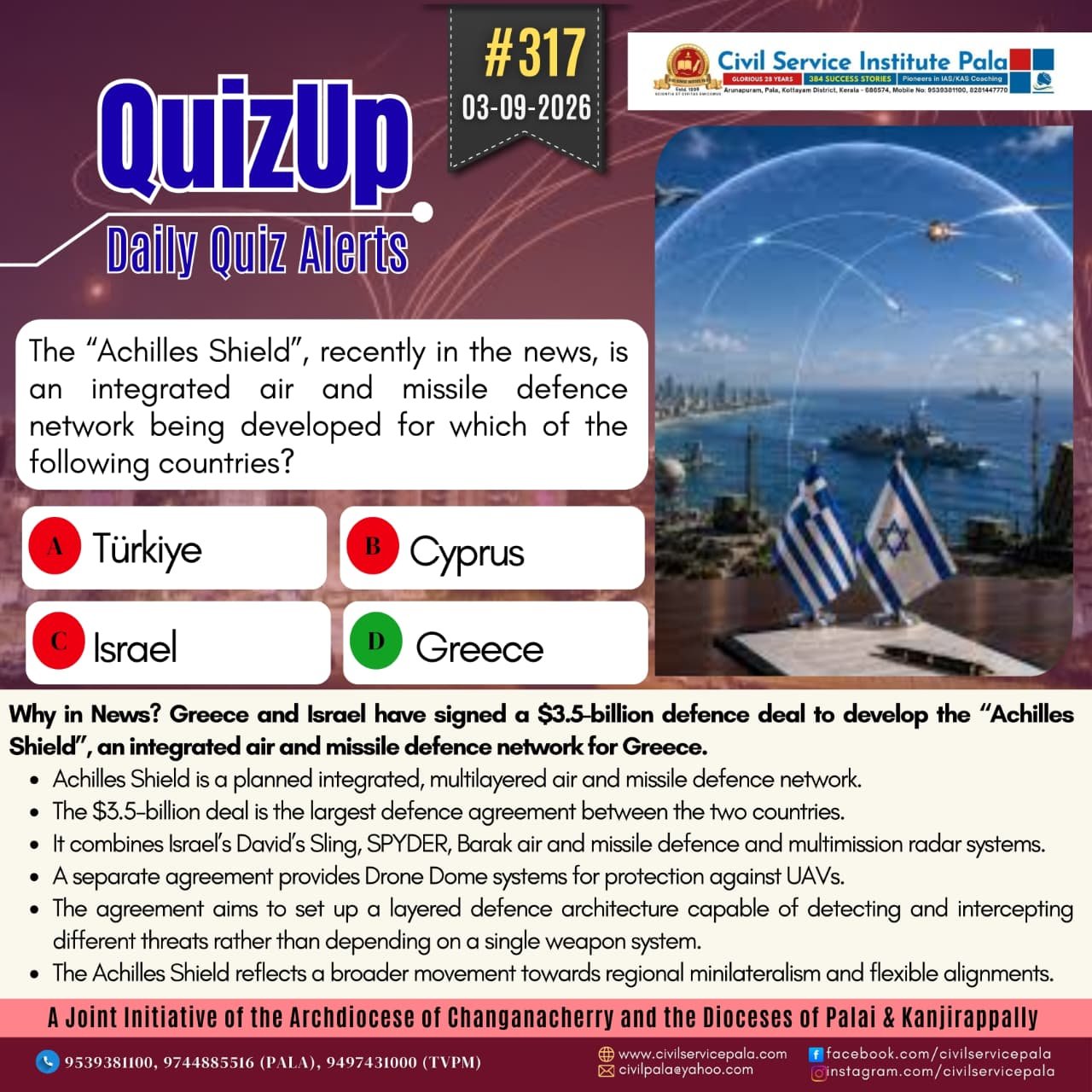
GREECE–ISRAEL “ACHILLES SHIELD”
GREECE–ISRAEL “ACHILLES SHIELD”
What is the Achilles Shield?
• Achilles Shield is a planned integrated, multilayered air and missile defence network for Greece, developed in cooperation with Israel.
• The $3.5-billion deal is the largest defence agreement between the two countries.
• It combines different Israeli systems, including David’s Sling, SPYDER, Barak air and missile defence systems and multimission radars.
• A separate agreement provides Drone Dome systems for protection against UAVs.
• The idea is to create a layered defence architecture capable of detecting and intercepting different threats rather than depending on a single weapon system.
Who is involved and what is the wider context?
• The deal is part of a wider strategic realignment in the Eastern Mediterranean, involving Greece, Israel, Cyprus and Türkiye.
• Greece, Cyprus and Israel have increasingly strengthened cooperation in defence, maritime security and energy.
• At the same time, Israel–Türkiye relations have deteriorated, transforming what was once a close security partnership into increasing strategic competition.
• This has created greater space for Greece to emerge as an important Israeli strategic partner in the Eastern Mediterranean.
What is the background?
Recent conflicts have demonstrated the growing use of drones, ballistic missiles, cruise missiles and precision weapons.
• The Israel–Iran conflict particularly highlighted the scale of drone and missile threats and the importance of integrated air-defence systems.
• A drone strike on Cyprus, Greece's close partner and neighbour, further reinforced Greek concerns about the vulnerability of the Eastern Mediterranean.
• Greece has therefore sought to strengthen its own air, missile and counter-drone capabilities.
• The agreement is also part of Greece's broader military modernisation amid its longstanding strategic competition with Türkiye.
Why is Israel an attractive defence partner?
Israel possesses extensive operational experience in missile defence, counter-drone warfare, surveillance and air defence.
• Its defence systems have acquired credibility through their use in actual conflicts.
• This gives Israeli defence companies an advantage in a global market increasingly seeking “battle-tested” technologies.
• Israel has also historically used defence exports as an instrument of “arms diplomacy”—using military technology, training and defence cooperation to cultivate long-term strategic relationships.
• Thus, the Achilles Shield is not merely a commercial transaction; it can strengthen military interoperability, technological cooperation and diplomatic ties.
What are the deeper strategic factors?
Periphery Doctrine
• Israel historically sought partnerships with non-Arab states on the periphery of its immediate neighbourhood to offset regional hostility.
• Türkiye was once an important component of this strategy.
• As Israel–Türkiye relations deteriorated, Greece and Cyprus acquired greater strategic significance.
Energy geopolitics
• Eastern Mediterranean gas resources have encouraged Israel–Greece–Cyprus cooperation.
• Energy infrastructure requires protection of offshore installations, maritime routes and pipelines, thereby reinforcing defence cooperation.
Regional balancing
• Increasing competition among regional powers is encouraging states to develop flexible partnerships and their own security capabilities, rather than depending entirely on a single external guarantor.
What does the deal indicate about the emerging regional order?
The Achilles Shield reflects a broader movement towards regional minilateralism and flexible alignments.
• States are increasingly forming partnerships around specific interests and threats, rather than belonging to rigid, permanent blocs.
• The strengthening of Greece–Israel–Cyprus cooperation is occurring alongside other emerging regional defence arrangements, including the Saudi Arabia–Türkiye–Pakistan partnership.
• However, these should not be interpreted as completely separate or rigid blocs: countries can cooperate in one domain while competing in another.
• The result is an increasingly multipolar and fluid security architecture in the Eastern Mediterranean and West Asia.
