



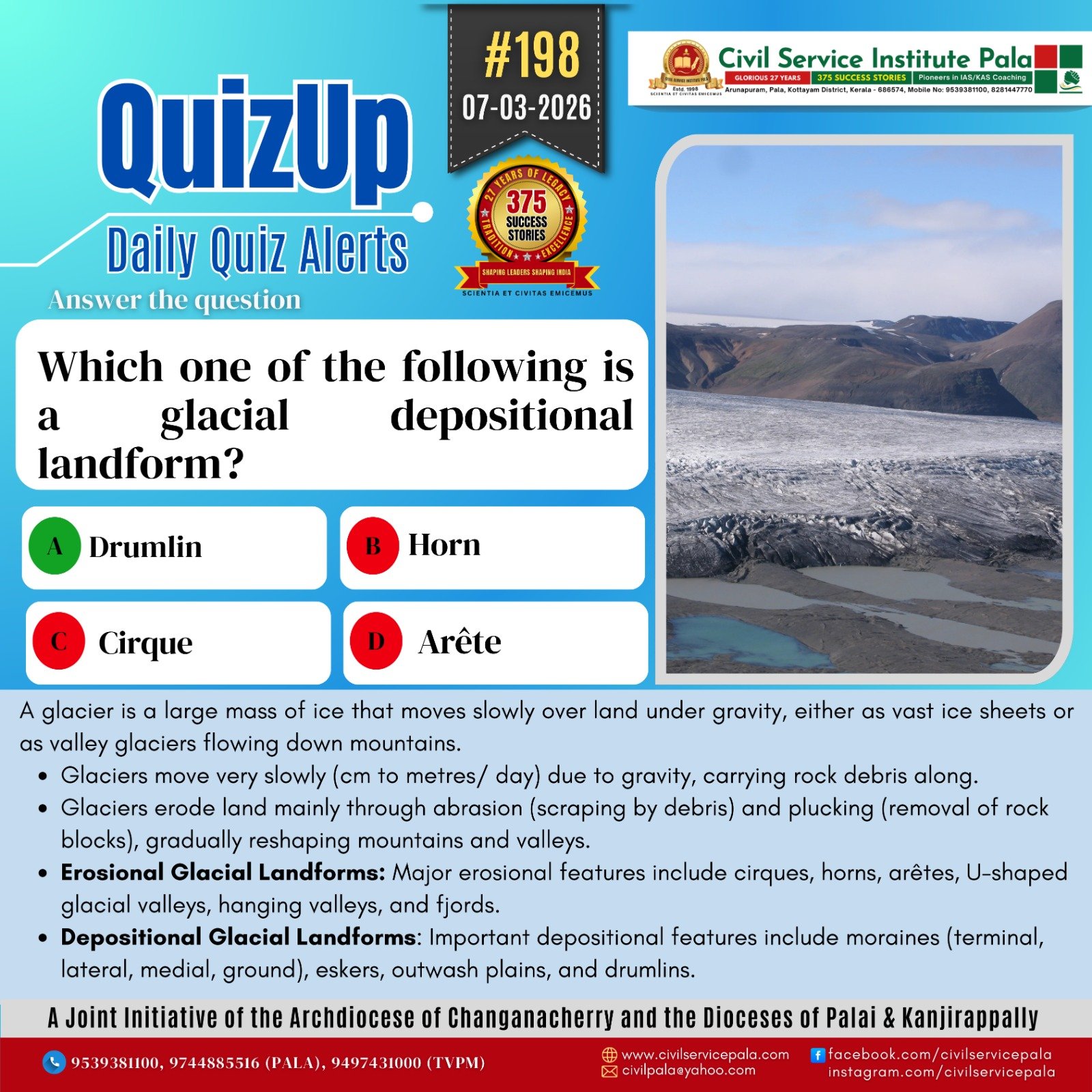
Glaciers
A glacier is a large mass of ice that moves slowly over land under gravity, either as vast ice sheets or as valley glaciers flowing down mountains. Glaciers move very slowly (cm to metres per day) due to gravity, carrying rock debris along their base and sides.
Types of Glaciers
1. Continental / Piedmont Glaciers: Vast ice sheets that spread widely over plains at the base of mountains.
2. Mountain / Valley Glaciers: Long, narrow streams of ice that flow down mountain valleys under gravity.
Movement
• Glaciers move very slowly, from a few centimetres to a few metres per day.
• Movement occurs mainly due to gravity acting on the ice mass.
Glacial Erosion
1. Abrasion: Rock debris embedded in the glacier scrapes and grinds the underlying surface as the ice moves.
2. Plucking: The moving glacier pulls away blocks of rock from the bedrock, enlarging cracks and joints.
Effects of Glacial Erosion:
• Gradual wearing down of mountains and highlands.
• Transport of large amounts of rock debris within and beneath the glacier.
Glacial Erosional Landforms
1. Cirque
• It is a deep, bowl-shaped depression found at the head of glacial valleys.
• It is surrounded by steep concave or vertical walls.
• It is formed by erosion of ice accumulating at mountain tops.
• After glacier melts, water may collect forming a tarn (cirque lake).
2. Horns
• They are Sharp, pyramidal peaks formed by the erosion of multiple cirques.
• They occur when three or more cirques erode a mountain from different sides.
Examples: Matterhorn (Alps) and Mount Everest (Himalayas)
3. Arêtes (Serrated Ridges)
• They are narrow, sharp ridges formed between two adjacent cirques.
• They have a jagged or saw-toothed appearance.
4. Glacial Valleys / Troughs
• They are valleys carved by glaciers have a U-shaped cross-section.
• Features: Broad flat floor and Steep smooth sides
5. Fjords
• They have very deep glacial troughs filled with seawater.
• Found mainly in high latitude coastal regions.
Glacial Depositional Landforms
Depositional Glacial Material: Debris deposited by glaciers is called glacial till, while sediments sorted and deposited by meltwater streams are called glacio-fluvial deposits.
1. Moraines - Moraines are ridges formed by glacial till.
Types of Moraines
Terminal Moraine
• Deposited at the end (toe) of the glacier.
Lateral Moraine
• Deposits along the sides of the glacier valley.
Medial Moraine
• Located in the centre of a glacial valley.
• Formed when two glaciers merge.
Ground Moraine
• Irregular sheet of till spread over valley floors after glacier retreat.
2. Eskers
• Long, winding ridges of sand, gravel, and boulders.
• Formed by streams flowing beneath glaciers.
• Deposits remain after the glacier melts.
Characteristics:
• Sinuous (snake-like) ridges
• Often consist of coarse sediments.
3. Outwash Plains
• Broad flat plains formed by glacio-fluvial deposits.
• Located at the foot of glaciers or beyond ice sheets.
4. Drumlins
A drumlin is a smooth, oval-shaped depositional hill formed mainly of glacial till. It is typically up to about 1 km long and around 30 m high, with its long axis aligned in the direction of glacier movement. The stoss end (facing the glacier) is steeper and blunt, while the tail end has a gentler slope. Because of this streamlined shape, drumlins help indicate the direction of past glacier movement.
