



Gallantry Awards
• The gallantry awards are announced twice every year — on the occasions of Republic Day and Independence Day.
• The order of precedence of gallantry awards is:
Param Vir Chakra → Ashoka Chakra → Maha Vir Chakra → Kirti Chakra → Vir Chakra → Shaurya Chakra
• After Independence, the first three gallantry awards — Param Vir Chakra, Maha Vir Chakra and Vir Chakra — were instituted by the Government of India on 26 January 1950. These awards were given retrospective effect from 15 August 1947.
• Later, three more gallantry awards — Ashoka Chakra Class-I, Ashoka Chakra Class-II and Ashoka Chakra Class-III — were instituted on 4 January 1952. These were also given retrospective effect from 15 August 1947.
• In January 1967, these three awards were renamed as Ashoka Chakra, Kirti Chakra and Shaurya Chakra respectively.
• Param Vir Chakra was instituted on 26 January 1950 by the Government of India. It is awarded for the highest degree of gallantry in the presence of the enemy. It is often awarded posthumously and represents extraordinary courage beyond the call of duty.
• Ashoka Chakra is awarded for the highest degree of bravery, daring, valour or self-sacrifice in situations other than in the face of the enemy. It is India’s highest peacetime gallantry award.
• On the eve of the 77th Republic Day, President Smt Droupadi Murmu approved gallantry awards for 70 personnel of the Armed Forces, including six posthumous awards.
• The awards include one Ashok Chakra, three Kirti Chakras, and 13 Shaurya Chakras, of which one is posthumous.
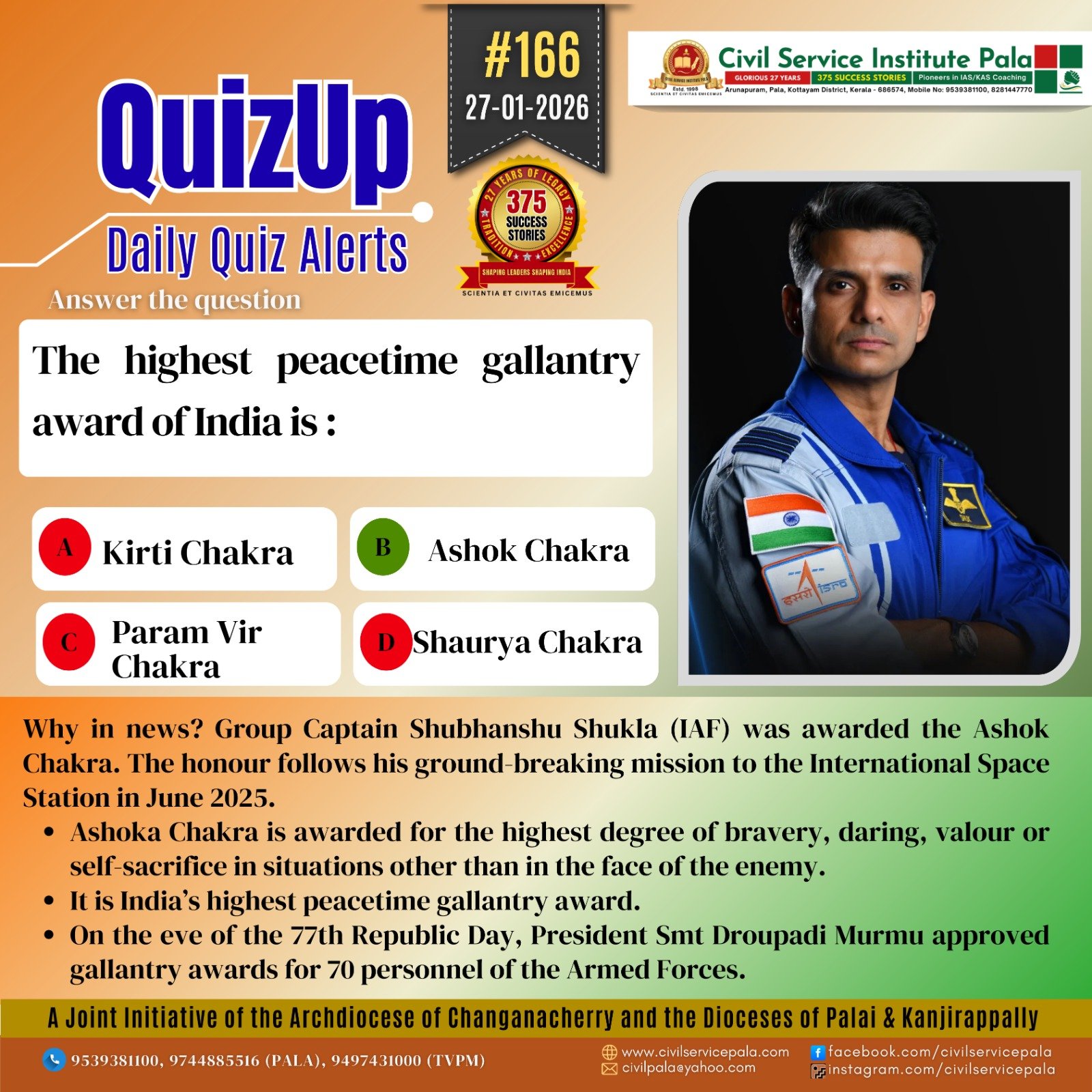
• Group Captain Shubhanshu Shukla (IAF) was awarded the Ashok Chakra. The honour follows his ground-breaking mission to the International Space Station in June 2025.
