



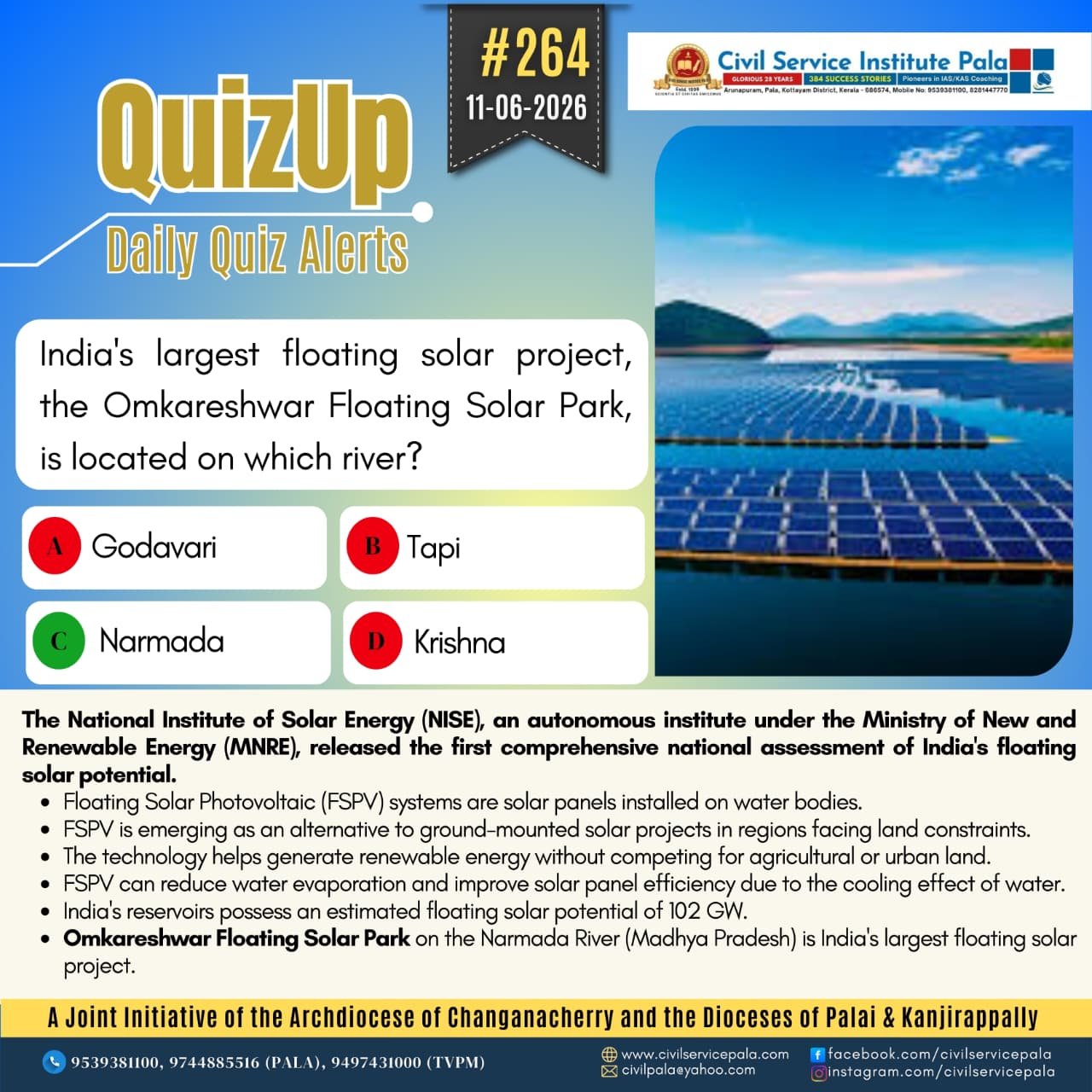
Floating Solar Power in India
Floating Solar Power in India
Background
Floating Solar Photovoltaic (FSPV) systems are solar panels installed on water bodies such as reservoirs, lakes, dams and quarry ponds.
Floating solar is emerging as an alternative to ground-mounted solar projects, particularly in regions facing land constraints.
The technology helps generate renewable energy without competing for agricultural or urban land.
Floating solar can also reduce water evaporation and improve solar panel efficiency due to the cooling effect of water.
Why in News?
The National Institute of Solar Energy (NISE), an autonomous institute under the Ministry of New and Renewable Energy (MNRE), released the first comprehensive national assessment of India's floating solar potential.
The report is titled "Solar PV Potential of India (Floating Solar)."
The assessment estimates that India's reservoirs can support approximately 102 GW of floating solar capacity.
Key Findings of the NISE Study
India's Floating Solar Potential
India's reservoirs possess an estimated floating solar potential of 102 GW.
The assessment identifies floating solar as a solution to one of the biggest challenges facing solar expansion: land availability.
Reservoir-based solar installations can significantly supplement India's renewable energy targets.
Cost Considerations
Floating solar projects generally require higher initial investments than ground-mounted solar projects.
The report cites a benchmark indicating that floating solar installations may cost approximately 25% more upfront than conventional land-based solar systems.
However, long-term benefits such as land savings and reduced water evaporation may offset some of the additional costs.
Advantages of Floating Solar
Land Conservation
Floating solar reduces the need for acquiring large tracts of land.
It helps avoid conflicts between energy generation and agriculture.
Improved Efficiency
Water beneath the panels provides a cooling effect that can improve solar panel performance.
Lower operating temperatures can increase energy output.
Water Benefits
Solar panels reduce direct sunlight exposure on water surfaces.
This can decrease water evaporation from reservoirs.
Grid Integration
Many reservoirs are already associated with hydropower infrastructure, facilitating grid connectivity.
Challenges and Limitations
Higher Costs
Floating solar projects require specialized floating structures and anchoring systems.
Initial capital costs are generally higher than ground-mounted systems.
Technical Issues
NISE field observations at Omkareshwar reported loosening float joints and uneven buoyancy.
Developers have reported instances of electrical cable failures.
Long-term maintenance remains more complex in aquatic environments.
Environmental Concerns
Large-scale installations may affect aquatic ecosystems.
Careful environmental assessment is necessary before deployment.
Omkareshwar Floating Solar Park
Omkareshwar is India's largest floating solar project.
It is located on the Narmada River in Khandwa district of Madhya Pradesh.
The project has scaled capacity of 600 MW.
It serves as India's flagship floating solar initiative.
International Scenario
Global Status
Global floating solar capacity reached approximately 9.6 GW by 2024.
Nearly 90% of global floating solar installations are located in Asia.
Asia is the leading region due to rapid renewable energy expansion and reservoir availability.
China
China is the global leader in floating solar deployment.
Major installations include large floating solar plants on fish farms and reservoirs.
A notable example is the 120 MW project at Poyang Lake.
Singapore
Singapore has played an important role in generating operational performance data for floating solar systems.
The Tengeh Reservoir floating solar project is widely cited in global studies.
Netherlands
Netherlands accounts for a significant share of Europe's floating solar capacity.
Most installations are located on quarry lakes and inland water bodies.
Government Initiatives
MNRE Focus
The Ministry of New and Renewable Energy is exploring policy support for floating solar deployment.
Discussions are underway regarding incentives for floating solar and agri-photovoltaic systems.
Agri-Photovoltaics
Agri-photovoltaics combine agriculture and solar power generation.
Solar panels are installed above agricultural fields, allowing simultaneous farming and electricity production.
The approach helps address land-use conflicts in renewable energy expansion.
Significance for India
Floating solar can help India expand renewable energy capacity without major land acquisition.
It supports India's commitments toward energy transition and climate goals.
Reservoir-based solar projects can complement hydropower infrastructure.
Floating solar could become an important component of India's future renewable energy mix.
Floating solar offers India a land-efficient pathway to expand renewable energy generation, with reservoirs alone estimated to support about 102 GW of solar capacity.
