



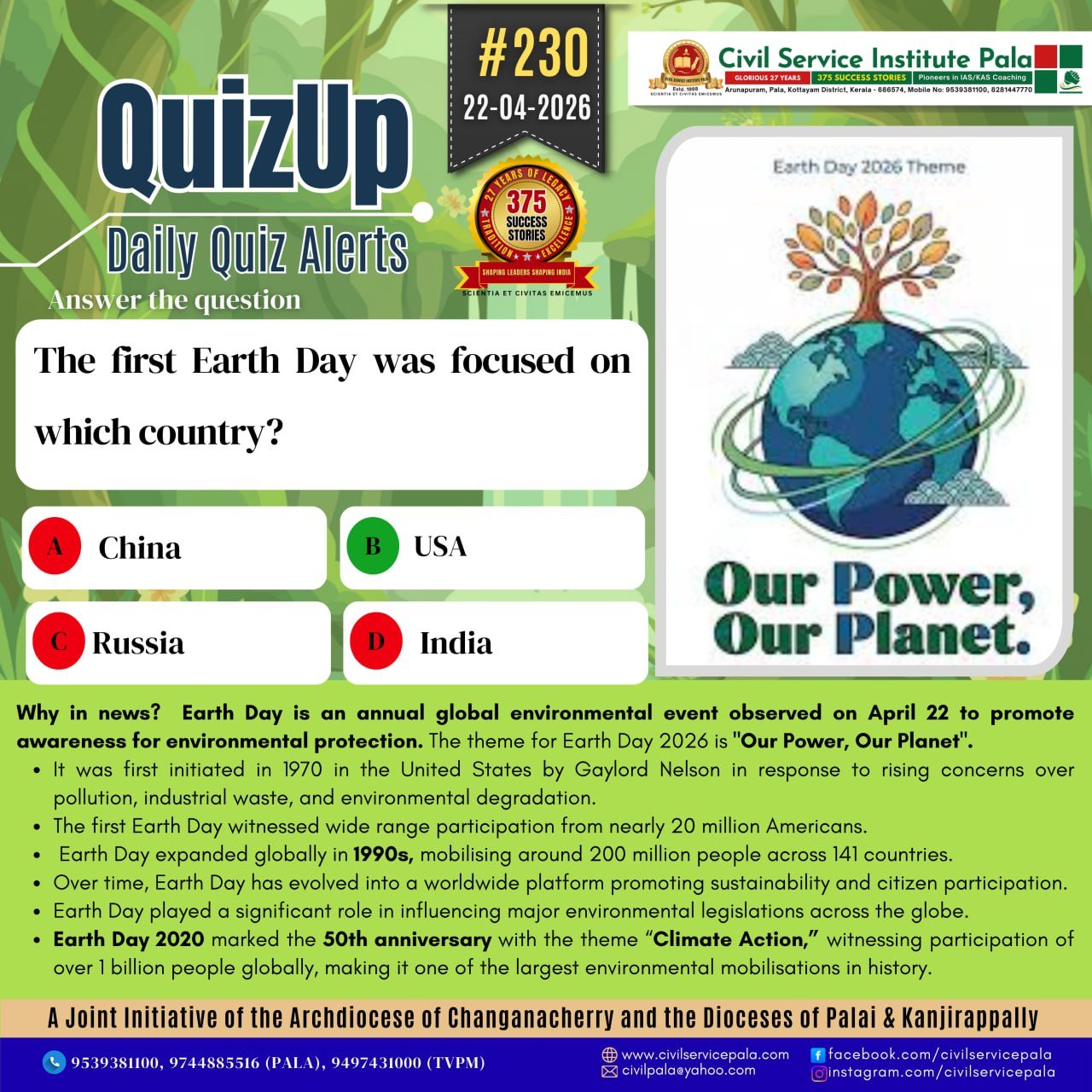
Earth Day
Earth Day
• Earth Day is an annual global environmental event observed on April 22 to promote awareness and action for environmental protection.
• It was first initiated in 1970 in the United States by Senator Gaylord Nelson in response to rising concerns over pollution, industrial waste, and environmental degradation.
• The first Earth Day witnessed participation from nearly 20 million Americans, marking one of the earliest large-scale environmental mass movements.
Evolution
• Earth Day expanded globally in 1990s under the leadership of Denis Hayes, mobilising around 200 million people across 141 countries.
• This global phase helped elevate environmental concerns to the international stage and contributed to the momentum for the United Nations Earth Summit.
• Over time, Earth Day has evolved into a worldwide platform promoting sustainability, environmental education, and citizen participation.
Key Milestones
• Earth Day played a significant role in influencing major environmental legislations across the globe.
• On April 22, 2016, the Paris Agreement was opened for signature, with 175 countries signing it on Earth Day, marking a major global climate commitment.
• Earth Day 2020 marked the 50th anniversary with the theme “Climate Action,” witnessing participation of over 1 billion people globally, making it one of the largest environmental mobilisations in history.
Contemporary Relevance
• Earth Day promotes activities such as environmental education, clean-up drives, citizen science, and advocacy for sustainable development.
• Schools, communities, and organisations worldwide actively participate in initiatives aimed at fostering ecological awareness and responsibility.
• The event continues to serve as a platform for addressing contemporary challenges such as climate change, biodiversity loss, and pollution.
Significance
• Earth Day reflects the evolution of environmentalism from a national protest movement to a global governance issue.
• It highlights the role of public mobilisation in shaping environmental policy and international cooperation.
• The continued relevance of Earth Day lies in bridging the gap between policy commitments and grassroots environmental action.
