



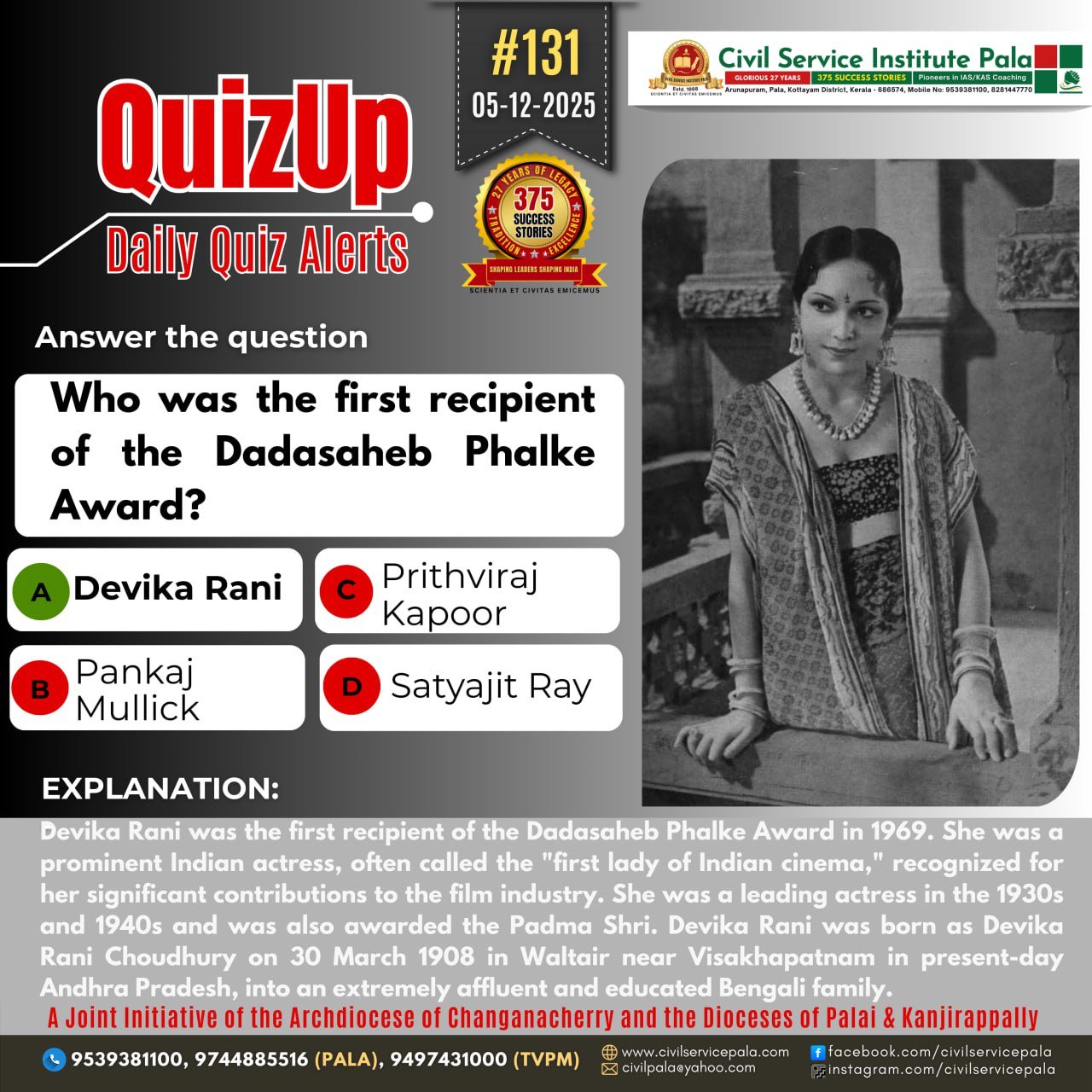
Devika Rani
Devika Rani – The First Lady of Indian Cinema
Devika Rani (1908–1994) was one of the most influential and pioneering figures in the early years of Indian cinema. Widely celebrated as the “First Lady of Indian Cinema”, she became the first-ever recipient of the Dadasaheb Phalke Award in 1969, India’s highest honour in film.
Early Life and Background
Born in Visakhapatnam, Andhra Pradesh.
Trained in textile design and interior decoration in London.
Later studied film-making and acting at leading European studios.
Her international exposure shaped her into a professionally trained artist at a time when very few Indian women worked in films.
Contribution to Indian Cinema
1. Founder of Bombay Talkies
Along with her husband Himanshu Rai, she co-founded Bombay Talkies in 1934—one of India’s most advanced and influential film studios.
This studio played a major role in:
Professionalizing the Indian film industry
Introducing disciplined production methods
Launching the careers of stars like Ashok Kumar
2. Acclaimed Actress
Devika Rani became the leading actress of the 1930s and early 1940s, known for her grace, expressive acting, and on-screen presence.
Notable films include:
Karma (1933) – famous for one of Indian cinema’s earliest romantic sequences
Achhut Kanya (1936) – a social reform film on untouchability, widely regarded as a classic
Jeevan Naiya (1936)
Izzat (1937)
3. Breaking Social Barriers
At a time when women were discouraged from acting, Devika Rani brought dignity, artistry, and professionalism to the profession.
She earned respect for shaping early Indian cinema’s identity.
Dadasaheb Phalke Award (1969)
Devika Rani was selected as the first-ever recipient because of:
Her pioneering contributions
Leadership in establishing a modern studio system
Elevating technical and artistic standards in Indian filmmaking
Her role as Indian cinema’s earliest female superstar
The award recognized her unmatched influence on the growth and evolution of Indian films.
Legacy
Devika Rani is remembered as one of India’s most cultured, progressive, and visionary artists.
Her work laid the foundation for:
Professional film production
Women’s participation in cinema
Modern storytelling techniques
She remains a symbol of Indian cinema’s golden beginnings and artistic legacy.
