



DENGUE FEVER
DENGUE FEVER
Why in News?
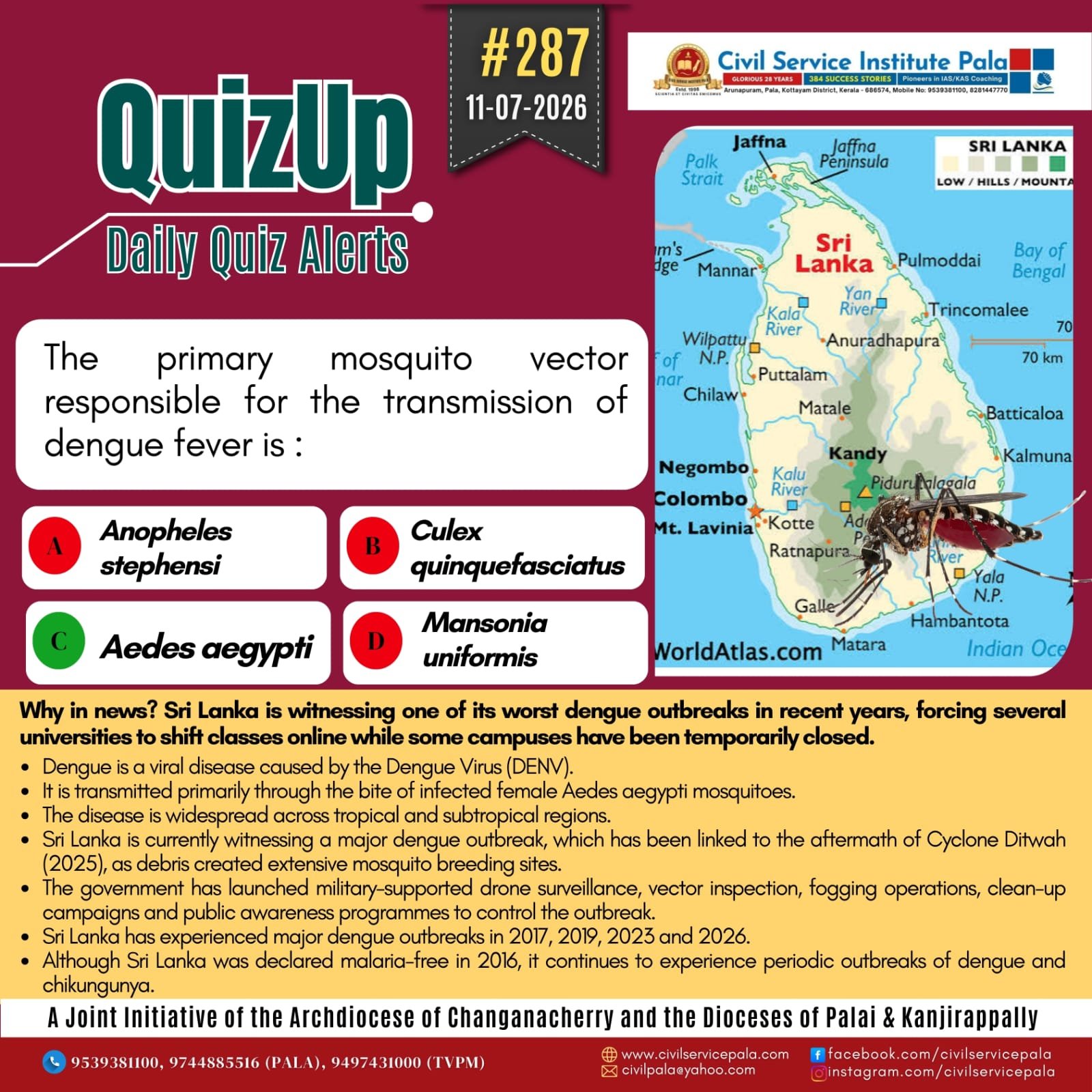
• Sri Lanka is witnessing one of its worst dengue outbreaks in recent years, reporting over 65,000 cases and 45 deaths in 2026.
• The outbreak has forced several universities, including the University of Colombo, to shift classes online, while some campuses were temporarily closed.
• Health authorities have linked the surge to the 2025 Cyclone Ditwah, whose debris created extensive mosquito breeding sites, along with favourable monsoon conditions.
Sri Lanka's Latest Dengue Outbreak
• Sri Lanka has reported 65,034 dengue cases and 45 deaths in june 2026, with Colombo accounting for nearly one-fifth of all reported infections.
• Universities have shifted to online or hybrid classes as increasing infections affected students across campuses.
• Authorities have launched a military-supported response involving drone surveillance, vector inspection, fogging operations, clean-up campaigns and public awareness programmes.
• Public health experts attribute the outbreak to Cyclone Ditwah (December 2025), whose widespread debris created ideal mosquito breeding habitats.
• Sri Lanka has experienced repeated major outbreaks in 2017, 2019, 2023 and 2026, with the 2017 outbreak remaining the largest (1,86,101 cases and 440 deaths).
• Although Sri Lanka was declared malaria-free in 2016, it continues to face periodic outbreaks of dengue and chikungunya, particularly during the monsoon season.
What is Dengue?
• Dengue (also called Break-bone Fever) is a viral disease caused by the Dengue Virus (DENV).
• It spreads primarily through the bite of infected female Aedes aegypti mosquitoes, while Aedes albopictus acts as a secondary vector.
• The disease is widespread across tropical and subtropical regions, especially in densely populated urban and semi-urban areas.
• Around half of the world's population is at risk, with an estimated 100–400 million infections occurring annually.
Transmission
• An infected female Aedes mosquito transmits the virus while taking a blood meal.
• After acquiring the virus, the mosquito remains infectious for the rest of its life.
• Mosquitoes become infected after biting a person carrying the virus.
• Infected individuals can transmit the virus to mosquitoes from about two days before symptoms appear until roughly two days after fever subsides.
Other Modes
Rare transmission has been reported through - Mother-to-child (vertical transmission), blood transfusion, and organ transplantation.
Clinical Features
Incubation Period
• Symptoms usually appear 4–10 days after infection and generally last 2–7 days.
• Common Symptoms include high fever, severe headache , pain behind the eyes, muscle and joint pain, nausea and vomiting, skin rash and swollen glands.
Individuals infected with dengue for the second time are at a much higher risk of developing severe dengue.
Diagnosis and Treatment
• Diagnosis can be performed using NAAT (molecular tests), ELISA, antigen tests and Rapid Diagnostic Tests (RDTs).
• There is no specific antiviral treatment for dengue.
• As no specific cure exists, dengue prevention depends primarily on mosquito control.
Current Vaccine Development: Brazil temporarily suspended its Butantan-DV dengue vaccination campaign after two reported deaths during the rollout. The development has drawn attention in India because DengiAll, India's upcoming indigenous dengue vaccine, is based on a similar vaccine platform, highlighting the importance of continued safety monitoring during large-scale immunisation programmes.
