



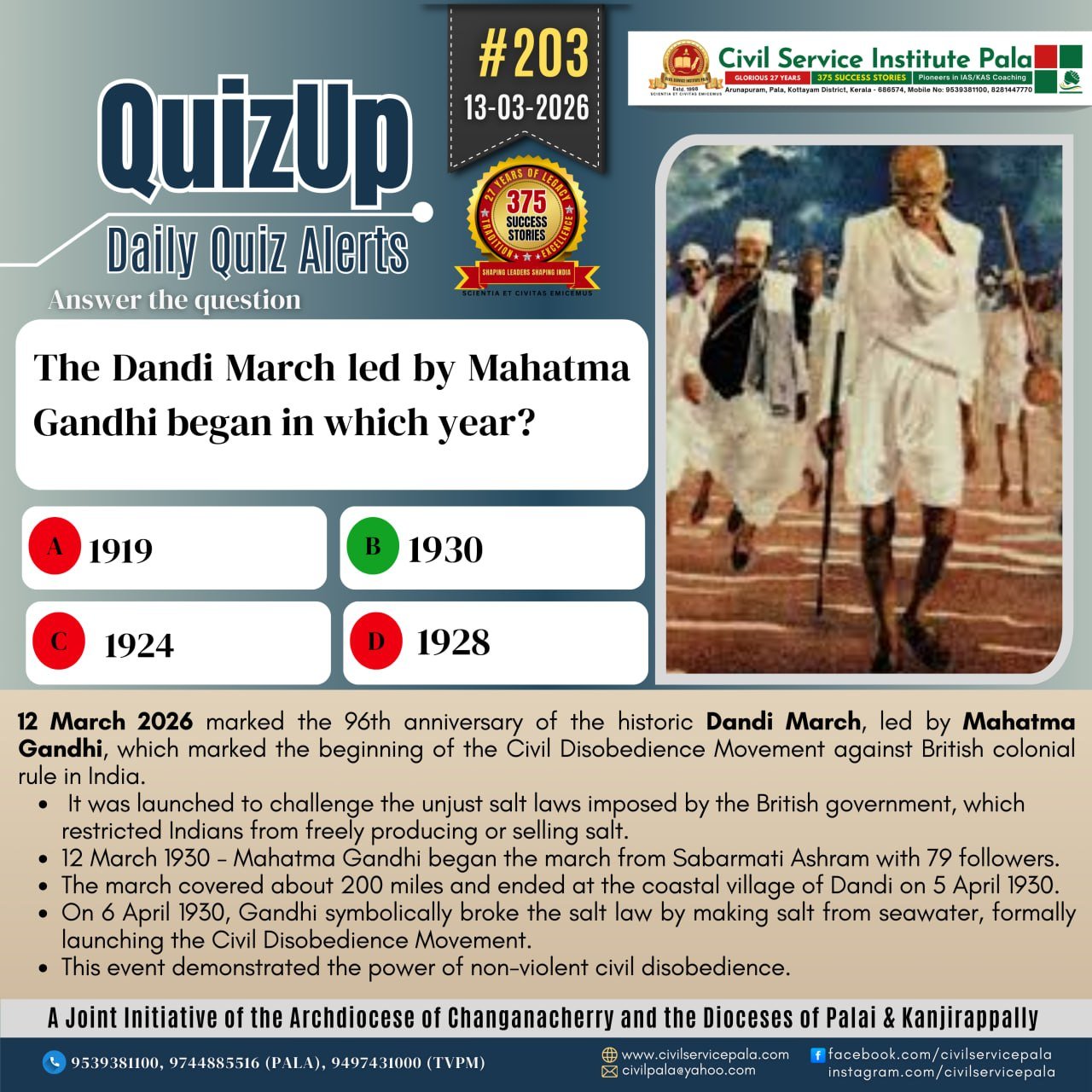
Dandi March
12 March 2026 marked the 96th anniversary of the historic Dandi March, led by Mahatma Gandhi, which marked the beginning of the Civil Disobedience Movement against British colonial rule in India.
The Dandi March marked the beginning of the Civil Disobedience Movement against British rule. It was aimed at challenging the colonial salt laws, which prevented Indians from producing or selling salt independently.
On 12 March 1930, Mahatma Gandhi started the march from Sabarmati Ashram with 79 followers. After marching about 200 miles, he reached Dandi on 5 April 1930 and on 6 April symbolically broke the salt law by making salt from seawater, thereby formally launching the Civil Disobedience Movement.
The programme of the movement included making salt in villages, picketing liquor and foreign cloth shops, burning foreign clothes, spinning khadi, campaigning against untouchability, boycotting government institutions, resigning from government jobs, and refusing to pay taxes. These measures were intended to promote self-reliance while directly challenging colonial authority.
The movement soon spread across the country and saw large-scale participation from students, workers, farmers, and women, turning the freedom struggle into a broad-based mass movement. In response, the British government resorted to repression by arresting Congress leaders and imprisoning activists.
Overall, the Dandi March demonstrated the power of non-violent civil disobedience, mobilised diverse sections of society, and strengthened the momentum of the national movement by intensifying the demand for independence.