



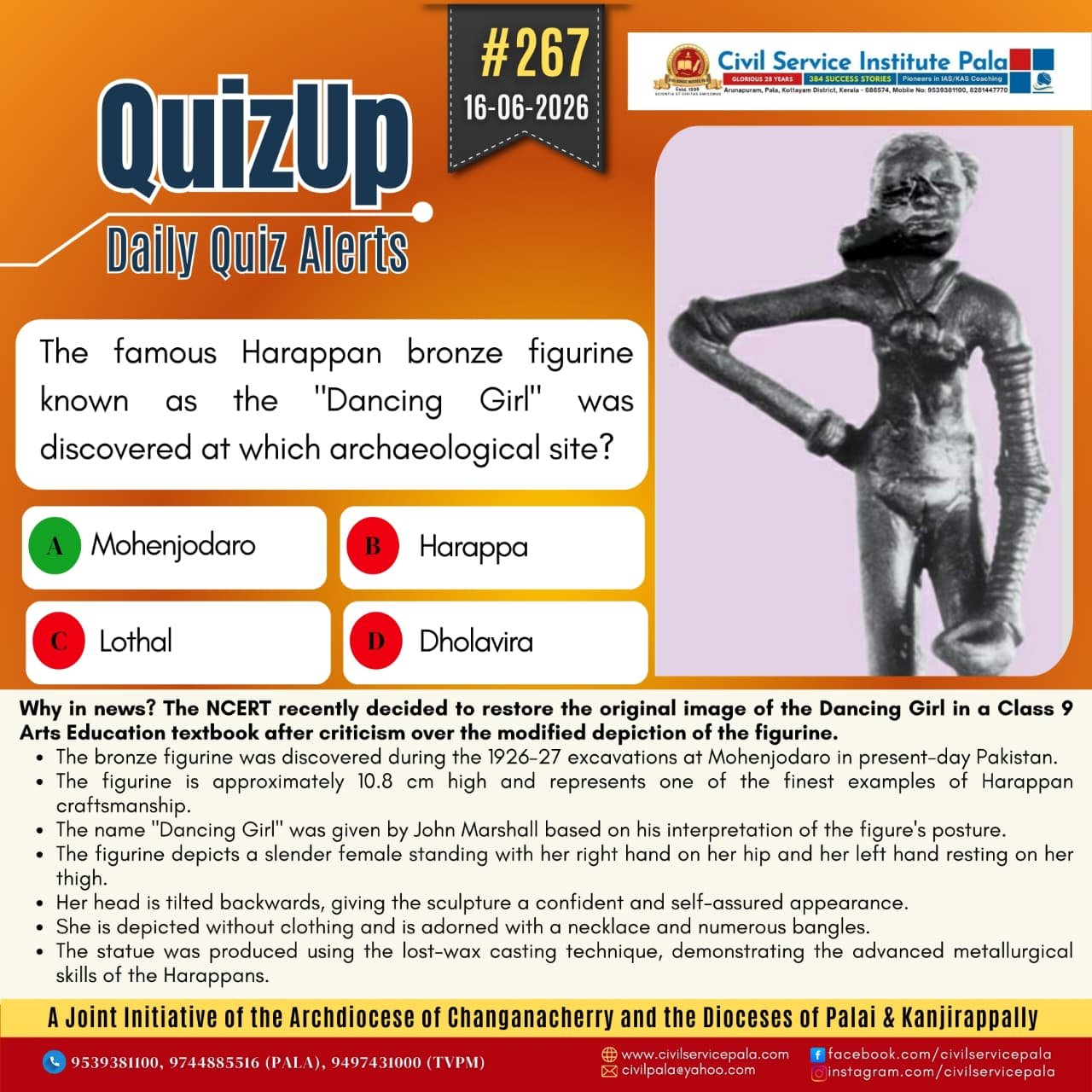
Dancing Girl of Mohenjodaro
Dancing Girl of Mohenjodaro
Why in News?
The NCERT recently decided to restore the original image of the Dancing Girl in a Class 9 Arts Education textbook after criticism over the modified depiction of the figurine.
Background and Discovery
The Dancing Girl is one of the most famous artefacts of the Indus Valley Civilization and a symbol of Harappan artistic excellence.
The bronze figurine was discovered during the 1926–27 excavations at Mohenjodaro in present-day Pakistan.
The figurine is approximately 10.8 cm high and represents one of the finest examples of Harappan craftsmanship.
The name "Dancing Girl" was given by John Marshall based on his interpretation of the figure's posture.
Experts highlight that there is no conclusive evidence that the figure actually represents a professional dancer.
Artistic and Technological Features
The figurine depicts a slender female standing with her right hand on her hip and her left hand resting on her thigh.
Her head is tilted backwards, giving the sculpture a confident and self-assured appearance.
She is depicted without clothing and is adorned with a necklace and numerous bangles.
The left arm contains around 24–25 bangles, while the right arm has only four.
Her hair is tied in a loose bun at the back of the head.
The statue was produced using the lost-wax casting technique, demonstrating the advanced metallurgical skills of the Harappans.
The technique involved preparing a wax model, covering it with clay, melting the wax, and then pouring molten bronze into the mould.
Variations of the lost-wax method continue to be used in parts of India even today.
Historical Significance
The figurine reflects the high level of artistic sophistication achieved by the Harappan Civilization.
It demonstrates advanced knowledge of bronze metallurgy and metal casting.
The sculpture suggests the importance of ornaments and personal adornment in Harappan society.
Its realistic posture and expressive form indicate a mature artistic tradition.
Along with artefacts such as the Priest-King sculpture, the Dancing Girl provides valuable insights into Harappan social and cultural life.
The figurine remains one of the most recognized symbols of India's ancient urban civilization.
