



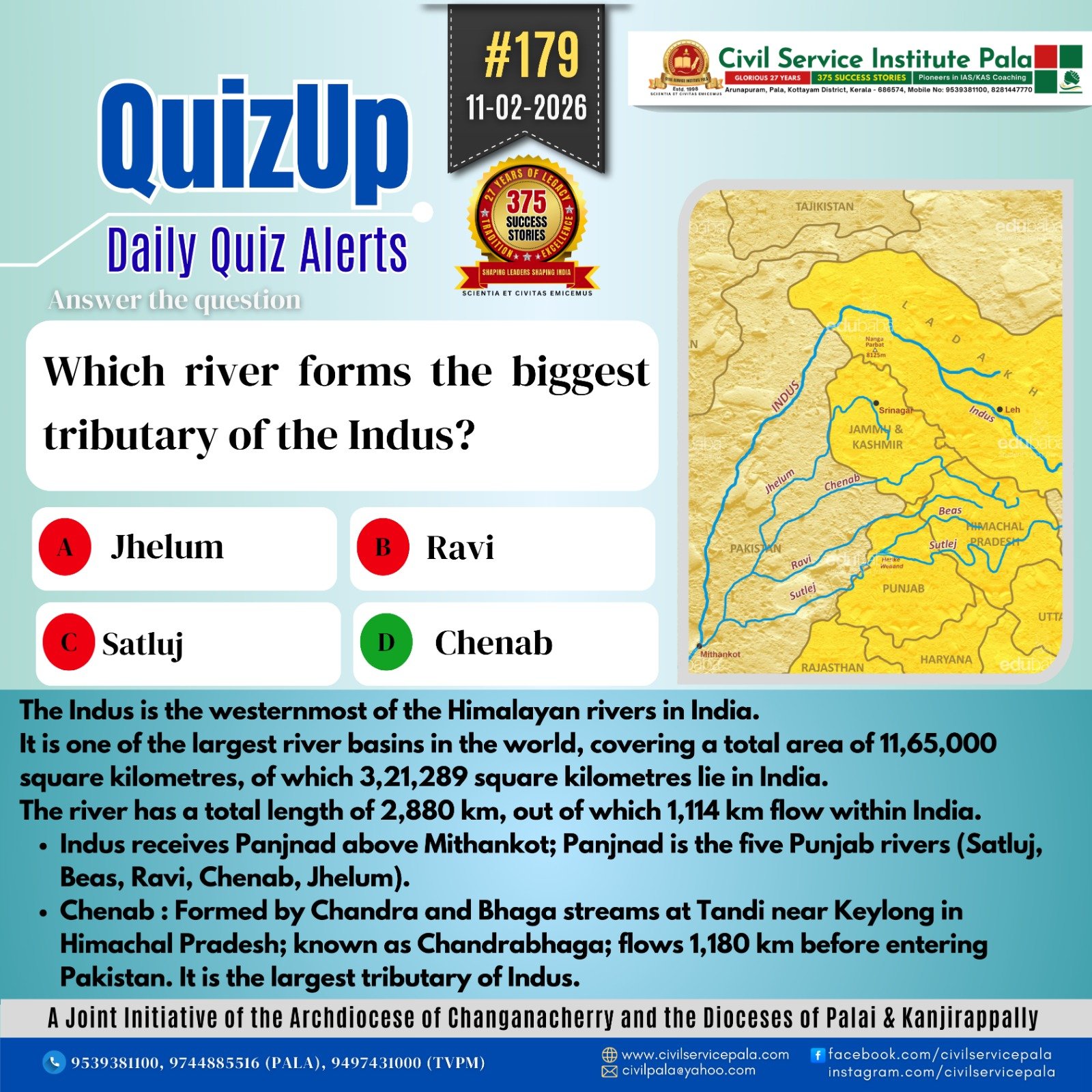
Chenab
The Indus, also known as Sindhu, is the westernmost of the Himalayan rivers in India. It is one of the largest river basins of the world, covering 11,65,000 sq. km total (321,289 sq. km in India). The river has a total length of 2,880 km (1,114 km in India).
Origin and Course
• Originates from a glacier near Bokhar Chu in the Tibetan region at 4,164 m in the Kailash Mountain range.
• In Tibet, known as ‘Singi Khamban’ or Lion’s mouth.
• Flows northwest between Ladakh and Zaskar ranges, passes through Ladakh and Baltistan.
• Cuts across the Ladakh range, forming a spectacular gorge near Gilgit in Jammu and Kashmir.
• Enters Pakistan near Chilas in the Dardistan region.
• Emerges out of the hills near Attock, receives Kabul river on right bank.
• Flows southward, receives Panjnad above Mithankot; Panjnad is the five Punjab rivers (Satluj, Beas, Ravi, Chenab, Jhelum).
• Discharges into Arabian Sea east of Karachi.
• The Indus flows in India only through Jammu and Kashmir.
•
Major Tributaries
Right Bank Tributaries
• Kabul (at Attock).
• Khurram, Tochi, Gomal, Viboa, Sangar (originate in Sulaiman ranges).
Himalayan Tributaries (Left Bank)
• Shyok, Gilgit, Zaskar, Hunza, Nubra, Shigar, Gasting, Dras.
Panjnad Tributaries
• Jhelum: Rises from spring at Verinag at foot of Pir Panjal in south-eastern Kashmir Valley; flows through Srinagar and Wular lake; enters Pakistan through deep narrow gorge; joins Chenab near Jhang.
• Chenab : Formed by Chandra and Bhaga streams at Tandi near Keylong in Himachal Pradesh; known as Chandrabhaga; flows 1,180 km before entering Pakistan.
• Ravi: Rises west of Rohtang pass in Kullu hills of Himachal Pradesh; flows through Chamba valley; drains area between south-eastern Pir Panjal and Dhauladhar ranges; enters Pakistan, joins Chenab near Sarai Sidhu.
• Beas: Originates from Beas Kund near Rohtang Pass at 4,000 m; flows through Kullu valley, forms gorges at Kati and Largi in Dhauladhar range; enters Punjab plains, meets Satluj near Harike.
• Satluj: Originates in Raksas tal near Mansarovar at 4,555 m in Tibet. In Tibet, Satluj is known as Langchen Khambab; flows parallel to Indus for 400 km before entering India; emerges from gorge at Rupar; passes through Shipki La; enters Punjab plains; antecedent river; feeds Bhakra Nangal canal system.
