



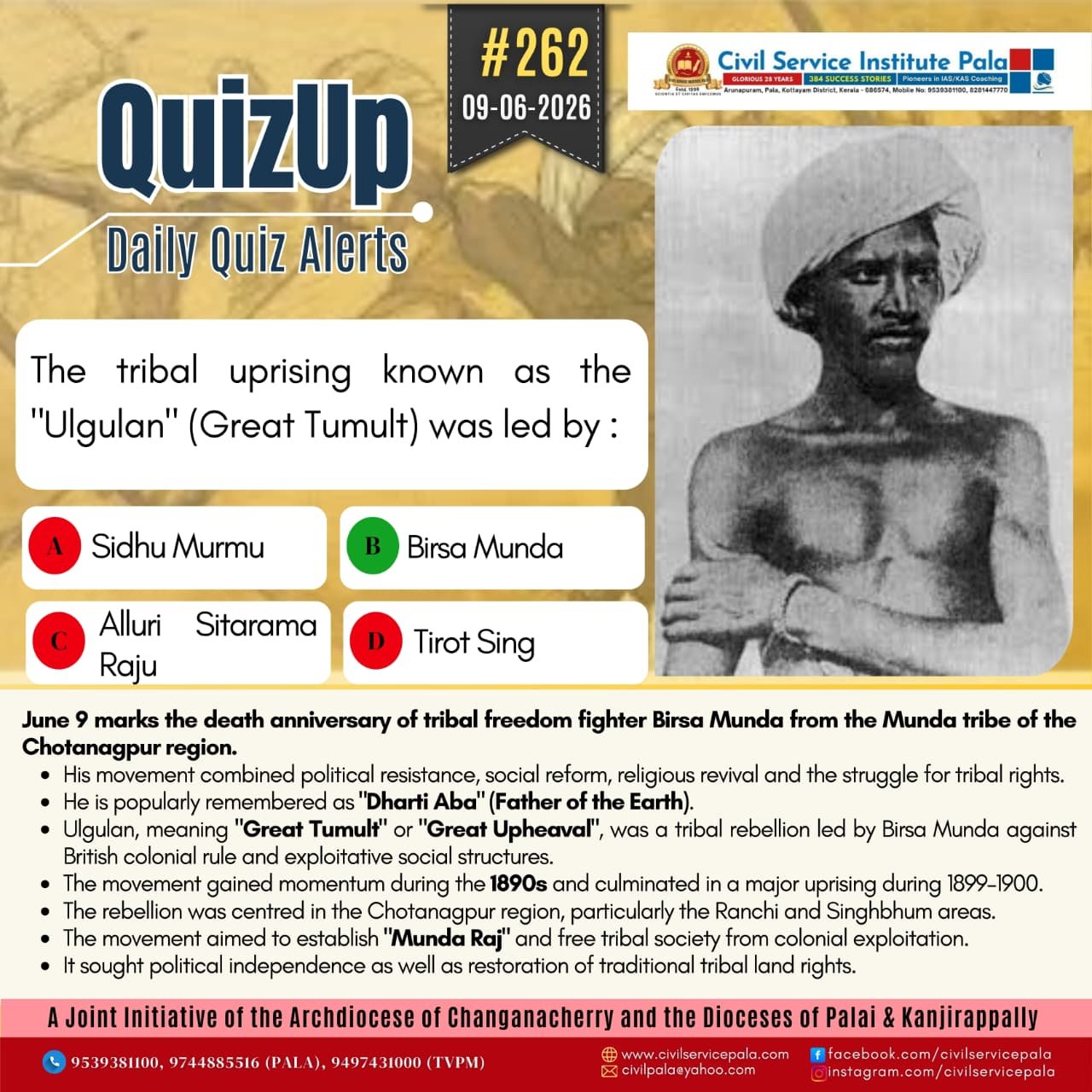
Birsa Munda and the Great Ulgulan (1899–1900)
Birsa Munda and the Great Ulgulan (1899–1900)
Birsa Munda
· Birsa Munda was a tribal leader, religious reformer and anti-colonial revolutionary from the Munda tribe of the Chotanagpur region.
He was born on 15 November 1875 at Ulihatu in present-day Jharkhand.
He emerged as the most influential tribal resistance leader against British rule in eastern India during the late nineteenth century.
His movement combined political resistance, social reform, religious revival and the struggle for tribal land rights.
He is popularly remembered as "Dharti Aba" (Father of the Earth).
The Great Ulgulan (Great Tumult)
Ulgulan, meaning "Great Tumult" or "Great Upheaval", was a tribal rebellion led by Birsa Munda against British colonial rule and exploitative social structures.
The movement gained momentum during the 1890s and culminated in a major uprising during 1899–1900.
The rebellion was centred in the Chotanagpur region, particularly the Ranchi and Singhbhum areas.
Objectives
The movement aimed to establish "Munda Raj" and free tribal society from colonial exploitation.
It sought political independence as well as restoration of traditional tribal land rights.
The movement demanded freedom from landlords, moneylenders, contractors and colonial officials.
Causes of the Revolt
Land Alienation
British land revenue policies disrupted the traditional Munda system of communal land ownership.
The introduction of the zamindari system created new classes of landlords and tenants.
Many tribal communities lost control over ancestral lands and became tenants on their own land.
Exploitation by Dikus
Birsa identified exploitative outsiders, known as "Dikus", as the main source of tribal suffering.
Dikus included landlords, moneylenders, contractors, government officials and others who benefited from colonial rule.
High rents, indebtedness and forced evictions intensified tribal grievances.
Forced Labour
Tribals were frequently subjected to begar (unpaid forced labour).
The practice became a major symbol of economic exploitation under colonial administration.
Cultural and Religious Pressures
Tribal customs and traditional beliefs came under pressure from colonial institutions and missionary activities.
Many tribals perceived the erosion of cultural identity as linked to the loss of land and autonomy.
Birsa's Religious and Social Reform Movement
Birth of Birsait
Around 1895, Birsa launched the Birsait movement as a religious and social reform movement.
The movement promoted worship of Sing Bonga, the supreme deity in Munda belief systems.
It emphasized monotheism, moral purity, social unity and cultural self-respect.
Key Teachings
Birsa urged tribals to abandon superstition and social evils.
He called upon followers to reject alcohol abuse and strengthen community discipline.
He emphasized pride in tribal identity and indigenous religious traditions.
The movement linked cultural revival with resistance against colonial domination.
Importance
The Birsait movement transformed Birsa from a political leader into a spiritual symbol of resistance.
His religious influence enabled him to mobilize large sections of tribal society.
Course of the Rebellion
Birsa was arrested and imprisoned by the British, which further intensified tribal resentment.
The uprising entered a militant phase in December 1899.
Rebels targeted symbols of colonial authority, including police stations, government officials, landlords and mission establishments.
The British administration responded with military force and widespread repression.
Birsa was arrested in 1900 during the suppression campaign.
End of the Movement
Birsa Munda died in British custody on 9 June 1900 at the age of 25.
Following his death, the organized rebellion gradually weakened.
Many followers were imprisoned, while others received severe punishments.
Impact and Legacy
Administrative Reforms
The British administration acknowledged the need to address tribal grievances.
The compulsory begar system was abolished in affected regions.
The Tenancy Act of 1903 recognized the traditional Khuntkatti landholding system of the Mundas.
The Chotanagpur Tenancy Act, 1908 provided legal safeguards against tribal land alienation.
Political and Cultural Legacy
Birsa became an enduring symbol of tribal resistance and self-respect.
His movement inspired later struggles for land rights, forest rights and tribal identity.
His ideas contributed significantly to the emergence of tribal consciousness in eastern India.
He remains one of the most important figures in India's tribal freedom movement.
