



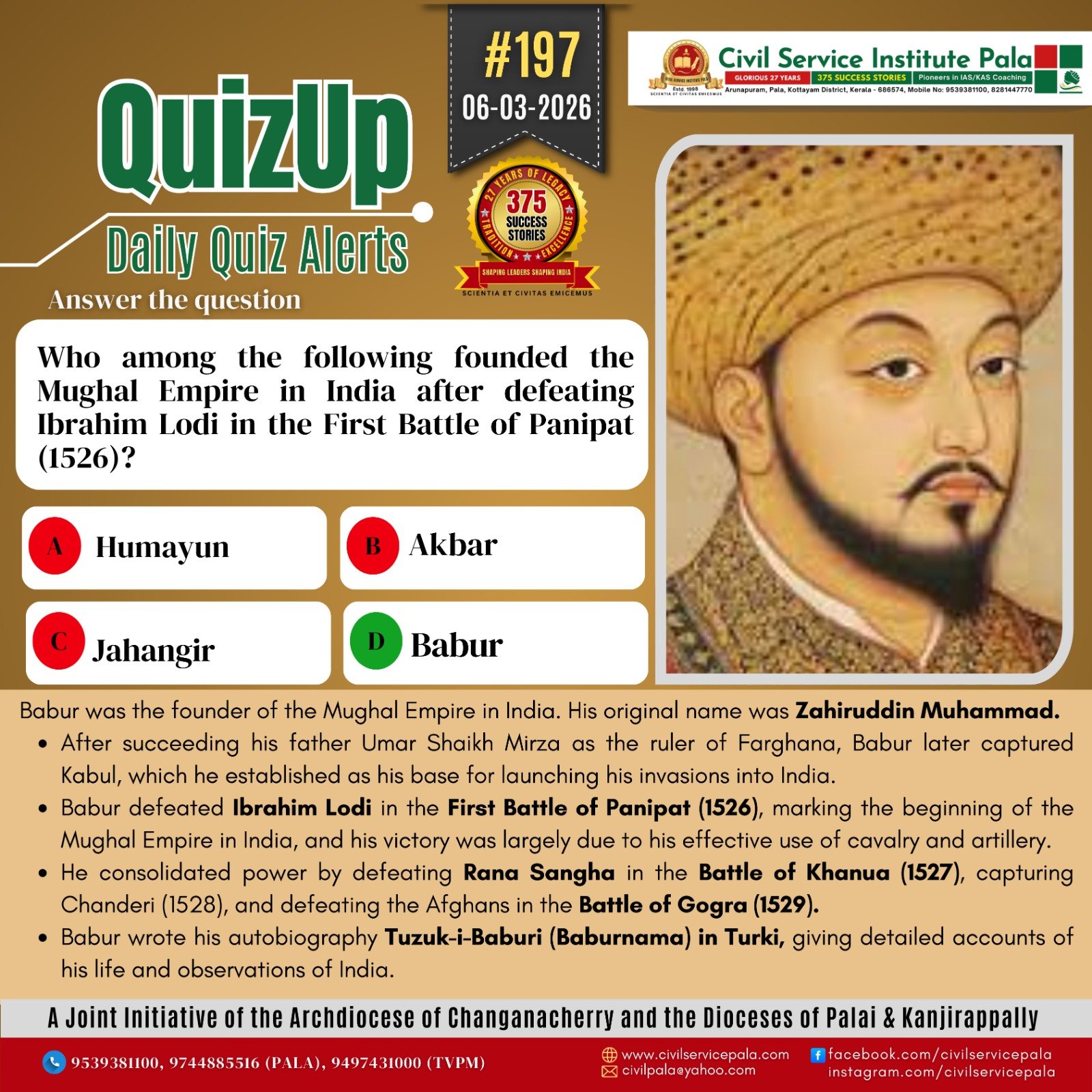
Babur
Early Life and Background
• Babur was the founder of the Mughal Empire in India. His original name was Zahiruddin Muhammad.
• He was related to Timur from his father’s side and to Genghis Khan through his mother.
• Babur succeeded his father Umar Shaikh Mirza as the ruler of Farghana.
• Soon after becoming ruler, he was defeated by a distant relative and lost his kingdom, after which he spent some time as a wanderer.
Establishment of Power in Kabul
• Later, he captured Kabul from one of his uncles and established his base there.
• From Kabul, Babur developed an interest in conquering India and launched four expeditions between 1519 and 1523.
Political Situation in India
• At the time of Babur’s invasion, India had several powerful rulers: the Muslim rulers of Delhi, Gujarat, Malwa, Bengal, and the Deccan.
• Major Hindu powers included Rana Sangha of Mewar and the Vijayanagar Empire.
Conquest of North India
• In 1525, Babur marched from Kabul to conquer India.
• He first captured Lahore by defeating its governor Daulat Khan Lodi.
• He then faced Ibrahim Lodi, the Sultan of Delhi, in the First Battle of Panipat on 21 April 1526, where Ibrahim Lodi was killed.
• Babur’s victory was mainly due to his effective cavalry and artillery.
• After this victory, he occupied Delhi and sent his son Humayun to seize Agra.
• He then proclaimed himself “Emperor of Hindustan.”
Consolidation of Mughal Power
• Babur further strengthened his rule by defeating Rana Sangha in the Battle of Khanua near Agra in 1527.
• After this victory, he assumed the title “Ghazi.”
• In 1528, he captured Chanderi from the Rajput ruler Medini Rai.
• In 1529, he defeated the Afghans in the Battle of Gogra in Bihar, which helped him consolidate his power in India.
Death
• Babur died at Agra in 1530 at the age of 47.
Personality and Literary Contributions
• Babur was considered a great statesman and capable ruler with notable achievements.
• He was also a scholar of Arabic and Persian, while Turki was his mother tongue.
• He wrote his memoirs Tuzuk-i-Baburi in Turki, which gives a vivid description of India.
• In this work, he honestly recorded his successes and failures.
• Babur was also interested in nature and described the flora and fauna of India in his writings.
