



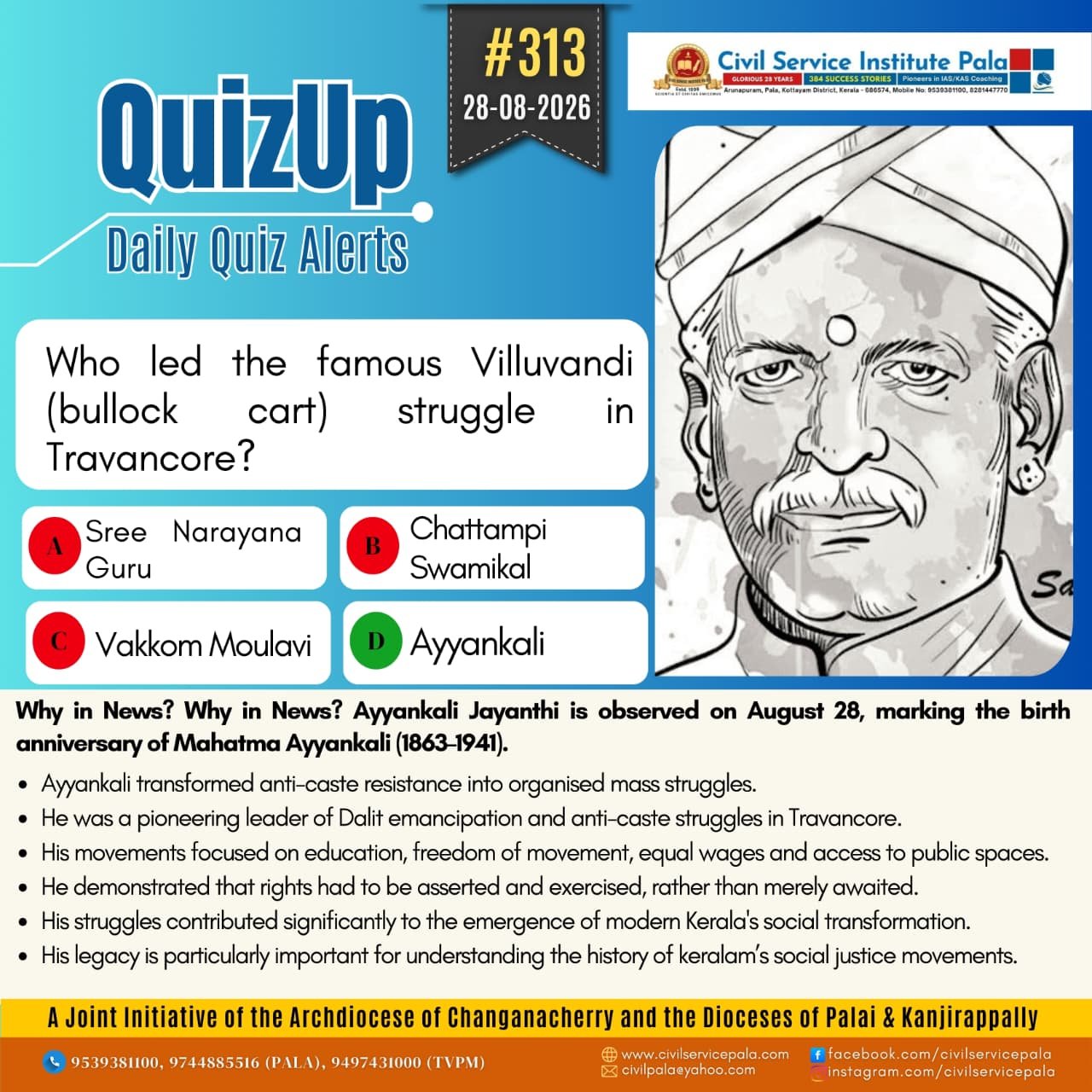
AYYANKALI
AYYANKALI
Why in News? Ayyankali Jayanthi is observed on August 28, marking the birth anniversary of Mahatma Ayyankali (1863–1941).
• He was a pioneering leader of Dalit emancipation and anti-caste struggles in Travancore.
• His movements focused on education, freedom of movement, dignity, equal wages and access to public spaces.
Who was Ayyankali?
• Born on 28 August 1863 at Venganoor, Thiruvananthapuram, in the erstwhile Travancore.
• Belonged to the Pulaya community and grew up under severe caste-based restrictions.
• Despite being illiterate, he emerged as an influential social revolutionary and organiser.
• His struggles challenged untouchability, caste hierarchy and social exclusion.
• His broader vision centred on freedom, equality, dignity and self-respect.
Conditions in Kerala Before Ayyankali
• Kerala society was marked by a rigid caste hierarchy and untouchability, with lower castes facing severe social discrimination.
• They were restricted from public roads, schools, temples and public spaces, while also facing caste-based restrictions on dress, ornaments, employment and wages.
• Untouchable communities were largely confined to agricultural labour, creating the social conditions that Ayyankali's movements sought to challenge.
Villuvandi Samaram — Bullock Cart Struggle
• 1893: Ayyankali undertook the famous Villuvandi Yatra/Bullock Cart Struggle.
• He rode a decorated bullock cart through public roads traditionally dominated by upper castes.
• The action challenged restrictions imposed on the movement of oppressed castes.
• It became a powerful assertion of equal rights, dignity and access to public spaces.
• The movement inspired further struggles for freedom of movement.
Struggle for Education
• Ayyankali strongly believed that education was essential for social emancipation.
• He fought against the exclusion of Dalit children from schools.
• In 1904, he established a school for Pulaya children at Moganur.
• The school faced severe opposition and was repeatedly attacked and burnt.
• He also supported struggles for admission of Dalit children into government schools.
• The struggle for school access became closely linked with his wider movement for social equality.
Sadhujana Paripalana Sangham (SJPS)
• Established by Ayyankali in 1907 to organise and unite Dalits and other oppressed sections.
• Focused on education, community organisation, social issues and support for schools, with the magazine Sadhu Jana Paripalani also launched in 1907.
• Its guiding principle was “Progress through education and organisation.”
Agricultural Labour Strike
• Ayyankali organised a major agricultural labour strike, linking labour rights with the demand for Dalit children's access to education.
• The strike demanded school admission, higher wages, permanent employment, protection from victimisation and freedom of movement, under the slogan “No Education – No Farming.”
• It demonstrated the collective bargaining power of agricultural labourers and the potential of organised resistance to challenge social and economic discrimination.
Kallumala Samaram
• 24 October 1915: Ayyankali led the Kallumala Samaram at Perinad in Kollam.
• Dalit women were traditionally expected to wear stone, wood or iron ornaments as markers of caste status.
• Ayyankali encouraged them to break and discard these ornaments.
• The struggle symbolised rejection of caste-based humiliation and imposed markers of inferiority.
• It became an important assertion of self-respect and dignity, particularly among Dalit women.
Overall Significance
• Ayyankali transformed anti-caste resistance into organised mass struggles.
• His movements went beyond social reform to address education, labour, public space and political representation.
• He demonstrated that rights had to be asserted and exercised, rather than merely awaited.
• His struggles contributed significantly to the emergence of modern Kerala's social transformation.
• His legacy is particularly important for understanding the history of Dalit movements and social justice in Kerala.
