



Asian Games
Asian Games
Why in News?
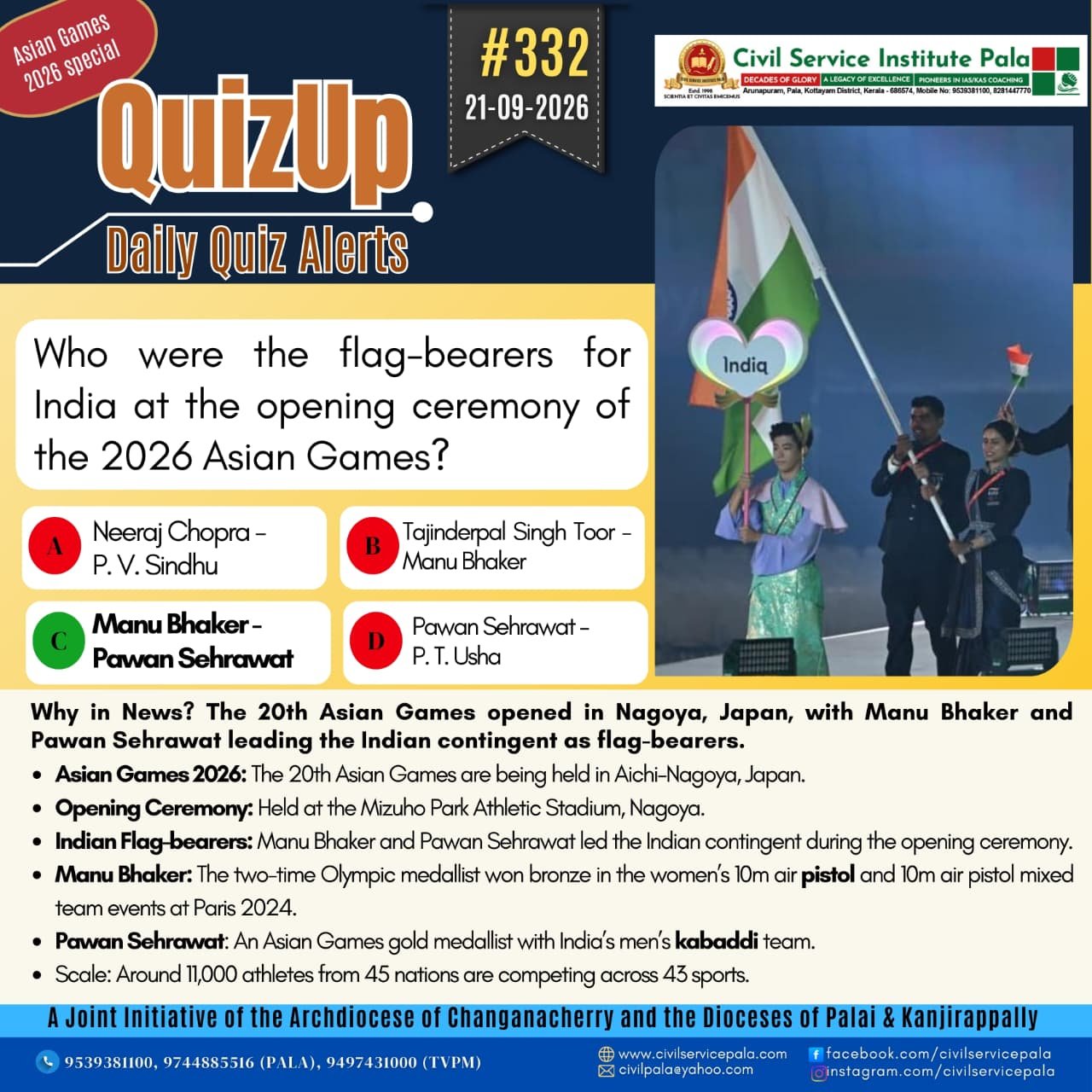
The 20th Asian Games opened in Nagoya, Japan, with Manu Bhaker and Pawan Sehrawat leading the Indian contingent as flag-bearers.
Asian Games 2026: Nagoya, Japan
• Host: Japan, with the Games centred in Nagoya and Aichi Prefecture.
• Edition: 20th Asian Games, being held from September 19 - October 4, 2026.
• Opening Ceremony: Held at the Nagoya City Mizuho Park Athletic Stadium.
• Indian Flag-bearers: Manu Bhaker and Pawan Sehrawat led the Indian contingent into the stadium.
• Manu Bhaker: The two-time Olympic medallist won bronze in the women’s 10m air pistol and 10m air pistol mixed team events at Paris 2024.
• Pawan Sehrawat: An Asian Games gold medallist with the Indian men's kabaddi team.
• Participation: Athletes from the Olympic Council of Asia's 45 National Olympic Committees are participating, with more than 11,000 athletes expected across 43 sports.
• Opening Ceremony Theme: The ceremony followed the “Harmonic Heart Beat” concept, with a heart-shaped stage symbolising unity among Asian athletes.
• Torch Relay: The relay began at Nagoya Castle on August 22 and travelled through all 40 municipalities of Aichi Prefecture and Nagoya's 16 wards, involving around 1,000 torchbearers.
• Japan’s Hosting Legacy: Japan is hosting the Asian Games for the third time, after Tokyo 1958 and Hiroshima 1994.
India and the Asian Games
India as a Founding Force
• India played a pioneering role in the creation of the Asian Games movement and hosted the inaugural edition in New Delhi in 1951.
• The idea of a pan-Asian sporting event took shape during the Asian Relations Conference held in Delhi in 1947.
• G. D. Sondhi proposed the idea of an Asian Games Federation, while Maharaja Yadavindra Singh of Patiala supported the initiative.
• The proposed name was initially “Asiatic Games”, but Jawaharlal Nehru suggested the name “Asian Games.”
The First Asian Games: New Delhi 1951
• The inaugural Asian Games were held in New Delhi in 1951, with India finishing second behind Japan.
• India won 51 medals — 15 gold, 16 silver and 20 bronze.
• Sachin Nag won the 100m freestyle and became India’s first Asian Games gold medallist.
• Roshan Mistry became the first Indian woman to win an Asian Games medal, winning silver in the 100m sprint.
• The first Games were organised largely through non-governmental funding, with support from institutions including the National Sports Club of India and Cricket Club of India.
India’s Performance and Legacy
• India has participated in every edition of the Asian Games and has won at least one gold medal at every edition.
• India has won 778 medals, including 183 gold, 238 silver and 357 bronze, according to the supplied material.
• India is identified as the fifth-most successful country in the history of the Games.
• Athletics has been India's strongest sport at the Asian Games, accounting for 283 medals across 19 appearances in the supplied data.
• India's previous best medal tally was achieved at Jakarta 2018 with 70 medals.
• India set a new record at the 2023 Hangzhou Asian Games, winning 106 medals, including 28 gold, 38 silver and 40 bronze.
• Athletics was India's most successful sport at Hangzhou, contributing 29 medals.
Important Indian Athletes
Milkha Singh
• Milkha Singh won gold in the 200m and 400m at the 1958 Asian Games.
• At the 1962 Jakarta Games, he won gold in the 400m and 4×400m relay.
P. T. Usha
• P. T. Usha, known as the “Payyoli Express,” was a major figure in India's Asian Games athletics history.
• At the 1986 Asian Games, she won four gold medals and one silver.
• She broke Asian Games records in the 200m, 400m, 400m hurdles and 4×400m relay.
• She ended her career as India's most successful Asian Games athlete, with 11 medals — four gold and seven silver.
Neeraj Chopra
• At the 2018 Asian Games, Neeraj Chopra became the first Indian to win gold in javelin throw.
• He successfully defended his Asian Games title at Hangzhou 2023.
Historical Significance of the Asian Games
• The creation of the Asian Games was closely linked to Asian decolonisation and the emergence of newly independent states.
• India's involvement reflected the idea of sport as a binding force among Asian nations.
• The 1947 Asian Relations Conference provided an important platform for developing the idea of a pan-Asian sporting federation.
• The establishment of the Games also reflected India's aspiration to play a significant role in the emerging post-colonial Asian order.
• The early history of the Games was preceded by regional sporting events such as the Far-Eastern Championship Games and the Western Asiatic Games, which served as precursors to the pan-Asian event.
