



Andhra Pradesh Population Management Policy
Andhra Pradesh Population Management Policy
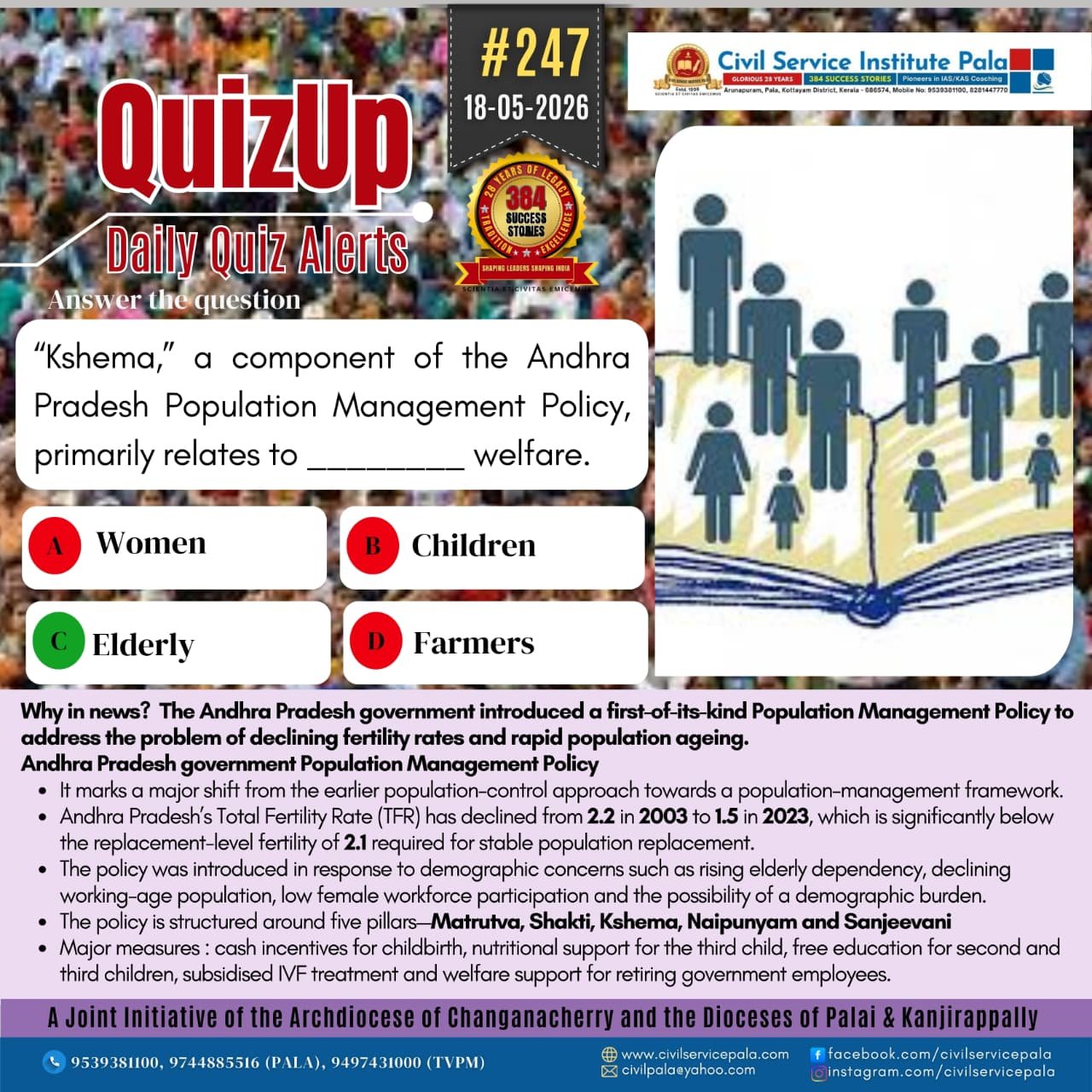
The Andhra Pradesh government introduced a first-of-its-kind Population Management Policy to address the problem of declining fertility rates and rapid population ageing.
The policy marks a major shift from the earlier “population control” approach towards a “population management” framework aimed at ensuring long-term economic sustainability, labour availability and social security.
Declining Fertility Rate
Andhra Pradesh’s Total Fertility Rate (TFR) has declined from:
2.2 in 2003
to 1.5 in 2023
The TFR is now well below the replacement level fertility of 2.1.
This means that, on average, each generation is not replacing itself fully.
Total Fertility Rate : It is the average number of children a woman is expected to have during her lifetime based on the current fertility rates of a population.
Demographic Concerns
Ageing Population
Nearly 10% of the population is above 60 years.
This is projected to rise to 23% by 2047.
The median age of the population is 32.5 years, compared to 28.4 years for the country as a whole.
Shrinking Workforce
Fewer births reduce the future working-age population which will further weaken economic productivity, industrial growth, tax revenues, and social welfare financing.
Female participation in the workforce is about 31 per cent — much lower than the 37 per cent national average.
Risk of Demographic Burden
A lower share of young population and higher elderly dependency can convert a demographic dividend into a demographic burden.
Value addition material – “A nation is not just about its land, regions, towns or borders, it is about its people.”
Major Features of the Population Policy
Cash Incentives for Childbirth
The policy introduces direct financial incentives to encourage larger families and address concerns relating to declining fertility rates. Families will receive ₹30,000 on the birth of a third child and ₹40,000 on the birth of a fourth child. To improve child nutrition and maternal care, ₹1,000 per month will be provided for five years for the nutritional support of the third child.
Five Pillars of the Population Management Policy
1. Matrutva
The Matrutva pillar focuses on maternal well-being, reproductive healthcare and safer childbirth practices in order to improve maternal and child health outcomes.
2. Shakti
The Shakti component aims to enhance female workforce participation and promote the economic empowerment of women through supportive welfare measures.
3. Kshema
The Kshema pillar concentrates on elderly welfare by strengthening old-age healthcare services and expanding social security support for senior citizens.
4. Naipunyam
Naipunyam focuses on skill development and healthcare workforce training, especially in areas relating to adolescent care, elderly care and community health services.
5. Sanjeevani
The Sanjeevani pillar seeks to strengthen digital public healthcare systems and improve the efficiency and accessibility of healthcare delivery mechanisms.
Other Major Policy Measures
Free Education Support
The policy provides free education for the second and third child in government educational institutions up to 18 years of age.
IVF Subsidy
The government proposes subsidised in-vitro fertilisation (IVF) treatment through the Public-Private Partnership (PPP) model in order to support infertile couples.
Expansion of Healthcare Workforce
The policy aims to train at least 10,000 healthcare assistants annually to strengthen the healthcare delivery system and improve public health services.
Welfare Measures for Government Employees
Government employees will receive a ₹50,000 incentive along with 15 days of leave for preventive health check-ups near the time of retirement.
Major Targets under the Policy
Reduction in C-Section Deliveries
The government aims to reduce Caesarean-section deliveries from 67.5% to below 40% by discouraging medically unnecessary surgeries and promoting healthier childbirth practices.
Reduction in Teenage Pregnancies. The policy seeks to reduce teenage pregnancies by improving reproductive awareness, maternal healthcare access and health education initiatives.
Reduction in Sterilisation Procedures
The government intends to reduce sterilisation procedures, particularly among males, indicating a shift away from the earlier population-control approach towards a population-supportive policy framework.
