



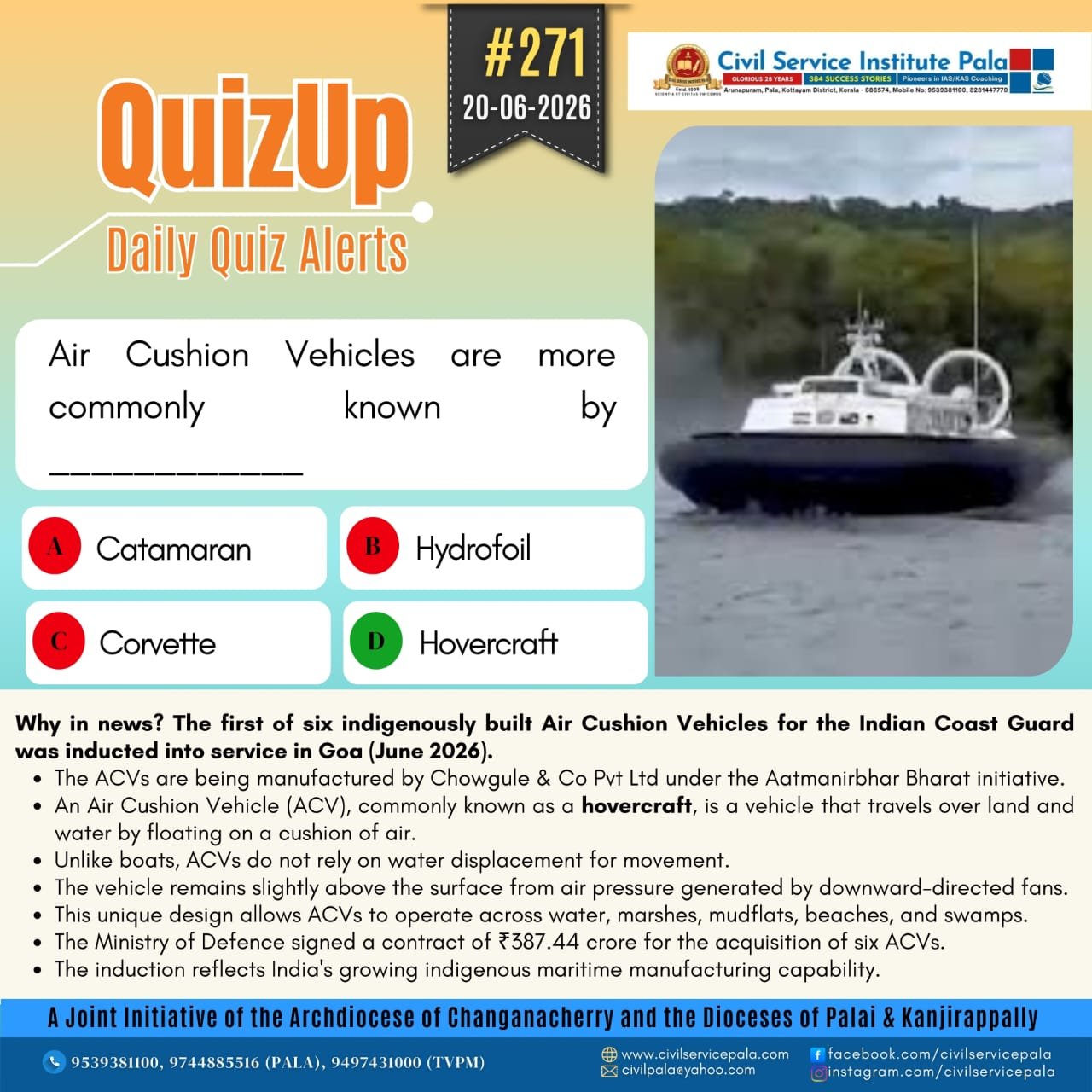
Air Cushion Vehicles
Why in News?
• The first of six indigenously built Air Cushion Vehicles for the Indian Coast Guard was inducted into service in Goa.
• The ACVs are being manufactured by Chowgule & Co Pvt Ltd under the Aatmanirbhar Bharat initiative.
• The Ministry of Defence signed a contract worth approximately ₹387.44 crore for the acquisition of six ACVs.
• The induction reflects India's growing indigenous maritime manufacturing capability.
What is an Air Cushion Vehicle?
• An Air Cushion Vehicle (ACV), commonly known as a hovercraft, is a vehicle that travels over land and water by floating on a cushion of air.
• Unlike boats, ACVs do not rely on water displacement for movement and unlike aircraft, they do not generate lift through aerodynamic flight.
• The vehicle remains slightly above the surface using air pressure generated by downward-directed fans enclosed within a flexible skirt.
• This unique design allows ACVs to operate across water, marshes, mudflats, beaches, swamps, and other difficult terrains.
Basic Principle
• An ACV creates a cushion of high-pressure air beneath its hull.
• The cushion is trapped by a flexible skirt surrounding the vehicle.
• This air cushion lifts the craft slightly above the surface, reducing friction and drag.
• Propellers or other propulsion systems move the vehicle forward.
Key Components
• The hull provides the structural framework of the vehicle.
• The skirt system helps contain the air cushion beneath the craft.
• The lift system pumps air into the plenum chamber to generate the cushion.
• The propulsion system provides forward movement and steering.
• Most modern ACVs use gas-turbine engines because of their high power-to-weight ratio.
Types of Air-Cushion Machines
Aerostatic Craft (ACV)
• These vehicles generate their own air pressure to remain suspended above the surface.
• Hovercraft belong to this category.
Ground Effect Machines (GEM)
• These vehicles require forward motion to generate sufficient air pressure.
• They rely on aerodynamic ground-effect principles for lift.
Advantages of ACVs
ACVs can travel seamlessly over land and water without changing modes of transport.
• They can operate in shallow waters where conventional boats cannot navigate.
• They can cross marshes, mudflats, wetlands, and sandy beaches with ease.
• Reduced surface friction enables relatively high-speed movement.
• They are highly suitable for rapid-response and emergency operations.
Applications of Air Cushion Vehicles
Maritime Security
• ACVs are used for coastal surveillance and maritime patrol operations.
• They support interception and interdiction missions against illegal activities.
Search and Rescue
• ACVs can rapidly reach areas inaccessible to conventional vessels.
• They are effective during floods, storms, and maritime emergencies.
Military Operations
• They are employed in amphibious assault operations and troop transport.
• Modern military hovercraft support logistics, surveillance, mine countermeasures, and anti-submarine operations.
Commercial Transport
• ACVs are used as ferries for passenger and cargo transportation over short water routes.
Survey and Scientific Activities
• They assist in seismic surveys and exploration activities in shallow water and desert regions.
Indian Coast Guard ACVs
Operational Roles
• High-speed coastal patrolling.
• Maritime reconnaissance missions.
• Interception and interdiction operations.
• Search and rescue missions.
• Assistance to vessels in distress.
• Operations across shallow waters, marshlands, and coastal regions.
Significance
• Enhances the operational reach of the Indian Coast Guard.
• Strengthens coastal security and maritime surveillance.
• Supports rapid disaster response and rescue operations.
• Promotes indigenous defence manufacturing under Aatmanirbhar Bharat.
ACV vs Boat vs Aircraft
ACV vs Boat
• Boats float by displacing water.
• ACVs hover above the surface using an air cushion.
• ACVs can operate in both water and difficult land terrains.
ACV vs Aircraft
• Aircraft generate lift through aerodynamic forces during flight.
• ACVs generate lift through pressurized air trapped beneath the hull.
• ACVs remain close to the surface rather than flying at altitude.
Strategic Importance for India
• ACVs fill an important capability gap in shallow-water and amphibious operations.
• They improve India's ability to monitor vulnerable coastal areas and estuaries.
• They strengthen maritime security in regions where conventional vessels face operational limitations.
• Indigenous production contributes to defence self-reliance and maritime industrial growth.
