



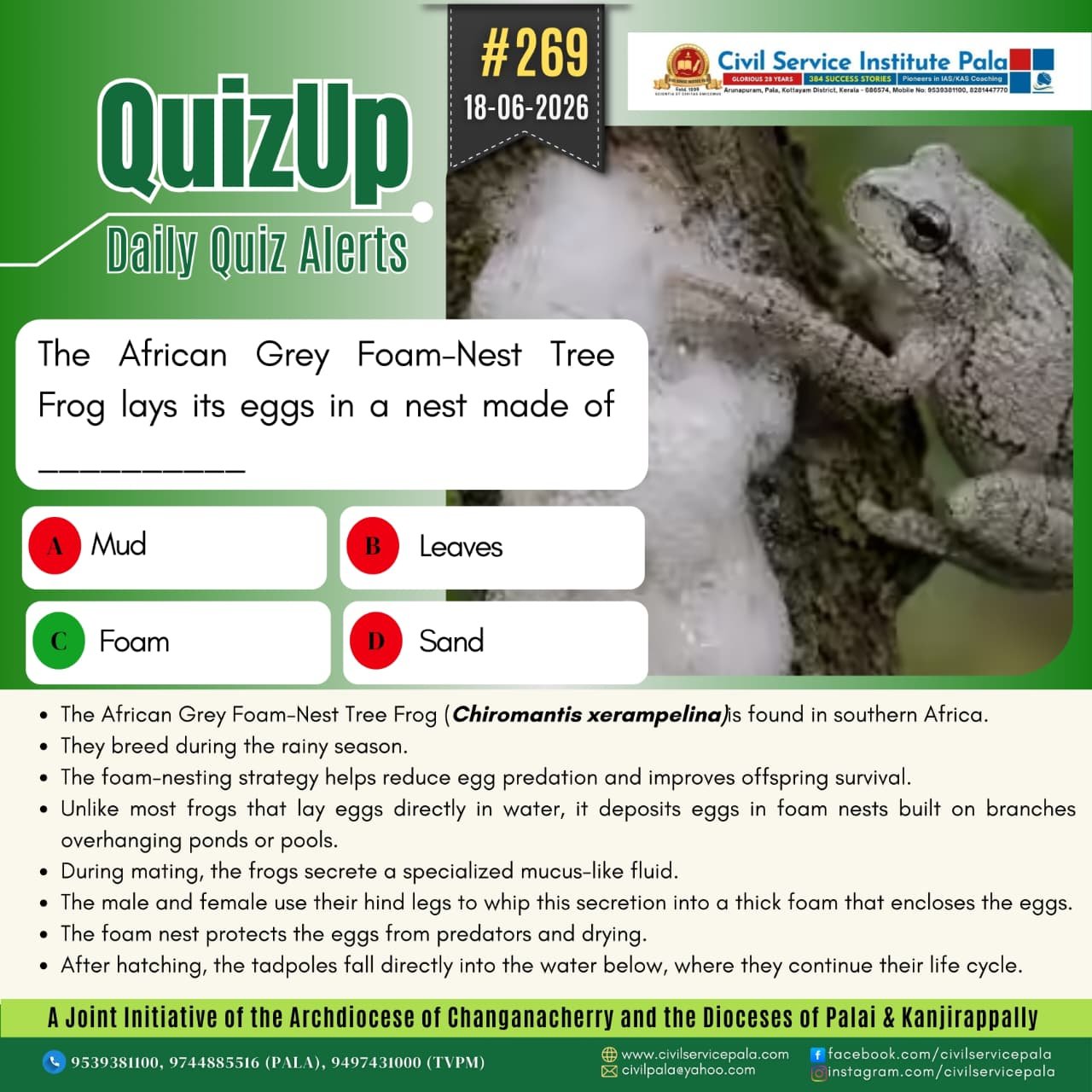
African Grey Foam-Nest Tree Frog
• The African Grey Foam-Nest Tree Frog (Chiromantis xerampelina)is found in southern Africa.
• They breed during the rainy season.
• The foam-nesting strategy helps reduce egg predation and improves offspring survival.
• Unlike most frogs that lay eggs directly in water, it deposits eggs in foam nests built on branches overhanging ponds or pools.
Foam Nest making
• During mating, the frogs secrete a specialized mucus-like fluid.
• The male and female use their hind legs to whip this secretion into a thick foam that encloses the eggs.
• The foam nest protects the eggs from predators and drying.
• After hatching, the tadpoles fall directly into the water below, where they continue their life cycle.
Why Foam Nests Matter
• Most frog eggs laid in water suffer heavy predation from fish and aquatic insects.
• Foam nests keep eggs away from many aquatic predators during the most vulnerable stage of development.
• The foam helps retain moisture and protects eggs from desiccation.
• This adaptation significantly improves the chances of survival of the offspring.
Recent Scientific Findings
• A recent study conducted in South Africa found that these frogs often build nests cooperatively rather than as isolated breeding pairs.
• A single female may be joined by numerous males during nest construction.
• Greater male participation results in larger and more durable foam nests.
• Researchers observed that nests built by multiple males can be up to three times larger than nests produced by a single pair.
Importance of Cooperative Nest Building
• Larger nests retain moisture for longer periods and reduce the risk of egg mortality due to drying.
• Cooperative nest construction increases overall reproductive success.
• DNA analysis revealed that paternity is often shared among several males participating in nest building.
• The strategy demonstrates that cooperation can enhance survival even among competing individuals.
Biological Significance
• Scientists suggest that chemicals called surfactants in the frogs' skin secretions help stabilize the foam structure.
• These compounds prevent bubbles from collapsing and maintain the integrity of the nest.
• The species provides an important example of behavioural adaptation and cooperative breeding in amphibians.
• It demonstrates how natural selection can favour innovative reproductive strategies in challenging environments.
