



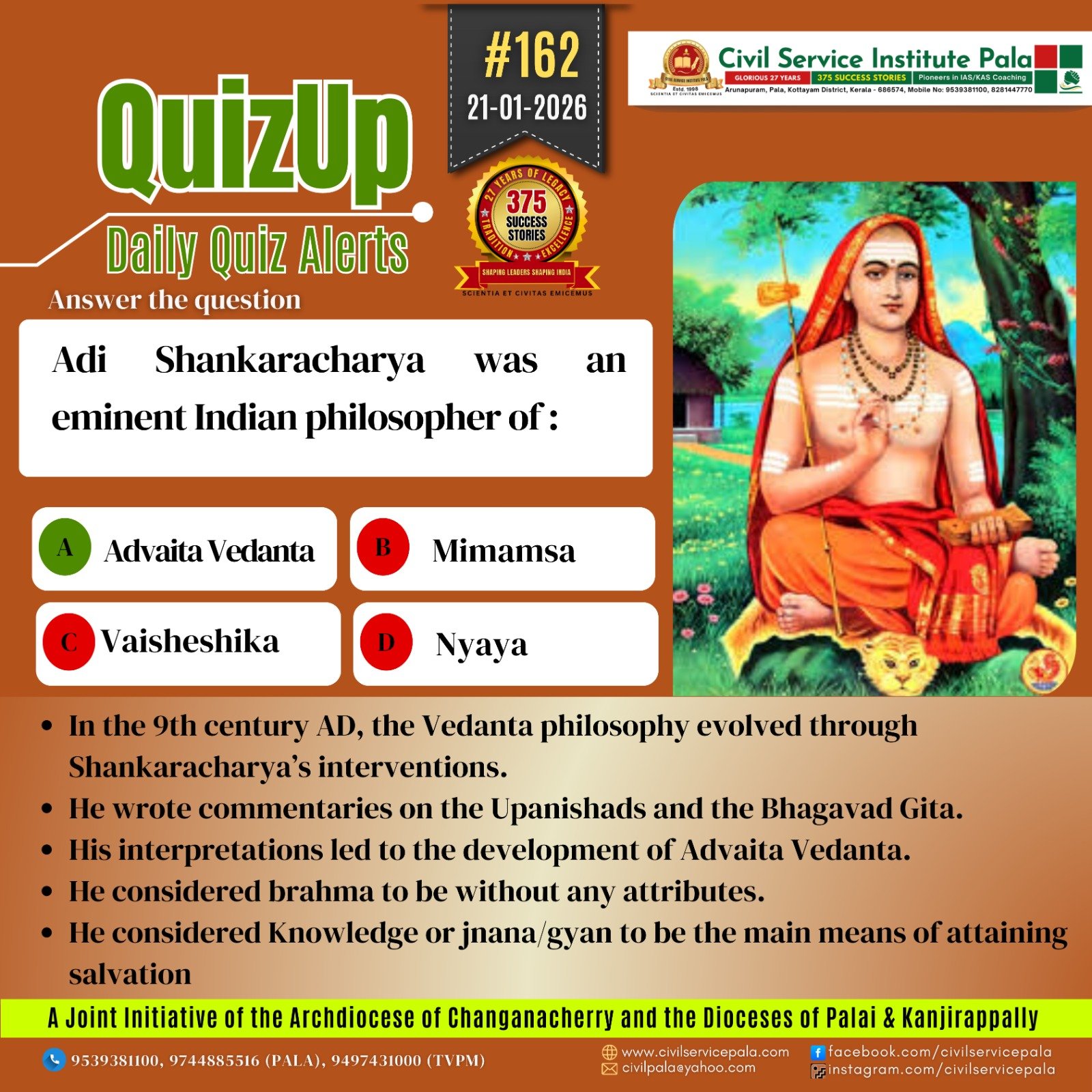
Adi Shankaracharya
In the 9th century AD, the Vedanta philosophy evolved through Shankaracharya’s interventions.
He wrote commentaries on the Upanishads and the Bhagavad Gita.
His interpretations led to the development of Advaita Vedanta.
He considers brahma to be without any attributes.
He considers Knowledge or jnana/gyan to be the main means of attaining salvation
Vedanta
The word Vedanta is made of two words: ‘Veda’ and ‘Ant’, meaning the end of the Vedas.
Vedanta school of philosophy upholds the ideas and philosophies of life as elaborated in the Upanishads.
The oldest text forming the basis of this philosophy is the Brahmasutra of Badarayana, written and compiled in the 2nd century BCE.
Brahma is the ultimate reality of life; everything else is unreal or Maya.
Atma (self or self-consciousness) is identical to Brahma.
If a person attains knowledge of the self, he automatically understands Brahma and achieves salvation.
This implies that both Atma and Brahma are eternal and indestructible.
