

Menu 
For detailed daily news analysis click on the link : https://youtu.be/QUMIk3ydSCo
Top Stories:
Context: Kerala’s KITE initiative has gained national and international attention for ethically integrating Artificial Intelligence (AI) in school education, with UNICEF recognising it as a global best practice in responsible EdTech.
What is KITE?
Kerala Infrastructure and Technology for Education (KITE) is the technology arm of Kerala’s General Education Department. It was established to integrate digital tools and AI in school education while ensuring transparency, inclusion, and teacher autonomy.
Launched by: Government of Kerala
Objective: To enable ethical, equitable, and open-source-based AI integration in public education; to empower teachers and protect student data sovereignty.
Key Features of the KITE AI Initiative:
Mass Teacher Training: Trained 80,000+ teachers (Classes 8–12) in critical AI use, including bias detection, privacy concerns, and curricular alignment.
Free and Open-Source Software (FOSS): Adopted across 15,000+ schools, ensuring autonomy, cost-effectiveness, and transparency in AI tools.
Samagra Plus AI Platform: Kerala’s own RAG-based AI engine curated by expert teachers; aligns
directly with state curriculum to avoid test-prep or bias traps.
Student-Centric Innovation: Little KITEs IT Clubs train students in robotics and AI through hands- on, contextual learning; praised by UNICEF as a global best practice.
Data Sovereignty & Bias-Resistance: By using in-house infrastructure and open datasets, KITE
avoids commercial surveillance models and ensures bias-resistant AI responses.
Central Adoption Resource Authority (CARA)
Context: The Central Adoption Resource Authority (CARA) has directed State Adoption Resource Agencies to strengthen structured counselling across pre-, during, and post-adoption stages, ensuring emotional well-being of all stakeholders.
Statutory body under the Ministry of Women & Child Development, Government of India.
Established in: 1990 and became statutory under the Juvenile Justice Act 2015.
Headquarters: New Delhi.
Mandate: Regulates, monitors, and facilitates in-country and inter-country adoption of Indian children.
International Role: Central Authority for inter-country adoption under Hague
Convention on Inter-country Adoption (1993), ratified by India in 2003.
Objectives of CARA:
Ensure ethical, transparent, and timely adoption processes.
Protect the rights of orphaned, abandoned, and surrendered children. Facilitate psychosocial support during all phases of adoption.
Key Functions of CARA:
Regulation & Accreditation: Monitors registered adoption agencies nationwide. Digital Oversight: Manages the CARINGS portal for adoption transparency.
Policy Implementation: Issues binding directions under JJ Act and Adoption Regulations.
Capacity Building: Trains adoption professionals and empanels qualified counsellors. Support Framework: Ensures counselling services for biological parents, adoptive parents, and adopted children.
Group of Friends (GoF) for Accountability of Crimes against Peacekeepers
Context: India reiterated its strong commitment to ensuring justice for crimes against UN peacekeepers at a high-level meeting of the Group of Friends (GoF) at the UN Headquarters, calling accountability a strategic necessity.
An informal platform of UN member states committed to advancing justice for crimes against UN peacekeepers and strengthening global peacekeeping norms.
Launched In: December 2022, during India’s Presidency of the UN Security Council.
Membership: Includes around 40 UN member states, co- chaired by India and like-minded countries from Asia, Africa, and Latin America.
Objectives: Promote legal and policy frameworks to prosecute crimes against peacekeepers.Ensure deterrence by addressing impunity.Uphold credibility and integrity of UN Peacekeeping Operations.
Key Functions:
Facilitate dialogue among states, UN bodies, and experts. Support investigation mechanisms and legal reforms.
Track implementation of UNSC Resolution 2589 (2021) which mandates accountability for attacks on peacekeepers.
Advocate for reports from the UN Secretary-General on progress made.
Significance:
Vital for the safety of UN peacekeepers in high-risk missions.
Reinforces trust in multilateralism and India’s leadership in peacekeeping.
Aligns with India’s legacy of contributing over 300,000 peacekeepers, the highest by any country. Safeguards operational morale and legal protections for personnel from Global South countries.
Outcomes of the July 2025 High-Level Meeting:
Strategic Framing of Accountability: India called accountability a strategic necessity, not just a legal duty—essential for peacekeeper safety and mission success.
Combatting Impunity: The GoF reaffirmed that lack of punishment fuels more attacks on peacekeepers, undermining global peace efforts.
India’s Role Reaffirmed: India showcased its historical leadership with 182 peacekeeper martyrs and
pledged continued legal, diplomatic, and moral support to the cause.
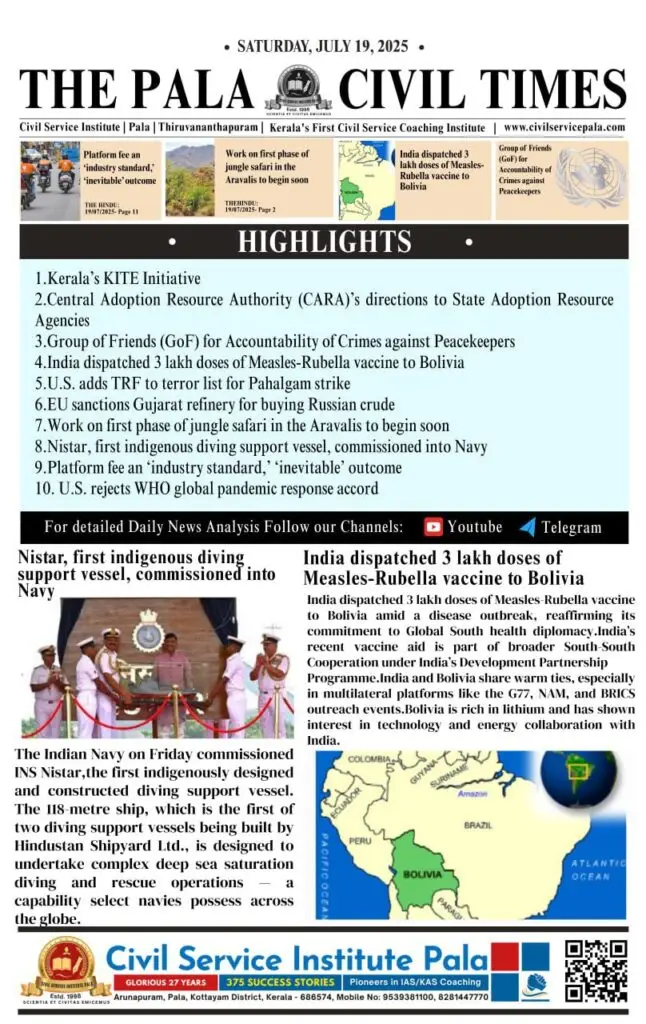
Context: India dispatched 3 lakh doses of Measles-Rubella vaccine to Bolivia amid a disease outbreak, reaffirming its commitment to Global South health diplomacy.
Location: Landlocked country in west-central South America.
Neighbours: Borders Brazil, Paraguay, Argentina, Chile, and Peru.
Physiographic Features :
Andes Mountains -Hosts Cordillera Occidental and Cordillera Oriental Altiplano Plateau , Lake Titicaca , Salt flats and part of Amazon drainage.
India’s recent vaccine aid is part of broader South-South Cooperation under India’s Development Partnership Programme.
India and Bolivia share warm ties, especially in multilateral platforms like the G77, NAM, and BRICS outreach events.
Bolivia is rich in lithium and has shown interest in
technology and energy collaboration with India.
U.S. adds TRF to terror list for Pahalgam strike
In a move that is being viewed as an endorsement of India’s international counter-terror campaign, the United States on Thursday designated The Resistance Front (TRF) as a ‘Foreign Terrorist Organisation’ and ‘Specially Designated Global Terrorist’. The TRF, backed by the Pakistan based Lashkar-e-Taiba militant group, claimed to be behind the deadly April 22 terror attack that left 26 people dead in Pahalgam.
The External Affairs Ministry added that India’s cooperation with international partners will continue to ensure “that terrorist organisations and their proxies are held accountable”.
The UN Security Council passed a resolution on the Pahalgam attack on 25 April that condemned the attack but stopped short of naming the TRF.
After Operation Sindoor that targeted terror facilities and military bases in Pakistan, India launched a global campaign by sending multi- party delegations abroad and also sent a technical team to New York to present evidence regarding the Pahalgam terror attack to the Monitoring Team of the 1267 Sanctions Committee that decides on the global listing of terrorist groups. Concerns on terrorism featured also in the 1 July Quad Foreign Ministers meeting held in Washington where a joint statement “strongly” condemned the Pahalgam attack.
EU sanctions Gujarat refinery for buying Russian crude
The European Union (EU) has sanctioned a Gujarat based refinery owned by Nayara Energy Ltd. as part of a fresh sanctions pack age announced on Friday targeting Russia’s energy sector.
The announcement comes just as the U.S. Congress debates tightening sanctions on purchasers of Russian crude oil, with India, China and Brazil being named by U.S. lawmakers as countries that could face penalties.
‘Full-fledged sanctions’ (travel bans, asset freezes, ban on providing resources) will apply to the refinery as per a statement from the EU.
The new EU sanctions also include a lowering of the oil price cap, i.e., the maximum price countries can pay for Russian oil while using shipping and insurance from the advanced economies of the G7 group of countries
As part of enhanced banking sanctions, the number of banks sanctioned and the breadth of the sanctions is set to increase and will include a total transaction ban for 45 Russian banks.
It also contains enhanced sanctions on Russia’s so-called ‘shadow fleet’ — ships that are sanctioned or transacting in sanctioned goods.
Work on first phase of jungle safari in the Aravalis to begin soon
Haryana Forest and Wildlife Minister said the work for the first phase of 10,000-acre jungle safari in
Aravalis would begin soon, adding that the project would be equipped with world-class facilities.
To be developed in an area of around 10,000 acres, the project would give a new identity to the National Capital Region in the direction of green and sustainable environment.
it would be developed in four phases.
The proposed project spread across Gurugram and Nuh districts
A group of 37 retired Indian Forest Service officers had written a letter to Prime Minister Narendra Modi earlier this year seeking to scrap the project arguing that the project’s aim was to simply increase tourist footfall and not conserve the mountain range.
Nistar, first indigenous diving support vessel, commissioned into Navy
The Indian Navy on Friday commissioned INS Nistar, the first indigenously designed and constructed diving support vessel
The 118-metre ship, which is the first of two diving support vessels being built by Hindustan Shipyard Ltd., is designed to undertake complex deep sea saturation diving and rescue operations — a capability select navies possess across the globe.
the commissioning of INS Nistar firmly reinforces the role of the Indian Navy as the “first responder” and “preferred security partner” in the region.
Supporting the indigenous shipbuilding industry has been one of the pillars of the government’s “Aatmanirbhar Bharat” campaign. At present, all of the 57 new warships in the pipeline are being constructed indigenously.
INS Nistar is installed with state-of-the-art diving equipment such as remotely operated vehicles, self propelled hyperbaric life boat, diving compression chambers.
It can under take diving and salvage operations up to 300 metres depth.
It would also serve as the “Mother Ship” for deep submergence rescue vessel to rescue and evacuate personnel, from a dived submarine in distress well below the surface
What started off as a small experiment — a ₹2 “platform fee” on Swiggy in 2023 — has now grown into an industry standard across e-com and quick com platforms alike.
The fee is no longer ₹2 either: Swiggy now charges ₹10 as a platform fee. There is GST applicable on top of this
The fees are netting relatively modest sums. Zomato said in a report for 2023 24 fiscal, the item earned ₹83 crore that year
platform fees are now being charged across all major food and grocery delivery platforms, such as BlinkIt, Swiggy, Zomato and Zepto.
Even Amazon has started charging a ₹5 ‘marketplace fee,’ something it doesn’t appear to charge users in other countries.
This fee helps us keep the app running smoothly, invest in product improvements, and continue delivering a smooth and convenient experience for users.
The fee are a “growing concern from a consumer point of view”
If it is becoming an industry standard and all players are in tandem appearing to raise prices -there is a concern around anti-competitive practices and entities and platforms acting as a cartel to raise prices for consumers.”
U.S. rejects WHO global pandemic response accord
The United States has rejected an agreement adopted by members of the World Health Organization to improve preparedness for future pandemics following the disjointed global response to COVID-19, the government said on Friday.
U.S. rejection of the legally binding pact, which was adopted in Geneva in May after three years of negotiations.
The pact aims to ensure that drugs, therapeutics and vaccines are globally accessible when the next pandemic hits.
It requires participating manufacturers to allocate a target of 20% of their vaccines, medicines and tests to the WHO during a pandemic to ensure poorer countries have access.
U.S. negotiators left discussions about the accord after President Donald Trump began a 12-month process of withdrawing the U.S. — by far the WHO’s largest financial backer — from the agency when he took office in January. Its exit means the
U.S. would not be bound by the pact.
Copyright © 2022 All Rights Reserved | Design by Insolutes

