Daily News – 23-08-2025
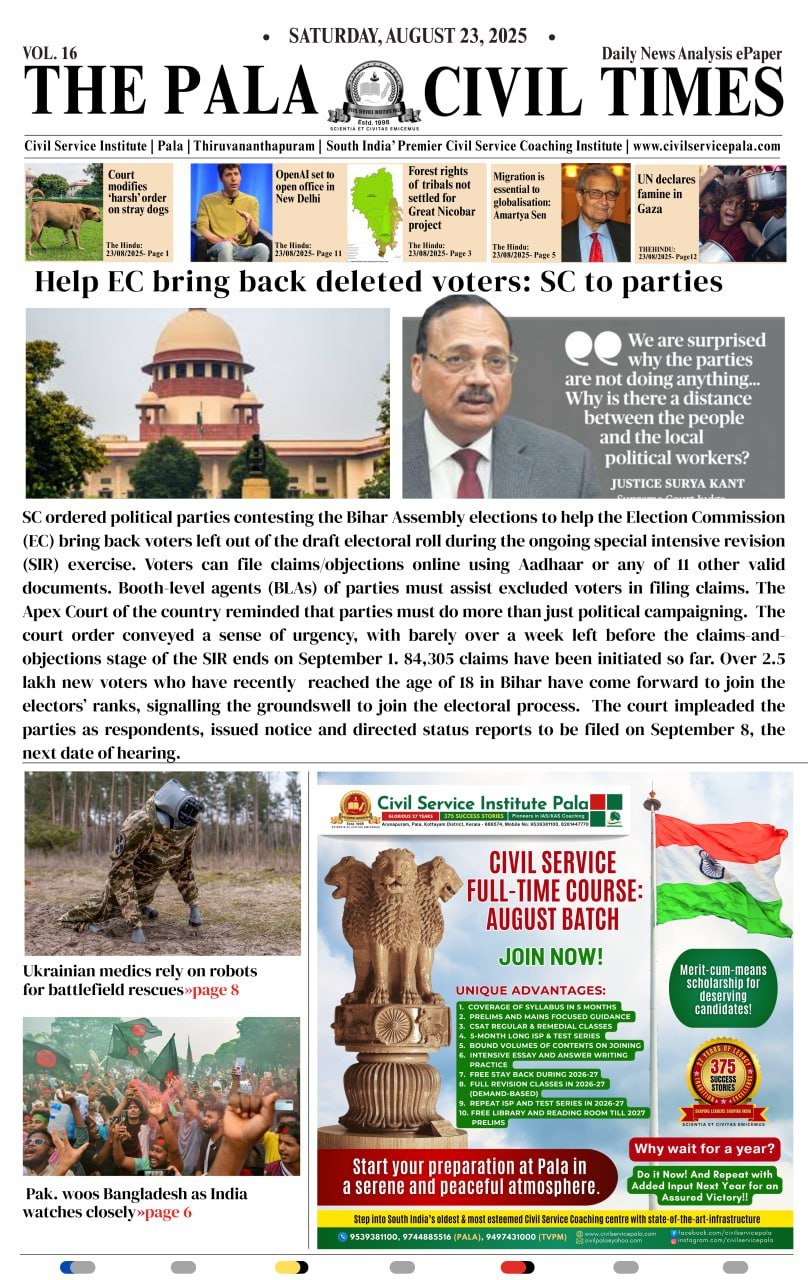
Help EC bring back deleted voters: SC to parties
SC ordered political parties contesting the Bihar Assembly elections to help the Election Commission (EC) bring back voters left out of the draft electoral roll during the ongoing special intensive revision (SIR) exercise. Voters can file claims/objections online using Aadhaar or any of 11 other valid documents. Booth-level agents (BLAs) of parties must assist excluded voters in filing claims. The Apex Court of the country reminded that parties must do more than just political campaigning. The court order conveyed a sense of urgency, with barely over a week left before the claims-and- objections stage of the SIR ends on September 1. 84,305 claims have been initiated so far. Over 2.5 lakh new voters who have recently reached the age of 18 in Bihar have come forward to join the electors’ ranks, signalling the groundswell to join the electoral process. The court impleaded the parties as respondents, issued notice and directed status reports to be filed on September 8, the next date of hearing.
Chendamangalam’s famed handloom industry battles crisis ahead of Onam
- Onam Demand: Customers prefer authentic ethnic wear for Onam, keeping demand for Chendamangalam handloom intact.
- Crisis in Industry: Despite demand, the industry is facing a crisis due to a steep decline in the number of weavers.
Declining Workforce:
- Earlier, around 5,000 weavers worked in the region. Now, only about 500 remain.
Reasons for Decline:
- Employment guarantee programme lures workers away.
- Widespread belief that handloom wages are very low discourages the younger generation.
Financial Strain:
- Cooperative societies like Hantex (Kerala State Handloom Weavers’ Co-operative Society) face severe financial issues.
- They are unable to pay dues worth lakhs, struggling with loan interests, and sinking into deeper crisis.
Adaptation Challenges:
- Although cooperatives are willing to adapt, survival is difficult without proper financial support and policy measures.
- The government reiterated that it is taking significant steps to keep Kerala’s traditional handloom sector abreast of the times through innovation, quality assurance and modernisation.
- The handloom industry is one of Kerala’s oldest traditional sectors, with its presence concentrated in Thiruvananthapuram and Kannur, and also spread across Kozhikode, Palakkad, Thrissur, Ernakulam, Kollam, and Kasaragod.
- The only silver lining has been the Handloom Uniform Project — an initiative that supplies handloom school uniform cloth to students of government and aided schools.
PRELIMS CORNER :
1. The Munshi–Iyengar formula, often
mentioned in the context of the Constituent Assembly debates, is associated with:
(a) Division of powers between the Union and the States
(b) Drafting of the Preamble to the Constitution
(c) Adoption of the official language of the Union
(d) Safeguards for minorities in the
Constitution
2. Which of the following tree species is most likely to be found in the tropical moist deciduous forest in India?
(a) Mahogany
(b) Mahua
(c) Bel
(d) Palas
3. Which of the following constitutional office holders can continue to hold office even after the expiry of their term, until their successor assumes charge?
1. President of India
2. Vice-President of India
3. Governor of a State
Select the correct answer using the code
given below:
(a) 1 and 2 only
(b) 2 and 3 only
(c) 1 and 3 only
(d) 1, 2 and 3
Forest rights of tribals not settled for Great Nicobar project: council
The conflict is essentially about whether tribal forest rights under FRA were properly settled before granting clearance for the mega project.
Great Nicobar Project:
- Proposed ₹72,000 crore infrastructure project includes a transshipment port, airport, power plant, and township.
- Requires diversion of nearly 13,075 hectares of forest land.
Council’s Complaint:
- The Andaman & Nicobar Islands administration allegedly gave a false report to the Centre.
- Claimed that tribal rights under the Forest Rights Act (FRA), 2006 were already “identified and settled.”
- Local tribal council (Little Nicobar and Great Nicobar) disputes this claim.
Certificate Controversy:
- Administration issued a certificate in Aug 2022 stating FRA rights were settled and Gram Sabha consent obtained.
- Council says consent was taken only after diversion decision, without proper tribal involvement.
- Gram Sabha meeting on Aug 12, 2022, approved diversion, but Great Nicobar’s council was not included.
Council’s Concerns:
- Loss of forest land affects vulnerable tribal communities.
- False representation bypassed proper FRA consent process.
- Tribals are pressing Union Tribal Affairs Minister Jual Oram to intervene.
Centre’s Stand:
- Maintains that due process was followed under FRA and PAT56 (Protection of Aboriginal Tribes Act, 1956).
- Claims FRA settlement done for 121.87 sq. km protected forest area, including 8.8 sq. km deemed forest.
Council’s Position:
- Says FRA process is incomplete and their concerns are being ignored.
- Exploring legal/political options if Minister does not respond.
Court modifies ‘harsh’ order, allows release of stray dogs
Supreme Court’s Earlier Order (Aug 11):
- Required civic authorities in Delhi and four adjoining districts to capture all stray dogs and confine them in shelters within 6–8 weeks.
- Was criticized as “too harsh.”
Modified Order (Aug 23):
- Dogs must undergo sterilisation, deworming, and immunisation before being released back into their localities.
- Aggressive or rabid dogs, or those suspected of rabies, will not be released.
- Stray dogs should ideally be housed separately in shelters post-treatment, but can be returned to the streets after sterilisation and vaccination.
Feeding & Public Safety:
- Court directed authorities to set up dedicated feeding zones in each ward to avoid public inconvenience.
- A dedicated helpline must be established for reporting violations.
- Unregulated feeding had earlier caused difficulties for common people.
Animal Adoption:
- Animal lovers can adopt strays through the municipal body.
- Responsibility lies with adopters to ensure dogs don’t return to streets.
National Policy:
- Court expanded the matter beyond Delhi-NCR, treating it as a pan-India issue.
- Ordered the involvement of Secretaries of all States and Union Territories to frame a uniform national stray dog policy.
Implementation & Enforcement:
- Civic bodies must take strict measures against NGOs/individuals violating rules.
Context & Opposition:
- Earlier directives faced strong opposition from animal rights activists and welfare organisations.
- Concern: Capturing 8 lakh stray dogs in Delhi-NCR would cause logistical chaos and possible cruelty.
Migration is essential to globalisation: Amartya Sen
Amartya Sen on Migration:
- Migration is essential to globalisation and has been a major driver of progress and advancement throughout history.
- Diversity from migration has been the bedrock of Indian society and contributed to its growth.
- Migration fosters interaction, collaboration, and cultural enrichment across communities.
Historical Example:
- Brahmagupta’s book on mathematics was translated into Arabic six times.
- Migration enabled exchange of languages, ideas, culture, science, and other collaborative endeavours (food, music, trade, etc.).
Current Context:
- Comments come amid recent attacks on migrants in West Bengal and other states.
- Criticism of Electoral Revision (SIR):
- Special Intensive Revision (SIR) of electoral rolls may deprive many people of voting rights, as many in India lack documents.
- Could create multiple problems for migrants and disadvantaged groups.
Sen’s Stand on Equality:
- Argued that equal rights for all should be the guiding principle of policies.
- Discrimination based on caste, class, language, religion, or gender must not affect rights.
- Emphasised that diversity is India’s strength and should be celebrated, not undermined.
Draft UGC curriculum puts focus on ‘ancient wisdom’
UGC’s Draft Curriculum Framework (LOCF):
- Released for subjects including anthropology, commerce, economics, geography, home science, mathematics, chemistry, physical education, and political science.
- Stresses inclusion of Indian knowledge systems in higher education.
Content Highlights:
- Mathematics: Explore contributions of Indian mathematicians (arithmetic, algebra, geometry, calculus).
- Commerce: Incorporate Bharatiya philosophy and holistic approaches from the ancient Gurukul system, emphasizing ethical and sustainable business practices (e.g., Kautilya’s Arthashastra).
- Economics: Teach Indian concepts of prosperity, dharmic thought, king’s role in economy, trade ethics, guild codes, agrarian values, dana, and indigenous exchange systems.
- Chemistry: Include traditional beverages and preparation methods (kanji, mahua); ancient fermentation techniques; atomic concepts from Indian knowledge alongside modern theories.
- Anthropology: Highlight Indian thinkers like Charaka, Sushruta, Buddha, and Mahavira on symbiotic human–nature relations.
Teaching Methods & Approaches:
- Use of Mandala geometry, yantras, rangoli, kolam as algorithmic art forms.
- Inclusion of Itihasa-Purana (e.g., V.D. Savarkar’s Indian War of Independence) in political science.
- National Education Policy promotes multidisciplinary, holistic education.
Criticism & Concerns:
- Opposition from some academics and non-BJP- ruled states.
- Concerns over “saffronisation” of education and prioritisation of single-major pathways limiting interdisciplinary studies.
U.S. Federal Reserve opens door to cuts, but non- committal
- Context: U.S. Federal Reserve Chair Jerome Powell spoke at the Fed’s annual conference in Jackson Hole, Wyoming.
- Possible Rate Cut: Powell hinted at a potential interest rate cut in the Fed’s September meeting but did not commit.
- Jobs Risk: He acknowledged increasing risks to the job market, citing a slowdown in both labor supply and demand.
- Inflation Concerns: Risks of higher inflation remain, with tariffs possibly fueling more lasting inflation pressures.
- Balance of Risks: The labor market slowdown presents downside risks, and if they escalate, they could worsen quickly.
- Policy Approach: Powell emphasized a cautious approach — balancing inflation risks with labor market stability.
- Non-Committal Stance: While keeping the option of cuts open, Powell stressed the need for flexibility and careful monitoring before making policy changes.
OpenAI set to open office in New Delhi
OpenAI’s Expansion in India:
- OpenAI will open its first office in India, located in New Delhi.
- An Indian entity, OpenAI India Private Limited, has been registered.
Reason for Entry:
- Reflects OpenAI’s support for the Indian government’s IndiaAI mission.
- Commitment to collaborate with the government to build AI solutions “for India, with India.”
India’s Importance for OpenAI:
- India is OpenAI’s second-largest market after the U.S. in terms of users.
- Rapidly growing adoption among students, educators, professionals, startups, and developers.
CEO Sam Altman’s Role:
- Decision follows Sam Altman’s visits to India as part of his Asia tour.
- Marks OpenAI’s first major entry into India.
Hiring & Team Setup:
- OpenAI has already started hiring in India, including a dedicated local team.
- Currently, three job openings (sales- focused) have been listed.
Office Location:
- Exact office site in New Delhi yet to be confirmed.
- OpenAI is formally entering India by opening a New Delhi office, citing India’s huge user base and growth potential, while aligning with the government’s AI vision.
Decades after 1971 conflict, Pak. woos Bangladesh as India watches closely
- Background: The 1971 war led to Bangladesh’s independence after Pakistani troops killed millions and caused widespread atrocities.
- Current Development: Pakistan’s Foreign and Trade Ministers visited Dhaka, marking the highest-level Pakistani visit in years, aiming to reset strained relations.
- Bangladesh’s Stance: Dhaka balances pragmatism with caution, mindful of the atrocities of 1971 and India’s long-standing role as a key partner.
- India’s Interest: Analysts note India is watching closely, as Pakistan courting Bangladesh could affect regional strategic balance.
- Cultural Ties: Shared love for cricket, music, and food strengthens informal people-to-people links despite political divides.
Challenges to Reconciliation:
- Bangladesh continues to demand an apology from Pakistan for the 1971 killings.
- Survivors and academics stress that relations cannot fully normalize without acknowledgment of genocide.
- Many see Pakistan’s past denial of atrocities as a barrier to trust.
Strategic Implications:
- Pakistan seeks stronger trade and government- to-government ties with Bangladesh.
- Analysts view Pakistan’s outreach as partly driven by shifting regional geopolitics, especially tensions with India.
- Skepticism: Experts believe reconciliation remains unlikely without Pakistan addressing the 1971 legacy.
- Outlook: With Bangladesh elections approaching, and India’s interests deeply tied, any warming of Dhaka-Islamabad ties will be closely scrutinized.
UN declares famine in Gaza, blames Israel for ‘systematic aid obstruction’
- UN Declaration: The UN officially declared a famine in Gaza, blaming Israel for “systematic obstruction of aid.”
- Scale of Famine: Around 500,000 people in Gaza governorate (one-fifth of the territory) are affected; famine could expand to cover two-thirds of Gaza.
- Israel’s Response: Israel rejected the UN report, calling it based on “Hamas lies” and insisted on continuing its military operations in Gaza.
- Humanitarian Crisis: UN agencies and aid groups warned of famine due to Israel’s severe restrictions and occasional cut-off of aid during its war with Hamas.
- Consequences: Over half a million people face starvation, destitution, and death after 22 months of conflict.
- Aid Access Issues: Israel completely banned aid from Gaza for two months in early March, worsening shortages of food, medicines, and fuel.
- UN Position: Aid chief Tom Fletcher said the famine was preventable, but systematic obstruction blocked aid.
- War Crimes Allegation: UN human rights chief Volker Turk stated that using starvation as warfare may amount to a war crime.
- Calls for Ceasefire: UN Secretary-General António Guterres urged for an immediate ceasefire, stressing accountability.
- Israel’s Threats: Defence Minister Israel Katz threatened to destroy Gaza City if Hamas does not agree to conditions for ending the war.
Prelims Corner: Explanations
Q1. Ans c
Munshi-Ayyangar formula is a compromise reached during the drafting of the Indian Constitution concerning the official language of the Union. It led to the adoption of Hindi in the Devanagari script as the official language, while also allowing English to continue as an associate official language for 15 years. As part of the Munshi-Ayyangar formula, Article 343 of the Constitution was adopted.
Q2. Ans b
Tropical moist deciduous forests are more pronounced in the regions that record rainfall between 100-200 cm. These forests are found in the northeastern states along the foothills of the Himalayas, the eastern slopes of the Western Ghats and Odisha. Teak, sal, shisham, hurra, mahua, amla, semul, kusum, and sandalwood etc. are the main species of these forests.
Q3. Ans d
Article 56(1) in Constitution
of India states that the President shall, notwithstanding the expiration of his term, continue to hold office until his successor enters upon his office.
Article 67(c) in Constitution of India states that a Vice-President shall, notwithstanding the expiration of his term, continue to hold office until his successor enters upon his office.
As per Article 156, a Governor shall hold office for a term of five years from
the date on which he enters upon his office. Provided that a Governor shall, notwithstanding the expiration of his term, continue to hold office until his successor enters upon his office.
Case Study:
Ukrainian medics are thinking out of the box. The excruciating helplessness has forced medics to get creative in their work. Evacuation robots are part of the solution, but only skilled operators can carry out delicate missions. The robots are slow, which means Russian drones can easily locate and target them, that is, if they don’t hit mines. The proliferation of cheap but deadly drones deployed by Russian and Ukrainian forces has irreversibly changed how the war is being waged. Ukrainian medics rely on a combination of aerial and ground robots for battlefield rescues, particularly in situations where it’s too dangerous for human evacuation, to deliver crucial supplies like blood, and to gather intelligence on enemy positions. These robotic systems, which include platforms like Milrem’s Themis and Ukrainian-developed Ardal robots, can carry payloads, navigate dangerous terrain, and gather information without risking human lives, although human intervention remains necessary for complex operations and in cases of