Daily News – 22-08-2025
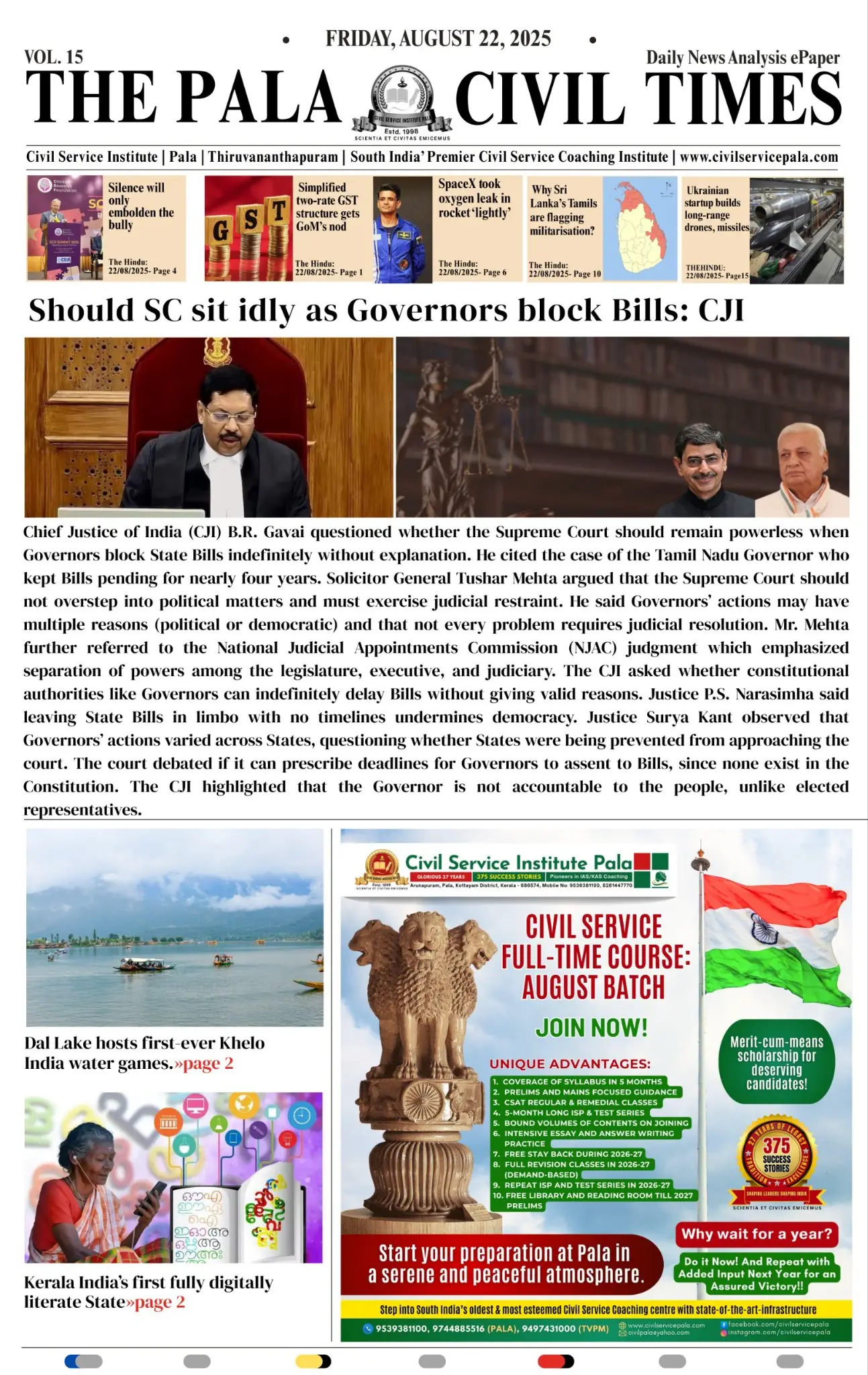
Should SC sit idly as Governors block Bills: CJI
Chief Justice of India (CJI) B.R. Gavai questioned whether the Supreme Court should remain powerless when Governors block State Bills indefinitely without explanation. He cited the case of the Tamil Nadu Governor who kept Bills pending for nearly four years. Solicitor General Tushar Mehta argued that the Supreme Court should not overstep into political matters and must exercise judicial restraint. He said Governors’ actions may have multiple reasons (political or democratic) and that not every problem requires judicial resolution. Mr. Mehta further referred to the National Judicial Appointments Commission (NJAC) judgment which emphasized separation of powers among the legislature, executive, and judiciary. The CJI asked whether constitutional authorities like Governors can indefinitely delay Bills without giving valid reasons. Justice P.S. Narasimha said leaving State Bills in limbo with no timelines undermines democracy. Justice Surya Kant observed that Governors’ actions varied across States, questioning whether States were being prevented from approaching the court. The court debated if it can prescribe deadlines for Governors to assent to Bills, since none exist in the Constitution. The CJI highlighted that the Governor is not accountable to the people, unlike elected representatives.
Dal Lake hosts first-ever Khelo India water games with eye on Olympics
Event Launch:
- Dal Lake in Srinagar hosted the first-ever Khelo India Water Sports Festival.
- Events include rowing, kayaking, and canoeing categories.
Participation:
- 409 athletes from 36 States and Union Territories are competing.
- Competitions will award 24 gold medals over the next three days.
- Of the total participants, 202 are female athletes.
State Representation:
- Largest contingents sent by:
- Madhya Pradesh (44 athletes)
- Haryana (37), Odisha (34), Kerala (33).
Olympic Focus:
- Aim: to boost India’s performance in water sports at the Olympics.
- Water sports have 16 medal events in the Olympics, making them crucial for India’s medal prospects.
Expert View:
- Bilquis Mir, India’s first jury member in the Olympics (2025), said Dal Lake’s waters offer conditions similar to Europe, making it ideal for training and talent development.
Significance of Event:
- First consolidated open-age category championship under Khelo India.
- Covers all 14 kayaking and canoeing events and 10 rowing events that feature in the Olympics.
‘Kerala India’s first fully digitally literate State’
Historic Achievement:
- Kerala has been declared the first fully digitally literate state in India.
- Announcement made by Chief Minister Pinarayi Vijayan.
Digi Kerala Project:
- The achievement marks the completion of Phase 1 of the Digi Kerala project, a grassroots- level initiative to bridge the digital divide.
- The project involved training people across all local bodies.
Survey Findings:
- Surveys covered 1.5 crore people from 83.46 lakh families in Kerala.
- 21.88 lakh people were identified as digitally illiterate.
- Out of this, 21.87 lakh people (99.98%) completed the training and passed the evaluation.
Symbolic Event:
- CM Vijayan interacted via video call with 104- year-old M.A. Abdullah Moulavi Baqavi, one of the oldest students trained under the project.
National Model:
- The CM said Kerala has set a model for the rest of the country in digital literacy.
- To ensure continuity of digital literacy, the second phase of the Digi Kerala will also include training to identify and prevent cybercrimes and misuse of social media, he said.
- “At present, around 9,000 government services have been made available online. In addition, services are being provided through K-SMART. Citizens can now obtain documents such as birth and income certificates, and even file police complaints, without having to visit offices. NRIs too can access services without having to travel home. This is the real Kerala Story,” he added.
Silence will only embolden the bully
China’s Stand with India:
- Chinese Ambassador to India, Xu Feihong, said China will “firmly stand” with India to uphold World Trade Organization (WTO) principles.
- He criticized the U.S. tariffs on Indian goods (50% tariffs, including 25% on Indian steel and penalties on Russian oil imports).
Criticism of the U.S.:
- Xu called the U.S. a “bully” in trade, accusing it of using tariffs as a bargaining chip to extract unfair prices.
- Warned that “silence or compromise only emboldens the bully.”
SCO Summit Context:
- Comments come ahead of the Shanghai Cooperation Organisation (SCO) Summit in Tianjin on September 1.
- Indicated likely criticism of the U.S. at the summit.
India-China Relations:
- Xu pushed for better bilateral ties after the four- year military standoff at the Line of Actual Control (LAC).
- Pointed to recent improvements in ties since the Modi-Xi meeting in 2024 (e.g., more visas, high- level engagements, re-opening of Kailash Mansarovar Yatra).
- Said bilateral trade crossed $75 billion in 2025, a 10% rise from the previous year.
Terrorism Remarks:
- On India’s concerns about China’s support to Pakistan, Xu said “Pakistan is also a victim of terrorism”, urging joint efforts against terrorism— remarks unlikely to be welcomed positively by India.
Future Engagements:
- Emphasized the 10-point consensus from Modi- Wang discussions, including an early agreement for border management.
42,000 Myanmar nationals mapped since December 2024: Assam Rifles
- 42,000 Myanmar nationals mapped: Since December 2024, around 42,000 Myanmar nationals have been mapped after entering India through border points.
- Border states affected: Most of them stay temporarily in Arunachal Pradesh, Manipur, Mizoram, and Nagaland, then return to Myanmar.
- FMR Policy: The Free Movement Regime (FMR) allows cross-border movement due to ethnic and familial ties. After the revised policy, individuals are now being mapped with biometrics and other measures.
- Lt. Gen. Vikas Lakhsera’s statement: He clarified that mapping began only after the revised FMR policy came into effect.
- Misrepresentation issue: A video of his speech was misrepresented as suggesting that 42,000 people had entered only Manipur, but Assam Rifles clarified it referred to overall mapping.
- Data sharing: The mapped data is being shared with all government agencies.
Changes in free movement limits:
- Originally 40 km under the 1968 FMR. Reduced to 16 km in 2004.
- Further reduced to 10 km less than a year ago. The FMR was established in 2018 as part of
- India’s Act East policy, promoting cross-border movement up to 16 km without a visa.
- It aimed to facilitate local border trade, improve access to education and healthcare for border residents, and strengthen diplomatic ties.
- Concerns have arisen about the influx of illegal immigrants, particularly the Chin, Naga communities and Rohingyas from Myanmar, potentially straining resources and impacting local demographics.
- The porous border facilitates the illegal movement of drugs and weapons, posing a threat to internal security to India and fueling crime.
Simplified two-rate GST structure gets GoM’s nod, awaits Council’s approval
- GoM approval: The Group of Ministers (GoM) on Rate Rationalisation has approved a simplified two-rate GST structure and will recommend it to the GST Council.
Proposed GST slabs:
- Current four main slabs: 5%, 12%, 18%, 28%.
- Proposal: retain 5% and 18% slabs, merge 12% into 5%, and 28% into 18%.
Impact:
- 99% of items in the 12% slab to move to 5%.
- 90% of items in 28% slab to move to 18%.
- Remaining items in 28% slab to be taxed at 40%.
Implementation:
- This is the first of two steps in GST rationalisation.
- Final approval to come from the GST Council.
Effective GST rate:
- Declined from 14.4% in May 2017 to 11.6% in Sept 2019.
- Expected to fall further to 9.5% by FY26–27 (SBI Research).
Concerns & suggestions:
- States to be compensated for revenue loss.
- Need for “careful calibration” to preserve revenue neutrality and avoid inflationary pressures.
Expected benefits:
- Relief for households and MSMEs.
- Supports broader agenda of growth and financial inclusion.
- Builds confidence in India’s domestic consumer base.
GST is the biggest revenue source for States. Any shock in GST rates will affect their fiscal health. The impact of the Centre’s proposed new GST structure (two rates: 18% and 5%) needs careful assessment.
Proposals developed outside the GST consultation forum leave States in the dark about how their revenues will be protected. GST’s shift from origin-based to destination based taxation has altered long-term revenue trajectories for several States. Some States face significant fiscal stress due to this structural change.
PRELIMS CORNER :
1. During the World War II, Indian soldiers fought heroically in the Battle at Monte Cassino. Where is Monte Cassino located?
(a) Poland
(b) Italy
(c) Germany
(d) Greece
2. The responsibility of preparation of electoral rolls in India rests with:
(a) The Parliament
(b) The Local Administration
(c) The Election Commission
(d) The Returning Officer
3. The Rhisotope Project, which involves injection of radioactive material into the horns of live rhinoceros to curb poaching, is launched by the:
(a) International Union for Conservation of Nature (IUCN)
(b) Government of Assam
(c) Government of South Africa
(d) World Wide Fund for Nature (WWF)
4. Recently, a species having the largest genome in the world has been identified. The size of its genome is about 350 feet, which is more than 50 times the size of the human genome. Which of the following species is being referred to in the text?
(a) Indo-Burmese Pangolin
(b) Paris japonica
(c) New Caledonian fork fern
(d) Curcuma kakchingense
Lawfare politics: Federal principles must not be undermined in the name of probity
Proposed Bills:
- Three bills introduced aim to ensure probity and accountability for Prime Minister, Chief Ministers, and Ministers.
- Ministers could lose their position if convicted of offences punishable with 5+ years imprisonment, but regain it upon acquittal.
Concerns:
- Opposition fears these proposals may concentrate power with the Centre.
- Investigating agencies (ED, CBI) are under Central control, raising doubts about fairness.
- While the law technically applies to the PM too, in reality, central agencies have acted mostly against Opposition leaders.
Political misuse risk:
- History shows Opposition leaders have often been arrested, while no sitting PM has ever been targeted.
- Pattern suggests laws could be used as political weapons to disempower rivals.
Judicial and legal issues:
- Harsh provisions in laws like PMLA and UAPA make getting bail difficult.
- Increasing judicial indifference to granting bail adds to misuse risks.
- Corruption must be tackled, but not at the expense of justice and federal principles.
Federalism concerns:
- Moves seen as attempts by Centre to control State Governments.
- Proposals undermine the balance of power in federal democracy.
Way Forward:
- While corruption is harmful, fighting it cannot come at the cost of justice, fairness, and federal principles.
- New proposals seem more like a tool to empower Centre politically than genuine reforms
- The statement of objects and reasons emphasizes that elected representatives are expected to act for public interest and welfare, and their conduct should be above suspicion.
- Arrests and detentions in serious criminal cases can harm constitutional trust and good governance.
- There is currently no constitutional provision for removal of a minister arrested and detained for serious criminal offences; hence, amendments to Articles 75, 164, and 239AA are proposed.
Axiom-4 learnings will help train for Gaganyaan: ISRO chief
- ISRO Documentation: ISRO prepared a 4,000-page document on the experiences of Group Captain Shubhanshu Shukla and astronaut Prashanth B Nair during the Axiom-4 mission.
- Purpose: The learnings will be applied to train astronauts for India’s Gaganyaan programme.
- Real space experience offers lessons that cannot be fully understood from training alone.
Mission Challenges:
- A leak in the rocket’s fuel line before launch delayed the mission.
- Leak was considered dangerous as it could cause catastrophic failure.
Incident:
- ISRO chief V. Narayanan revealed that SpaceX initially took a pre-launch oxygen leak in Falcon 9 rocket lightly during Axiom-4 mission.
- Leak was found in the oxidiser line of one of the engines.
ISRO’s insistence:
- ISRO pushed for a full-fledged test, which revealed the leak was actually a crack in the fuel line.
- Without this, the mission could have faced a catastrophic failure.
Mission impact:
- Axiom-4 mission, carrying Indian astronaut Group Captain Shubhanshu Shukla, was supposed to launch on June 11, 2024, but postponed due to the leak.
- After detection, the Falcon team was asked about the location and oxygen leak rate, but they initially couldn’t provide clear answers, citing “confidential” data.
- ISRO insisted on proper correction and tests before proceeding.
Outcome:
- Leak was repaired on June 12, and subsequent tests satisfied ISRO’s safety requirements.
- Mission successfully launched, sending Shukla to the ISS.
ISRO’s experience:
- Narayanan highlighted ISRO’s 40 years of experience with liquid engines.
- He stressed that cracks in the fuel line cannot be ignored as vibrations during launch could cause catastrophic failure.
Collaboration:
- The incident showcased ISRO’s technical expertise and insistence on safety standards.
- ISRO, NASA, and SpaceX collaborated closely to ensure mission success.
Ukrainian startup builds long- range drones, missiles to take war to Russia
Ukraine is compensating for its resource disadvantage by innovating domestically, producing long-range drones and missiles. Startups like Fire Point demonstrate Kyiv’s determination to strike deep into Russia, reducing reliance on Western supplies and showcasing self-sufficiency and asymmetric warfare.
Ukraine’s Defence Innovation Push:
- Ukraine is becoming a global hub for defence innovation, developing long-range drones and cruise missiles.
- Goal: To match or outmuscle Russia’s capabilities and achieve greater battlefield advantage.
Fire Point Startup:
- Ukrainian company Fire Point is mass-producing drones and developing missiles.
- Drones can travel up to 1,600 km (1,000 miles).
- Working on a cruise missile capable of traveling 3,000 km (1,864 miles).
- Aims to mass-produce drones by year-end.
Self-Sufficiency:
- Ukraine shifting from reliance on foreign defence supplies to domestic production.
- Western allies reluctant to provide long-range strike weapons, pushing Ukraine to innovate on its own.
- President Volodymyr Zelensky stresses need for independence in weapons production.
Drone Development & Design:
- Designed by founders with no defence background
- — drawing from architecture, construction, and game design.
- Drones don’t need airfields for launch, increasing survivability.
- Production goal: 100 drones per day at ~$50,000 each.
Battlefield Impact:
- Long-range drones used to hit ammunition depots, oil refineries, power plants inside Russia.
- Poses new threat to Russia’s military supply lines and economy.
- Drones designed to evade Russian air defences and electronic warfare.
Strategic Context:
- Seen as Ukraine’s asymmetric advantage since Russia outnumbers Ukraine in manpower and resources.
- U.S. and NATO hesitant to provide longer-range strike weapons directly, leaving Ukraine to build its own.
Future Prospects:
- These technologies may reshape global defence markets after the war.
- European officials believe Ukraine could emerge as a major weapons producer.
China, Pakistan Foreign Ministers agree to launch new economic corridor projects
China-Pakistan Cooperation:
- China and Pakistan pledged to expand economic cooperation and investment under the China-Pakistan Economic Corridor (CPEC), part of China’s Belt and Road Initiative (BRI).
- New projects will be launched through the CPCC (CPEC Joint Cooperation Committee).
Meeting Details:
- Chinese Foreign Minister Wang Yi met Pakistani counterpart Ishaq Dar in Islamabad.
- No details of specific projects were disclosed. Belt and Road Initiative Context:
- BRI has built power plants, roads, railways, and ports worldwide.
- CPEC links China’s Xinjiang province to Pakistan’s Gwadar port on the Arabian Sea.
Chinese Investment & Security Issues:
- China has invested billions of dollars in Pakistan via CPEC.
- Chinese workers in Pakistan, particularly in Balochistan and Gwadar, face security threats from separatists and insurgents.
- Wang Yi urged Pakistan to ensure the safety of Chinese workers and engineers.
Focus Areas for Cooperation:
- Science & technology
- Industry
- Agriculture
Geopolitical Context:
- Meeting came a day after both ministers visited Kabul for talks with Afghanistan’s Taliban rulers.
- Highlights China’s role as a key ally and financial backer for Pakistan amid economic crisis.
Why Sri Lanka’s Tamils are flagging militarisation?
Sri Lanka’s Tamil-majority north and east remain heavily militarised even after 16 years of war’s end. This has led to protests, with locals accusing the military of land control, economic interference, and even drug trafficking. Despite promises, the government has not significantly reduced military presence, raising concerns over federalism, justice, and human rights.
Symbolic Hartal (Protest):
- On August 18, the Ilankai Tamil Arasu Kachchi (ITAK), a major Tamil party, called a hartal in the Tamil- majority northern and eastern provinces.
- Protest was against militarisation of the former war zone, 16 years after the defeat of the LTTE.
- Triggered by the killing of 32-year-old Ehmranasingham Kapirija in Mullaitivu, allegedly shot by the military.
Tamil Concerns:
- ITAK demanded a full and fair investigation into the killing and highlighted “oppressive conduct and excessive presence of the military”.
- Local grievances link militarisation to daily hardships, including control over land and resources. Government’s Defence Spending:
- 2024 budget allocated LKR 442 billion (~$1.5 billion) for Defence — higher than education. Defence expenditure projected to increase by LKR 75 billion (258% compared to 2022).
- Sri Lanka spends nearly 2% of GDP on military expenses, considered high for a non-war country.
Extent of Military Presence:
- Around 60,000 military personnel are stationed in the north and east.
- Military controls large areas of land, hotels, restaurants, farms, and shops, competing with locals trying to rebuild livelihoods.
- Locals say military presence is visibly greater in Tamil regions compared to the rest of the country.
Tamil Leaders’ Criticism:
- Accusations of military’s involvement in drug trade in Jaffna and elsewhere.
- Fear of creating a “drug dependency” among Tamil youth.
Government Response:
- President Ranil Wickremesinghe and President Dissanayake have promised that military-held land will be returned to rightful owners.
- However, progress has been slow, and the extent of reduction in military presence is unclear.
Human Rights Perspective:
- UN Human Rights Office (2022 report):
- 16 years after the war, security sector reform has not taken place.
- Security apparatus in north and east remains largely under military control with little civilian oversight.
- Calls for meaningful devolution of power and accountability for war-era abuses.
Prelims Corner: Explanations
Q1. Ans b
The Battle of Monte Cassino was a series of four assaults by the Allies against the Winter Line in Italy held by Axis forces during the Italian Campaign of World War II. The intention was a breakthrough to Rome.
Q2. Ans c
The responsibility of preparing the electoral roll in India lies with the Election Commission. The electoral roll is a list of all eligible voters in a particular constituency and is essential for conducting free and fair elections. Election Commission of India is to prepare and periodically revise electoral rolls and to register all eligible voters.
Q3. Ans c
The Rhisotope Project was launched by South African scientists. It involves injecting a small, safe dose of radioactive material into the horns of live rhinoceroses to deter poaching and make horns detectable at border posts. South Africa, having the largest population of rhinoceroses, is a hotspot for poaching. The Rhisotope Project is supported by IAEA. The radioactive material makes the horns detectable at border checkpoints.
Q4. Ans c
The species being referred to is Tmesipteris oblanceolata, a fork fern. The species grows in New Caledonia and neighboring islands. This fern has recently been identified as having the largest genome in the world, with DNA that would stretch nearly 350 feet if uncoiled — which is more than 50 times the size of the human genome. It surpasses the previous record-holder, the Japanese flowering plant Paris japonica, by about 7% in genome size.
Case Study:
Once a week, Collectorate’s courtyard in Sikkim’s Namchi turns into melting pot of artisans, farmers selling wares. Every Thursday, groups of villagers set up stalls on the Col lectorate’s courtyard, measuring about 138 square metres, to sell their wares — home-cooked meals, snacks, farm products, and utilitarian handicraft items. They also utilise a passage in the Collectorate building, the district’s epicentre of administration, 78 km southwest of Gangtok, the capital of Sikkim. The SHGs, FPOs, and cooperatives found a captive market in dozens of employees at the Collectorate and scores of people who came for official work. The employees, on the other hand, looked forward to Thursday as a “no-tiffin day” and an opportunity to buy farm-fresh vegetables at the office. Thursdays mean weekly interaction with the villagers and others who come for their wares toward bridging the gap between the public and the administration, helping us learn about their problems first-hand and monitor their growth,” the District Magistrate
In Loving Memory:
More Sympathetic, Less Confrontational and Judgmental: US Judge Frank Caprio, whose empathy in court earned him fame online, dies at 88, dubbed America’s “Nicest Judge”.said.
THE PALA CIVIL TIMES (22-8-2025)