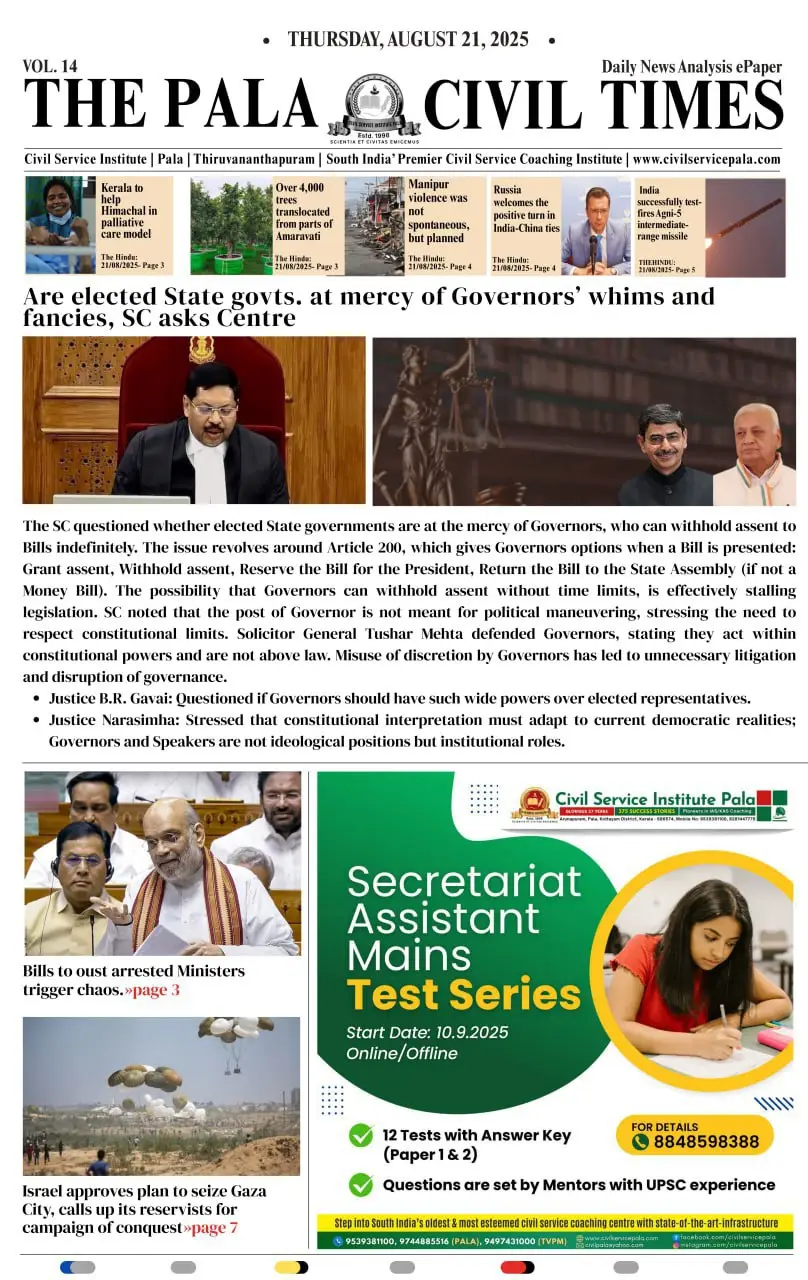
Daily News – 21-08-2025
Are elected State govts. at mercy of Governors’ whims and fancies, SC asks Centre
The SC questioned whether elected State governments are at the mercy of Governors, who can withhold assent to Bills indefinitely. The issue revolves around Article 200, which gives Governors options when a Bill is presented: Grant assent, Withhold assent, Reserve the Bill for the President, Return the Bill to the State Assembly (if not a Money Bill). The possibility that Governors can withhold assent without time limits, is effectively stalling legislation. SC noted that the post of Governor is not meant for political maneuvering, stressing the need to respect constitutional limits. Solicitor General Tushar Mehta defended Governors, stating they act within constitutional powers and are not above law. Misuse of discretion by Governors has led to unnecessary litigation and disruption of governance.
- Justice B.R. Gavai: Questioned if Governors should have such wide powers over elected representatives.
- Justice Narasimha: Stressed that constitutional interpretation must adapt to current democratic realities; Governors and Speakers are not ideological positions but institutional roles.
Manipur violence was not spontaneous, but planned, ethnically targeted: report
- Nature of Violence: The report by the Independent People’s Tribunal concluded that the Manipur violence was not spontaneous, but planned, ethnically targeted, and facilitated by state failures.
Causes:
- Historical ethnic divisions, socio-political marginalisation, and land disputes.
- Systematic hate campaigns via digital media and political statements.
- Trigger: The Manipur High Court’s March 27, 2023 directive recommending Scheduled Tribe (ST) status for Meiteis, which other tribal groups (Kuki- Zo, Nagas) saw as a threat to their constitutional protections.
Impact:
- More than 60,000 internally displaced people still live in relief camps.
- Violence initially started in tribal districts but engulfed the entire state.
Other Factors:
- Propaganda linking Kukis to poppy cultivation under the “war on drugs” campaign by then CM Biren Singh fueled tensions.
Findings of the Tribunal:
- Widespread testimonies showed state authorities failed to protect victims, forcing them to fend for themselves.
- The Centre also failed to fulfil its constitutional duty to maintain law and order and protect rule of law in Manipur.
- Tribunal Composition: Formed by PUCL (People’s Union of Civil Liberties) in 2024, chaired by former SC judge Kurian Joseph, with members including ex-judges, IAS officers, professors, journalists, and human rights activists.
Kerala to help Himachal Pradesh adopt community- based palliative care model
Kerala’s Support to Himachal Pradesh: Kerala Health Department will help Himachal Pradesh adopt the Kerala model of community-based palliative care across all Assembly constituencies.
- Study Visit: A team from Himachal, including the Health Minister, Health Secretary, and NHM Mission Director, visited Thiruvananthapuram and Ernakulam to study Kerala’s model of universal palliative care for bedridden patients.
- Appreciation: Himachal officials praised Kerala’s delivery system of palliative care.
- Decision: Himachal Pradesh decided to adopt the community-based palliative care model of Kerala.
Training Programme:
- First batch: 15 doctors and 15 nurses from Himachal received 10 days of training in palliative care delivery.
- Certificates were distributed by Kerala Health Minister Veena George.
- In total, 70 doctors and 70 nurses will be trained.
- Officials Present: Additional Chief Secretary (Health) Rajan Khobragade and State Nodal Officer for Palliative Care Mathew Numpeli attended the event.
Bills to oust arrested Ministers trigger chaos
- Bills Introduced: The Union government introduced three new Bills in the Lok Sabha:
- Constitution (One Hundred and Thirtieth Amendment) Bill, 2025
- Government of Union Territories (Amendment) Bill, 2025
- Jammu and Kashmir Reorganisation (Amendment) Bill, 2025
- Purpose of Bills: To allow removal of Prime Ministers, Chief Ministers, and other Ministers under certain conditions:
- If arrested/detained for 30 consecutive days on serious criminal charges.
- If facing charges punishable with imprisonment of five years or more.
Authority of Removal:
- President for PM and Union Ministers. Governors for CMs and State Ministers.
- Lieutenant-Governors for Ministers in Union Territories.
- Additional Provision: Removed leaders can be reappointed once released.
Opposition Reaction:
- Strong protests; called the Bills “unconstitutional and anti-federal”.
- MPs tore copies of the Bills, alleging they were not circulated properly.
- Opposition accused the government of trying to turn India into a “police state” and enabling political misuse.
Parliamentary Chaos:
- Sharp exchange between Union Home Minister Amit Shah and Congress leader K.C. Venugopal over Shah’s 2010 arrest in Gujarat.
- Allegations of MPs being physically pushed and shoved.
- Bills were referred to a Joint Parliamentary Committee (21 LS + 10 RS members) to report by the Winter Session.
- Government’s Stand: Amit Shah defended the Bills as a move to bring “morality back into politics”, saying leaders must resign if under prolonged arrest.
Criticism by Leaders:
- Rahul Gandhi: Called it a return to medieval times where kings could dismiss ministers at will.
- Asaduddin Owaisi: Warned of a “police state.”
- Manish Tewari: Called it a law opening doors to political misuse.
- N.K. Premchandran: Accused the government of bypassing House procedures.
India successfully test-fires Agni-5 intermediate-range ballistic missile
- Event: India successfully test-fired its intermediate-range ballistic missile Agni-5 from the Integrated Test Range at Chandipur, Odisha, on August 20.
- Purpose: The launch validated all operational and technical parameters under the Strategic Forces Command.
Missile Details:
- Variant of Agni-5 Intercontinental Ballistic Missile (ICBM).
- Range: 5,000 km.
- Developed by DRDO (Defence Research and Development Organisation).
- Designed considering India’s security requirements.
- Ministry of Defence said the launch validated all operational and technical parameters and was conducted under the aegis of the Strategic Forces Command.
Previous Trial:
- Conducted on March 11, 2024.
- Missile tested with Multiple Independently Targetable Re-entry Vehicle (MIRV) technology, enabling it to strike multiple targets with a single launch.
Evolution of the Agni Missile:
- India’s Agni missile programme dates back to the early 1980s under the Integrated Guided Missile Development Programme (IGMDP), which was started by Dr. A.P.J. Abdul Kalam.
- These missiles are well designed with solid propulsion systems, road and rail mobility, with advanced guidance from DRDO and other teams to ensure the technology’s survivability and precision even in hostile conditions.
- Over the past decade, India has developed various versions of Agni Missile, which range from short-range Agni-I to the intercontinental Agni-V, with work on Agni-VI already underway.
Russia welcomes Wang Yi’s visit and the positive turn in India-China ties
- Russia welcomed Chinese Foreign Minister Wang Yi’s visit to India as a positive development in India-China relations.
- Russian diplomats stated that India-Russia energy trade has not been affected by U.S. penalty tariffs targeting India. Russia currently supplies over 40% of India’s crude oil imports.
- Russia plans to deepen cooperation with India in the defense sector, including joint projects like fighter jets, the Sudarshan Chakra missile defense, and the S-400 air defense system.
- Russia stressed the importance of unity among major economies like the BRICS and Shanghai Cooperation Organisation to collectively address Western sanctions.
- Russia has supported the ‘Make in India’ defense initiative and highlighted the ongoing partnership on key defense systems.
- Roman Babushkin, Charge d’affaires at the Russian Embassy, described Western secondary sanctions as “unlawful tools” that only weaponize the economy.
- Jaishankar cautioned that global complexities and “complex geopolitical environments” create further challenges, but he affirmed that both countries remain “closely and regularly engaged.”
- The visit included the 26th session of the India-Russia Inter-Governmental Commission (IRIGC-TEC), which focused on scientific, technical, economic, and cultural cooperation.
- India-Russia trade grew significantly, from $13billion in 2021 to $68billion in 2024–25, driven mainly by India’s import of Russian hydrocarbons.
- The meeting highlighted Russia and India’s continued cooperation amid shifting geopolitical dynamics, with specific emphasis on energy, defense collaboration, and the shared need to overcome trade barriers and external sanctions for robust bilateral growth.
PRELIMS CORNER :
1. In the context of Indian Arts and Crafts, the terms “Cauka Pitaka”, “Dighala Pitaka”, and “Yama Pitaka” are:
(a) Jain literature
(b) Buddhist literature
(c) Style of paintings
(d) Types of stoneware
2. Which among the following best describes the ‘Langlands Program,’ seen recently in the news?
(a) Google-funded world’s largest large language model
(b) NASA’s initiative to track outer space debris
(c) United Nations initiative to curb farm land emissions
(d) Mathematical abstraction combining number theory and harmonic analysis
3. The recently announced ‘bank.in’ and ‘fin.in’ internet domain initiative aimed at enhancing cyber security in the financial sector is an initiative of
(a) GIFT International Financial Services Centre
(b) National Payments Corporation of India (NPCI)
(c) Reserve Bank of India (RBI)
(d) Securities and Exchange Board of India (SEBI)
4. The well-known rock-cut cave also known as Rang Mahal, is part of
(a) Ajanta Caves
(b) Ellora Caves
(c) Bagh Caves
(d) Udayagiri Caves
Lok Sabha clears Bill that bans real money gaming
- Bill Passage: The Lok Sabha passed the Promotion and Regulation of Online Gaming Bill, 2025, by a voice vote.
- Purpose: The Bill seeks to ban the offering, operation, facilitation, advertisement, promotion, and participation in online money games, especially those involving real money in fantasy sports and card games.
- Definition: “Real money gaming” refers to platforms where players risk their money for winnings, such as Dream11 and PokerBaazi.
- Industry Issues: The minister highlighted that unregulated growth of online money games has led to social, financial, and psychological harms, with families facing destruction of savings.
- Economic Impact: The industry’s revenue has exceeded ₹13,000 crore, employing over two lakh people.
- Skill vs. Chance: The Bill makes the distinction between games of chance and skill irrelevant, aiming to ban all “online money gaming.”
- Regulation vs. Prohibition: While the Bill promotes e-sports and seeks to establish a regulatory authority, it did not propose a blanket prohibition law and invited industry consultation.
Punishments:
- Up to three years’ imprisonment and/or a fine up to ₹1 crore for entities offering/facilitating such games.
- Advertisement or facilitation of online money games is also punishable.
- Advertising can attract up to two years’ imprisonment and/or ₹50 lakh fine.
- Facilitating financial transactions for these games also leads to imprisonment and/or penalty up to ₹1 crore.
- Arguments in Support: Government leaders argued for urgent intervention due to the risk of fraud, addiction, and loss of lifetime savings for users.
- Industry Pushback: The bill faces criticism and likely legal challenges from the gaming industry, which calls for clear regulatory frameworks instead of outright bans, citing concerns about restrictions and constitutionality.
Global solar alliance plans to establish research hub in India
- New Research Hub: The International Solar Alliance (ISA) will establish a Global Capability Centre (GCC) in India by the end of the year, aiming to create a “Silicon Valley for solar.”
- Centres of Excellence: ISA plans to set up 17 centres of excellence across different countries. These will focus on pilot testing, lab training, and fostering a “startup ecosystem” similar to IITs in India.
- Expansion Plans: The number of such centres could increase to 50, with rising interest from other countries seeking to enhance their human capability through collaboration with India.
- Purpose of GCC: The GCC in India will act as a central “hub” connecting all the centres and supporting international solar research and innovation efforts.
- ISA Structure: ISA is a collaborative initiative by India and France, established in 2015 at the Paris climate talks. It is headquartered in Gurugram, Haryana, and comprises about 100 member countries.
- India’s Role: India is emerging as a major provider of solar-related human capital, with many countries seeking Indian engineers to support solar projects, including tenders, operations, and maintenance.
- Installed Capacity: India has installed about 119GW of solar capacity as of July 2025.
- Significance: These developments underscore India’s growing influence and leadership in the global solar energy sector while enhancing global cooperation through ISA.
A bistable gene in a deadly bacterium offers a clue on how to overcome it
About the Pathogen
- Pseudomonas aeruginosa is a deadly opportunistic pathogen, often fatal in burn victims due to secondary infections.
- It also infects urinary catheters, prosthetic devices, and bloodstream infections.
- Highly resistant to antibiotics due to genetic mutations and horizontal gene transfer.
Key Discovery
- Researchers found a bistable gene expression pattern in P. aeruginosa. The gene of interest: glpD (glycerol-3-phosphate dehydrogenase gene).
- Not all bacteria in a population express glpD at the same level — some show high expression, others low/no expression.
- This variability creates subpopulations of bacteria with different survival advantages.
Mechanism
- High expression of glpD → bacteria can metabolize glycerol efficiently, aiding infection spread.
- Low/no expression of glpD → bacteria become more resistant to antibiotics and host stress, acting as a survival strategy.
- This bistability makes infections persistent and harder to treat.
Clinical Importance
- The variability in gene expression explains the pathogen’s success as an opportunistic organism.
- Drug targeting of bistable populations could prevent bacteria from surviving in hospitals and patients.
- Study shows that within the same bacterial colony, subpopulations exist with different levels of glpD activity — giving them flexibility to adapt and persist.
Implications for Treatment
- Standard antibiotics are often ineffective because resistant subpopulations survive and cause relapses.
- Future strategies may include:
- Targeting bistable genes like glpD.
- Disrupting variability in gene expression.
- Designing drugs that prevent P. aeruginosa from switching survival modes.
Israel approves plan to seize Gaza City, calls up its reservists for campaign of conquest
Israel’s Decision
- Israel’s Defence Minister approved a plan for the conquest of Gaza City.
- The plan includes the call-up of around 60,000 reservists, signaling preparations for a large-scale military campaign.
- Move comes as Prime Minister Benjamin Netanyahu seeks approval from the security cabinet for the military action.
Military Context
- Israel has conducted three weeks of aerial bombardments on Gaza.
- The bombardments have been described by officials as the “most intense” campaign against Hamas in recent years.
- Defence Minister described the plan as a “decisive plan for conquest” aimed at eliminating Hamas’s military presence.
Humanitarian Crisis
- Gaza is facing severe shortages of food, water, fuel, and electricity.
- The humanitarian situation is worsening, with the UN describing it as a “catastrophe”.
- Israel’s attacks have displaced majority of Gaza’s 2.3 million people, forcing them into overcrowded shelters.
Diplomatic & International Angle
- Qatar, Egypt, and the U.S. have been mediating efforts for a truce and hostage release deal.
- Despite these talks, Israel has continued with its ground invasion preparations.
- Netanyahu dismissed calls for de-escalation, saying Israel is fighting a “war of survival.”
Casualties & Losses
- Gaza Health Ministry reports over 15,000 Palestinians killed, mostly civilians.
- Israeli officials maintain that Hamas bears responsibility for civilian suffering.
Water extremes drive people from homes in Afghanistan
- Since the war ended between the now- ruling Taliban and US-led forces in 2021, floods, droughts and other climate change- driven environmental hazards have become the main cause of displacement in the country, according to the UN’s International Organisation for Migration (IOM).
- Most Afghans live in mud homes and depend heavily on agriculture and livestock, making them particularly exposed to environmental changes.
- The water cycle has been sharply affected, with Afghanistan again in the grip of drought for the fourth time in five years and flash floods devastating land, homes, and livelihoods.
- The country’s limited infrastructure, endemic poverty and international isolation leave Afghans with few resources to adapt and recover.
- Experts and Taliban officials have repeatedly warned of escalating climate risks as temperatures rise, extreme weather events intensify and precipitation patterns shift.
- “Crop failure, dry pastures, and vanishing water sources are pushing rural communities to the edge,” the UN Food and Agriculture Organisation said in July.
- Successive wars displaced Afghans over 40 years, but peace has not brought reprieve, as climate change-fuelled shocks drive people from their homes and strain livelihoods.
Explained:Why India needs a national space law?
Background
- India is set to celebrate its second National Space Day on August 23, marking the success of Chandrayaan-3 and progress in missions like Gaganyaan and Bharat Antariksh Station.
- While India has advanced technologically, the legal framework for space activities remains incomplete.
- A national space law is crucial to explore, innovate, and commercialize outer space effectively.
Global Space Legislation
- Outer Space Treaty (1967):
- Establishes space as the province of all mankind.
- Prohibits national appropriation of space.
- Holds states responsible for all activities in outer space (government or private).
- The treaty is not self-executing → countries must enact national space laws to ensure compliance.
- Many nations (e.g., Luxembourg, Japan, U.S.) already have frameworks for:
- Licensing
- Liability coverage
- Commercial rights
India’s Approach
- India has ratified the treaty but still needs comprehensive national legislation.
- Current space policy reflects a methodical, incremental strategy:
- Indian Space Policy (2023) outlines non-governmental activities.
- IN-SPACe guidelines help regulate private sector participation.
- Catalogue of Indian Standards defines safety rules.
- However, a statutory authority-backed law is required for full clarity and execution.
Industry Perspectives
- Current transitional framework poses regulatory challenges.
- Key requirements of a national space law:
- Clear licensing rules and timelines.
- Streamlined approvals (avoid delays from multiple ministries).
- FDI clarity (100% allowed in satellite manufacturing would attract investors).
- Proper third-party insurance to cover damages.
- Affordable insurance frameworks for startups handling high-value space assets.
- Protection of intellectual property rights.
Expert Views
- National law should address two key aspects:
- Technical regulations for space
- Authorisation of “space activities” under international
- Without a statutory law, IN-SPACe’s decisions remain vulnerable to procedural challenges.
- Experts emphasize balancing innovation, investor confidence, and government oversight.
Explained:What are ‘machine readable’ electoral rolls?
Background
- Rahul Gandhi (Leader of the Opposition) has demanded machine-readable electoral rolls to be made available to all political parties by the Election Commission (EC).
- The demand comes amid allegations of ‘vote theft’ by the Congress.
How Electoral Rolls Work
- Electoral rolls = authoritative list of who is and isn’t allowed to vote in India.
- Continuously updated when:
- New eligible voters register.
- People change addresses.
- People become ineligible.
- Prepared under EC’s authority by local officials using ERONET (a digital application).
- Current format = image PDFs made available by EC, or physical printouts given to parties/public.
- Image PDFs are not searchable, making it hard to scrutinize and detect errors.
Issues with Current System
- India has over 900 crore voter roll entries (as of January).
- Duplicates or errors cannot be easily identified unless reviewed manually.
- Example: In Bengaluru’s Mahadevapura constituency (2019), Congress review found 11,965 duplicate entries.
- Without machine-readable rolls, such errors are resource-intensive to detect.
Why EC Stopped Sharing Machine-Readable Rolls
- One year before the 2019 elections, EC directed state Chief Electoral Officers to stop uploading machine- readable rolls.
- Reason: Prevent private companies from misusing voter roll data (leak of names, addresses, phone numbers).
- Supreme Court (2018, Kamal Nath vs Election Commission of India) ordered EC to provide machine-readable rolls, but EC still restricts access.
- EC’s concern: Making searchable rolls could expose Indians’ full names and addresses.
Technical & Cost Concerns
- To make rolls machine-readable, OCR (Optical Character Recognition) technology is required.
- Voter rolls are split into hundreds of PDFs per constituency, making the process resource-heavy.
- Estimated cost of converting all voter rolls = $40,000 (₹30–35 lakh) annually.
Debate
- Pro (Rahul Gandhi & advocates):
- Machine-readable rolls improve transparency.
- Help political parties spot duplicate or fake entries easily.
- Make voter rolls easier to search and analyse.
- Against (EC & some experts):
- Risk of misuse by private companies/individuals.
- Potential exposure of sensitive personal information.
- Question remains whether data security outweighs transparency.
Prelims Corner: Explanations
Q1. Ans c
Certain painting techniques from Indian painting traditions have been recorded in ancient texts, offering insights into the development and importance of these art forms. In the context of Indian arts and crafts, the phrases “Cauka Pitaka,” “Dighala Pitaka,” and “Yama Pitaka” refer to styles of painting.
Cauka Pitaka: This style is characterized by isolated framed drawings.
Dighala Pitaka: This style involves long scrolls of paintings. Yama Pitaka: Similar to Cauka Pitaka, this style consists of isolated paintings but may vary in thematic content or execution.
Q2. Ans d
Langlands Program is an attempt to find connections between two far-flung areas of mathematics: number theory and harmonic analysis. Number theory is the arithmetic study of numbers and the relationships between them. A famous example of such a relationship is the Pythagoras theorem. Harmonic analysis is interested in the study of periodic phenomena. The Langlands Program allows mathematicians to investigate polynomial equations using tools from calculus and build a bridge from harmonic analysis to number theory.
Q3. Ans c
In a major move aimed at enhancing cybersecurity and public trust in digital finance, the Reserve Bank of India (RBI) has announced the launch of exclusive internet domains—‘bank.in’ and ‘fin.in’—for Indian financial institutions. This initiative comes in the backdrop of rising instances of cyber frauds, phishing attacks, and growing concerns over the safety of online transactions as digital payments surge across the country.
Q4. Ans c
The Bagh Caves are a collection of nine rock-cut monuments located on the southern slopes of the Vindhyas near Bagh, Dhar district, Madhya Pradesh, India. They were developed around the 6th centuryA.D. These are known for mural paintings by ancient Indian master artists. Only 5 of the original 9 caverns have survived. Cave 4, also known as the Rang Mahal, is the most important of the five caves that still exist (Palace of Colors). Cave2, popularly known as “Pandava Cave,” is the cave with the best preservation.
Case Study:
In a major green initiative, Amaravati Development Corporation Limited (ADCL) has translocated over 4,000 trees from different parts of the Amaravati Capital Region, saving them from infrastructure development works. The project, being implemented along with an instant tree nursery at Ananthavaram village, aims at preserving decades-old trees and replanting them in the buffer zone. ADC chairperson said the translocation involves pruning tree branches to reduce weight, applying chemical treatment to the cut surfaces, and digging trenches around the root systems. Following this, the tap roots are cut, and the entire root ball is protected with cloth or sheets before being shifted to the nursery. There, the trees are placed in large bags filled with potting mixtures for protection. The highest number of trees moved are from the Ficus species (2,200).