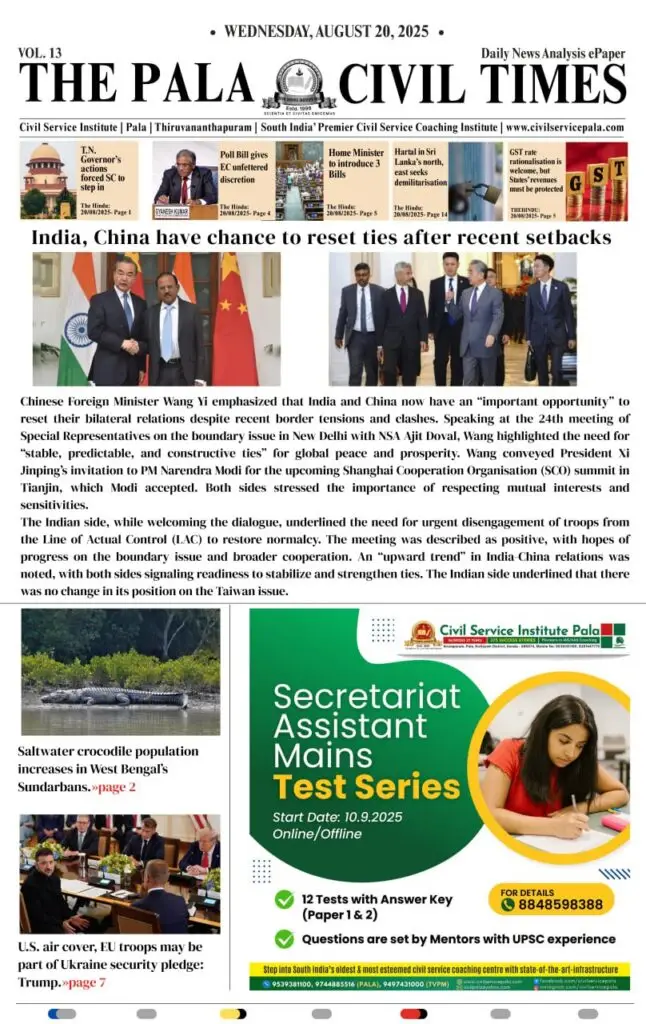
Daily News – 20-08-2025
India, China have chance to reset ties after recent
Chinese Foreign Minister Wang Yi emphasized that India and China now have an “important opportunity” to reset their bilateral relations despite recent border tensions and clashes. Speaking at the 24th meeting of Special Representatives on the boundary issue in New Delhi with NSA Ajit Doval, Wang highlighted the need for “stable, predictable, and constructive ties” for global peace and prosperity. Wang conveyed President Xi Jinping’s invitation to PM Narendra Modi for the upcoming Shanghai Cooperation Organisation (SCO) summit in Tianjin, which Modi accepted. Both sides stressed the importance of respecting mutual interests and sensitivities.
The Indian side, while welcoming the dialogue, underlined the need for urgent disengagement of troops from the Line of Actual Control (LAC) to restore normalcy. The meeting was described as positive, with hopes of progress on the boundary issue and broader cooperation. An “upward trend” in India-China relations was noted, with both sides signaling readiness to stabilize and strengthen ties. The Indian side underlined that there was no change in its position on the Taiwan issue.
Saltwater crocodile population in Bengal’s Sundarban Biosphere Reserve shows substantial increase: survey
The estimated population of saltwater crocodiles, one of the largest reptiles in the world, has increased in the Sundarban Biosphere Re serve (SBR) from last year, according to a survey by the State’s Forest Department.
- In 2025, the estimated maximum population is between 220 and 242, with 213 direct sightings; last year’s maximum was between 204 and 234.
- The 2025 survey recorded 125 crocodiles (71 adults,41 juveniles, 2 hatchlings in 2024 vs. 125 total—88 juveniles, 23 hatchlings—in 2025), indicating a substantial increase, especially in hatchlings.
- Saltwater crocodiles (Crocodylus porosus) is the largest of all crocodilians and the largest reptile in the world.
- They are “hypercarnivorous apex predators” that keep flowing water ecosystems clean by feeding on carcasses.
- In India, saltwater crocodiles are distributed across the swamplands, rivers, mangroves of Odisha and West Bengal and the coastal areas of the Andaman and Nicobar Islands.
- The encounter rate for crocodiles in the Sundarbans is 0.18 per kilometre, meaning one crocodile per 5.5km of surveyed stretch.
- The census was conducted using systematic surveys, GPS mapping, and habitat characterization.
- The West Bengal government has, in the last many decades, made significant efforts to conserve saltwater crocodiles, with a conservation and breeding facility in the form of the Bhagabatpur Crocodile Project being started in the South 24 Parganas in 1976.
Bengal Governor bats for MoUs with other States for welfare of migrant workers
- West Bengal Governor C.V. Ananda Bose has recommended several measures for the welfare of migrant workers, including signing MoUs with major destination states such as Kerala, Karnataka, Tamil Nadu, Maharashtra, Gujarat, and Delhi.
- The Governor advised the West Bengal government to proactively engage and sign MoUs with other states to address multifaceted challenges faced by migrant workers and to ensure socio-economic justice.
- The proposed MoUs should specify responsibilities for enforcing minimum wages, workplace safety standards, and efficient grievance mechanisms for West Bengal workers in other states.
- Recommendations include establishing migrant workers’ registration portals and worker cards, developing affordable hostels, skill training centres in high migration districts, multilingual helplines, legal aid, and dedicated emergency transport and relief funds.
- The recommendations follow reports of harassment and detention of migrant workers, especially in other states, prompting many to return to West Bengal.
- Chief Minister Mamata Banerjee announced the “Shramashree” scheme to provide ₹5,000 monthly to registered migrant workers until they secure a job.
- As per the West Bengal government, around 22,400 registered migrant workers are currently working in other states.
- The Governor has interacted with migrant workers and officials during state visits and has made on-the-ground recommendations forworkplace and residence improvement.
‘Poll Bill gives EC unfettered discretion’
- The proposed “One Nation, One Election” Bill (Constitution 129th Amendment Bill, 2024) aims to synchronize elections for the Lok Sabha and all State Assemblies, but is under scrutiny for conferring “unfettered discretion” to the Election Commission.
- Former Chief Justice of India Sanjiv Khanna warned a parliamentary committee that Clause 5 of proposed Article 82A allows the Election Commission to postpone Assembly elections, which could indirectly trigger President’s Rule and lead to the Centre effectively taking over the reins of State governments.
- Khanna argued this could violate the federal structure of the Constitution and be challenged for being arbitrary and offending Article 14.
- Four other former Chief Justices (U.U. Lalit, Ranjan Gogoi, Jagdish Singh Kehar, D.Y. Chandrachud) had previously pointed out significant legal flaws in the Bill.
- Khanna asserted that the Bill does not address the intended goal of reducing policy paralysis caused by differing election cycles, and the clause goes beyond powers envisioned under Article 356 of the Constitution.
- The committee, led by BJP MP P.P. Chaudhary, questioned Khanna extensively and plans further meetings with economists to assess the financial implications, with the government arguing that synchronized elections will reduce expenditure.
- Khanna also noted that the Model Code of Conduct would disrupt governance each time a State Assembly faces premature dissolution, making the Bill’s purpose questionable.
‘T.N. Governor’s actions forced SC to step in’
- The Supreme Court’s move to grant deemed assent to 10 crucial Tamil Nadu State Bills was a response to an “egregious situation” created by the State’s Governor, who had kept these Bills pending since 2020.
- The Presidential Reference Bench clarified that it was not pronouncing a judgment on the T.N. Governor’s conduct, nor setting binding precedents.
- Justice P.S. Narasimha noted that the Court was compelled to intervene and resolve the situation, but stressed it was not meant to act as a precedent.
- Attorney General R. Venkataramani argued that the Governor had reasons to keep the Bills pending and was within his powers under Article 200 of the Constitution, which does not bind him to the Council of Ministers’ advice.
- The Constitution gives discretion to Presidents and Governors when withholding assent to Bills; the Supreme Court was asked to clarify its role and avoid imposing a binding precedent.
- The Supreme Court’s April 2024 two-judge Bench plugged a constitutional gap by imposing specific time limits for Governors and Presidents to assent, withhold assent, or reserve State Bills for consideration, beyond which the Bill would be deemed approved.
- Solicitor General Tushar Mehta and Attorney General Venkataramani both cautioned that Article 142 powers—used for extraordinary measures—should not supplant constitutional provisions, and stressed the Court should not overreach into the executive and legislative domains.
- The Court ultimately emphasized maintaining constitutional balance and not encroaching upon the autonomy of the executive offices of President and Governor when dealing with State Bills.
Home Minister to introduce 3 Bills for removal of PM, CMs, Ministers held on serious criminal charges
- Union Home Minister Amit Shah is set to introduce three Bills in Lok Sabha to create a legal framework for the removal of the Prime Minister, Union Ministers, Chief Ministers, and Ministers in States and Union Territories if they are arrested and detained in custody for 30 consecutive days for serious criminal charges punishable by five years or more.
- The proposed removal will be executed by the President for Union Ministers, Chief Minister for State Ministers, Governor for Chief Ministers, and Lieutenant-Governor for Chief Ministers in Union Territories. Officials removed could be reappointed upon release from custody.
- The three Bills are:
- Constitution (130th Amendment) Bill, 2025
- Jammu and Kashmir Reorganisation (Amendment) Bill, 2025
- Government of Union Territories (Amendment) Bill, 2025
- The statement of objects emphasizes that elected representatives are expected to act for public interest and welfare, and their conduct should be above suspicion.
- Arrests and detentions in serious criminal cases can harm constitutional trust and good governance.
- There is currently no constitutional provision for removal of a minister arrested and detained for serious criminal offences; hence, amendments to Articles 75, 164, and 239AA are proposed.
- The other two Bills specifically outline the process for removal of the Chief Minister and other ministers in the Union Territory of Delhi, Puducherry, and J&K.
PRELIMS CORNER :
1.With reference to Asiatic caracal sometimes mentioned in the news, consider the following statements :
1. It is a cat species.
2. It is added to the recovery program for critically endangered species in India.
3. Presently it is found only in the continent of Asia.
Which of the statements given above is/are correct ?
(a) 1 and 2 only
(b) 2 and 3 only
(c) 1 and 3 only (d)1, 2 and 3
2.I-Familia is a global database for identifying missing persons based on international DNA kinship matching. It is a service provided by which among the following institutions/organizations ?
(a) Interpol
(b) UN High Commissioner for Refugees
(c) International Investigation Agency
(d) UN Relief and Rehabilitation Administration
3. The Mapping and Exchange of Good Practices initiative is associated with :
(a) Waste segregation
(b) Millet production
(c) Import of GM crops
(d) Afforestation programme
States question Centre’s move seeking SC opinion to overrule ‘binding’ order
- Context: Kerala and Tamil Nadu question the Centre’s use of the Presidential Reference mechanism to seek the Supreme Court’s opinion.
- Issue: The Centre asked the SC for an opinion under Article 143 of the Constitution regarding the powers of the President and Governors in assenting to State Bills.
State’s Argument:
- The April 8 judgment of a two-judge SC Bench already comprehensively settled these constitutional questions.
- 11 out of 14 questions raised in the Reference have already been answered.
- Hence, the Reference is unnecessary and a way to “override” an already binding judgment under Article 141.
Kerala & Tamil Nadu’s stand:
- The SC’s judgment is binding; the Reference is being misused.
- They demand the Reference be rejected and the April 8 verdict upheld.
- Judicial principles cited: Past rulings (like Ahmedabad St. Xavier’s College Society v. State of Gujarat) state that SC’s advisory opinions cannot replace binding judgments.
Attorney-General’s Argument (R. Venkataramani):
- The Governor can act independently of the Council of Ministers when withholding assent to State Bills.
- This power involves “personal independent judgment” guided by constitutional principles.
Legal references:
- Article 145(3) of the Constitution allows substantial questions of law to be referred to a larger SC Bench.
- Historical context: Post-1970s constitutional amendments modified the President’s discretionary powers but left Governor’s role largely unchanged.
- The 42nd Amendment made Article 74(1) mandatory for the President to act on Council of Ministers’ advice, but Article 163 (Governor) was not similarly amended.
- Implication: Unlike the President, the Governor is not strictly bound by the advice of the State Cabinet if a Bill is unconstitutional.
- Ongoing case: The debate is tied to the Tamil Nadu Governor’s actions on withholding assent to State legislation.
‘Action plan needed to distribute industries evenly across States
- Standing Committee on Finance recommendation
- The Standing Committee on Finance (chaired by BJP MP Jayant Sinha) recommended that the Government create an action plan to evenly distribute industries across States.
- Goal: Ensure balanced and equitable economic development across the country.
Concerns raised
- Current industrial investments are not progressing as expected, and the rate of investment remains lower than required.
- Opposition has accused the Government of being biased against Opposition-ruled States, alleging that new investments are favored towards politically aligned regions.
- Jairam Ramesh (Congress) said the Government supports investments only in “friendly” States, hurting balanced growth.
Committee observations
- Industrial policy is a State subject, but Central Government initiatives are vital for industrial growth.
- The Committee urged the Government to:
- Ensure balanced distribution of industries across all States.
- Accelerate the disinvestment process of non- strategic Public Sector Enterprises (PSEs), privatizing loss-making companies to promote fiscal prudence and resource allocation.
Disinvestment issue
- The Committee noted that guidelines for disinvestment of non-strategic CPSEs issued in Dec 2021 have not been implemented.
- Recommended speeding up the process of:
- Privatisation of loss-making PSEs.
- Closure/disinvestment of inefficient CPSEs.
ST rate rationalisation is welcome, but States’ revenues must be protected
Concerns raised by States:
- GST is the biggest revenue source for States. Any shock in GST rates will affect their fiscal health.
- The impact of the Centre’s proposed new GST structure (two rates: 18% and 5%) needs careful assessment.
- Proposals developed outside the GST consultation forum leave States in the dark about how their revenues will be protected.
Revenue impact:
- GST’s shift from origin-based to destination- based taxation has altered long-term revenue trajectories for several States.
- Some States face significant fiscal stress due to this structural change.
Need for protection:
- States want GST rate rationalisation to include measures safeguarding their revenues.
- Gowda said the issue was raised with the Finance Commission, but the response was unsatisfactory since GST and fiscal issues were treated separately.
Structural problem:
- GST Council discusses GST-related issues only, while the Finance Commission avoids fiscal issues linked to GST.
- This leaves States with no effective redressal mechanism within the federal structure.
Minister’s appeal:
- He urged that federal unity requires understanding and addressing States’ concerns.
- Warned that ignoring States’ fiscal worries would harm the federal spirit.
- Next step: A Group of Ministers (GoM) meeting on GST rate rationalisation was scheduled to be addressed by Union Finance Minister Nirmala Sitharaman.
U.S. air cover, EU troops may be part of Ukraine security pledge: Trump
Trump’s statement:
- U.S. air support and European ground troops may be part of Ukraine’s future security guarantees if talks between Moscow and Kyiv fail.
- He emphasized U.S. is willing to provide security assistance but not directly deploy troops.
European involvement:
- European allies, particularly France and Germany, could potentially contribute ground troops.
- Trump noted that the U.K. and others may also be involved but stressed that “no one has the kind of stuff we have.”
Security concerns:
- Post-war security is a key concern for Ukraine after more than three years of Russian invasion.
- Russia has opposed Ukraine’s NATO membership and Western troop presence in its former territories.
Diplomatic efforts:
- Trump is pushing for a bilateral summit involving Russian President Vladimir Putin and Ukrainian President Volodymyr Zelenskyy.
- He spoke with Putin and hopes for a meeting with Zelenskyy soon, though he warned that failure could create a “rough situation.”
Flexibility needed:
- Ukraine may have to accept it cannot regain all its lost territories, including eastern Donbas, in exchange for peace.
Status of occupied land:
- The future of areas held by Russia remains a central sticking point in peace negotiations.
U.S. stance:
- Trump emphasized that Ukraine is not powerful enough to change the situation militarily and must adapt to political realities.
Hartal in Sri Lanka’s north, east seeks demilitarisation
- Hartal observed: A symbolic hartal (shutdown strike) took place in Sri Lanka’s north and east, mainly in Tamil-majority areas, demanding demilitarisation 16 years after the civil war ended.
- Reason for protest: It was triggered by the alleged killing of 32-year-old Ethirumanasingham Kapilraj in Mullaitivu district by military personnel.
- Response by authorities: Sri Lanka Police arrested three soldiers in connection with the incident.
- The Defence Minister promised a fair investigation.
- The Minister condemned attempts to “undermine” the security forces.
Political reactions:
- Tamil political parties, led by Illankai Tamil Arasu Kachchi (ITAK), demanded a thorough investigation into the killing.
- They also highlighted the “continued and excessive presence of security forces” in the north and east.
- Some Muslim parties and opposition MPs also extended support to the protest.
Impact of hartal:
- Many commercial and trading establishments remained closed in Northern and Eastern provinces.
- The hartal reflected enduring concerns over militarisation and divisions within the Tamil polity.
- Response was mixed — some factions supported it, while others did not.
Human rights concerns:
- The UN High Commissioner for Human Rights report noted that 16 years after the war, meaningful security sector reform is yet to happen, and surveillance remains largely intact.
- Large numbers of Army camps remain in the north and east; military personnel are engaged in civil activities like farming and businesses.
Broader issue:
- Persistent militarisation in Tamil areas continues to fuel protests.
- Sinhalese political establishment continues to celebrate soldiers as “war heroes” for defeating LTTE in 2009, despite allegations of wartime human rights violations.
Prelims Corner: Explanations
Q1. Ans a
The Caracal is a species of wildcat that has long legs, a short face, long canine teeth, and distinctive ears — long and pointy, with tufts of black hair at their tips. The iconic ears are what give the animal its name — caracal comes from the Turkish kara kulak, meaning ‘black ears.’ In India, it is called siya gosh, a Persian name that translates as ‘black Ear.’ The National Board for Wildlife and Union Ministry of Environment, Forest and Climate Change in March 2021 included the caracal, a medium-sized wildcat found in parts of Rajasthan and Gujarat, in the list of critically endangered species. Besides India, the caracal is found in several dozen countries across Africa, the Middle East, and Central and South Asia. While it flourishes in parts of Africa, its numbers in Asia are declining. So, Statement 3 is not correct.
Q2. Ans a
Interpol has launched a new global database named “I-Familia” to identify missing persons through family DNA and help the police solve cold cases in member countries. The first of its kind, I-Familia is a global database for
identifying missing persons based on international DNA kinship matching.
The result of cutting-edge scientific research, the database seeks to identify missing persons or unidentified human remains when a direct comparison is not possible by using DNA samples from family members instead. This is a complex process – even more so when carried out internationally – which is where INTERPOL can play a unique role through its global network. I-Familia helps to reunite loved ones or to bring closure to cases and allow families to rebuild their lives.
Q3. Ans b
NITI Aayog, Government of India, in collaboration with United Nations World Food Programme (WFP), India is launching the Mapping and Exchange of Good Practices (MEGP) Initiative, which aims to map and exchange the best practices for millet mainstreaming in Asia and Africa. The initiative will support the documentation of good practices and lessons learned and present an opportunity for experience sharing amongst Asian and African developing countries. Millets can grow on arid lands with minimal inputs and are resilient to changes in climate. They are, therefore, an ideal solution for countries to increase self-sufficiency and reduce reliance on imported cereal grains.
Case Study:
In a logistical feat, a Swedish church is being relocated. With great fanfare, a historic red wooden church considered one of Sweden’s most beautiful buildings began its slow move from its home in the Arc tic town of Kiruna to allow the expansion of Europe’s biggest underground mine. The complex and costly logistical operation kicked off after a blessing by Bishop Asa Nystrom and Vicar Lena Tjarnberg, with the trailers’ 220 wheels slowly pulling out under sunny blue skies. In preparation, the ground around the church had been dug out, allowing big yellow beams to be placed underneath so the building could be jacked up on the trailers. Kiruna’s entire town centre is being moved be cause of the giant LKAB iron ore mine that dominates the region, whose ever deeper burrowing over the years has weakened the ground, increasing the risk of collapse in some parts. The relocation of the church alone is expected to cost 500 million.