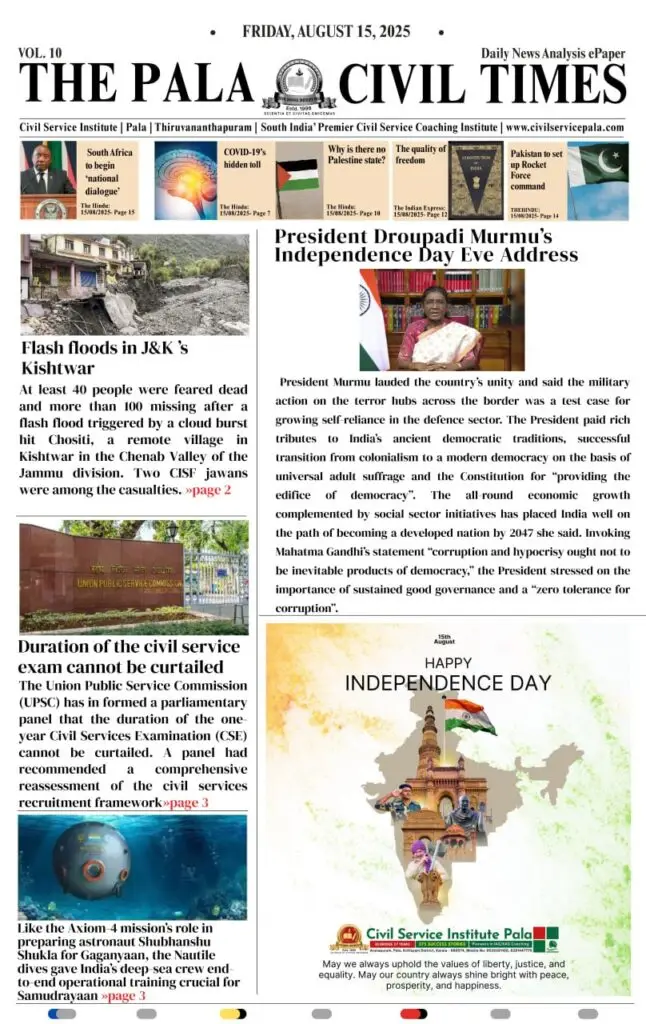
Daily News – 15-08-2025
President Droupadi Murmu’s Independence Day Eve Address
President Murmu lauded the country’s unity and said the military action on the terror hubs across the border was a test case for growing self-reliance in the defence sector. The President paid rich tributes to India’s ancient democratic traditions, successful transition from colonialism to a modern democracy on the basis of universal adult suffrage and the Constitution for “providing the edifice of democracy”. The all-round economic growth complemented by social sector initiatives has placed India well on the path of becoming a developed nation by 2047 she said. Invoking Mahatma Gandhi’s statement “corruption and hypocrisy ought not to be inevitable products of democracy,” the President stressed on the importance of sustained good governance and a “zero tolerance for corruption”.
Flash flood leaves 40 people dead; over 100 missing in J&K’s Kishtwar
- A sudden cloudburst struck Chositi triggering powerful flash floods along the Machail Mata Yatra route—a pilgrimage site in Kishtwar district, Jammu & Kashmir.
- This remote village is the last motorable point before devotees proceed on foot toward the Machail Mata temple
- Rescue efforts were extremely challenging due to mudslides, debris, washed-away roads, and harsh terrain
- The Machail Mata Yatra pilgrimage has been officially suspended, and Independence Day cultural events in the region were cancelled in the aftermath
The main causes for flash floods include:
- Intense Rainfall
- Short duration, high intensity storms can dump huge amounts of rain in minutes or hours.
- Common during monsoon bursts, cloudbursts, or thunderstorms.
- Example: A cloudburst in Kishtwar (J&K, 2025) released extreme rainfall in a short span, causing the disaster.
- Cloudbursts
- Localized, extremely heavy downpours (often >100 mm/hr) in mountainous regions.
- The steep slopes cause water to rush downhill instead of soaking into the soil.
- Often occurs in the Himalayas due to orographic lift (moist air forced upward over mountains).
- Dam or Glacier Lake Outburst
- Sudden failure of a dam, reservoir, or glacial lake can release millions of cubic meters of water downstream.
- In high-altitude regions, Glacial Lake Outburst Floods (GLOFs) are increasingly common due to melting glaciers.
- Topography
- Narrow valleys and steep gorges channel water quickly, concentrating its destructive power.
- Mountainous terrain accelerates the speed of flow, giving less warning time.
- Human-Induced Factors
- Deforestation reduces natural absorption and increases surface runoff.
- Unplanned construction in flood-prone areas blocks natural drainage.
- Mining, road cutting, and slope destabilization in mountains increase vulnerability.
- Poorly maintained drainage systems in cities lead to waterlogging and sudden flooding.
PRELIMS CORNER :
1. Which of the following Acts enacted by the British Government in reference to the English East India Company was also known as the “half-loaf system”?
(a) Regulating Act of 1773
(b) Pitt’s India Act of 1784
(c) Charter Act of 1813
(d) Act for the Better Government of India, 1858
2. The Kundara Proclamation with respect to Indian history is related to:
(a) Velu Thampi’s call to openly take up arms against the British.
(b) Wazir Ali’s guards attacking Europeans and the Magistrate of Benares.
(c) Lakshaman Dawa’s call to Bundelkhand soldiers to protect the Ajaygarh Fort against British siege.
(d) Mufti Muhammad Aiwaz’s call to his followers to revolt against the imposition of police tax.
3. Who among the following was the first European to interfere in the internal politics of the Indian rulers?
(a) Alphonso de Albuquerque
(b) Joseph Francis Dupleix
(c) Robert Clive
(d) Captain Hawkins
Duration of the civil service exam cannot be curtailed, says the UPSC
UPSC’s Position:
- The Union Public Service Commission (UPSC) informed a parliamentary panel that the one-year Civil Services Examination (CSE) duration cannot be shortened.
- This is to maintain confidentiality, integrity, and the quality of the examination process.
Reasoning:
- Despite more candidates, centres, and venues over the years, the exam cycle has been optimised after detailed analysis.
- Checks and balances have been built into the system to reduce risks.
CSE Structure:
- Conducted in three stages: Preliminary (objective), Mains (descriptive), and Personality Test/interview.
- Prelims → Mains gap: 2.5 to 3 months.
- Large scale: 2023 prelims had over 1 million applicants, held at 2,538 venues for 10.27 lakh candidates.
Challenges in Reducing Duration:
- Descriptive-type answer sheet evaluation takes over two months; in 2023, 1.2 lakh answer sheets were evaluated.
- Publishing answer keys is delayed until the final result to protect confidentiality.
Panel Recommendations:
- Suggested a comprehensive re-examination of the recruitment framework.
- Recommended setting a clear CSE calendar.
- Suggested allowing candidates to raise objections to prelims answer keys before mains.
UPSC’s Response to Recommendations:
- Already has a Question Paper Representation Portal (QPRep) for candidate feedback.
- The system of releasing answer keys only after the final result is in the public interest and will continue.
Background:
- Recommendations linked to the Baswan Committee (2015), which reviewed CSE reforms.
- The Ministry of Personnel, Public Grievances and Pensions was involved in the review process.
Two aquanauts reach record depths in Atlantic
In a first for the country, two Indian aquanauts have taken dives to depths of nearly 4,000 metres and 5,000 metres in the Atlantic Ocean on board the French submersible Nautile — the deepest an Indian has ever gone underwater — as part of preparations for Samudrayaan, India’s first manned deep-sea mission that aims to send three aquanauts to 6,000 metres by 2027 in a made-in-India titanium submersible.
The training dives also underline a rare collaboration. France opened access to one of the world’s few submersibles capable of such depths after months of back-and-forth, at a time when most nations guard deep- sea technology closely. The Nautile gave the Indian team more than a seat — it gave them first-hand exposure to mission protocols, vessel handling, and recovery operations.
From deployment to retrieval, the 5,000-metre dive lasted about 9.5 hours. One key learning was in communication. India has already developed its own acoustic phones and the titanium sphere for Samudrayaan, with the latter being manufactured by ISRO.
Samudrayaan is part of the country’s Deep Ocean Mission, which will, for the first time, take a three-member crew 6,000 metres below the surface in the indigenously developed Matsya6000 submersible. The mission aims to develop technologies to access and transport tonnes of valuable minerals from the ocean- bed in an environmentally safe manner. Equipped with scientific sensors and tools, Matsya6000 can operate for 12 hours, extendable to 96 in emergencies. Only five countries — the USA, Russia, China, France, and Japan — have so far carried out successful crewed deep-ocean missions; India is set to join this exclusive club.
The quality of Freedom
- Meaning of a Country’s Freedom
- Freedom for a society means independent political existence that can withstand internal and external pressures.
- India’s 79th Independence Day comes at a time of geopolitical tensions, with incidents on the China border and Pakistan’s reactions.
- Discussions on freedom often get limited to external threats, ignoring internal dimensions of civic freedom.
- Internal Dimension of Freedom
- Civic freedom is about citizens’ right to dissent, opposition, and public reasoning.
- A healthy democracy requires critical citizens, not just loyal subjects.
- Increasing tendency to view dissent as disloyalty undermines democratic values.
- Decline in Democratic Culture
- Growing acceptance of state authority leads to erosion of citizens’ critical role.
- Legal and bureaucratic systems are being used to curb dissent.
- Opposition is often sidelined, and freedom of expression is weakened.
- Public Reason and Civic Culture
- Freedom should be understood as freedom to question and challenge authority.
- The current political climate fosters majoritarian views, reducing space for diverse opinions.
- Protest and opposition are essential to the framework of freedom.
- Role of Citizens
- Citizens must go beyond being passive voters; they should critically evaluate government actions.
- A culture of questioning strengthens democracy, while blind loyalty weakens it.
- Call to Action
- On Independence Day, we should recommit to the idea of critical citizenship.
- Public reasoning should remain central to India’s democratic ethos.
- The quality of freedom depends on how actively citizens participate in public discourse and hold power to account.
COVID-19’s hidden toll: how the pandemic has aged our brains
- People exposed to the pandemic environment showed an average brain age increase of 5.5 months versus those studied before COVID-19.
- Brain aging acceleration was more pronounced in men and those from disadvantaged socioeconomic backgrounds.
- Advanced brain scans confirmed statistically significant declines in cognitive abilities, measurable changes in brain structure and function, and increased mental health issues among COVID-19 survivors.
- COVID-19 increases brain aging through two main pathways: Direct viral attack on nerve cells (neurotropic effect). Indirect psychological stress and social isolation caused by the pandemic.
- Adolescents assessed after pandemic and school shutdowns had higher levels of anxiety and depression.
- SARS-CoV-2 can breach protective barriers around the brain, allowing harmful substances in and increasing inflammation
- Studies showed ongoing damage even in those who weren’t hospitalized.
Need for Recovery and Innovation
- Innovative treatments and approaches (including neurorehabilitation combining neurotechnology and holistic therapies) show promise for reversing some effects.
- There’s a pressing need for research to help mitigate neurological impact and restore brain health, given the wide-reaching effects beyond initial symptoms.
- Long-Term Public Health Challenge
- Estimation that 65 million people globally are living with long COVID symptoms, highlighting a major ongoing challenge for medicine and society.
Blood Biomarkers for Chronic Fatigue Syndrome Technology:
- RNA sequencing analysis of blood samples
- Application: Detecting chronic fatigue syndrome through biomarkers
- Method: Analyzes RNA particles in blood plasma released from cell damage/death
- Significance: Could provide objective diagnostic tool for a condition currently diagnosed by symptoms
- Research: Cornell University study comparing patients vs. healthy controls
South Africa to begin ‘national dialogue’ on poverty, inequality
- South Africa is initiating a “national dialogue” on Friday, aiming to bring together all sectors of society to address major issues like poverty, crime, and inequality.
- The dialogue was called for by civil society and is being initiated by President Cyril Ramaphosa.
- Expected participants include most political parties, civic groups, and members of the public.
- The dialogue will be a people-led, society-wide process; everyone is expected to have a voice
- More than 30 years after apartheid, South Africa faces high levels of poverty, crime, unemployment (>30%), and inequality.
- Transition to democracy saw some improvements, but many issues persist.
- The dialogue will unfold in phases and involve public discussions across all nine provinces.
- Duration of the dialogue is uncertain but could continue into the following year.
- Some organizations have pulled out citing rushed timelines and logistical concerns. There are also questions about the estimated $40 million cost and doubts whether the process will result in significant changes.
- While President Ramaphosa and the ANC support the process, opposition parties like the Democratic Alliance and Economic Freedom Fighters have expressed skepticism, with some indicating they won’t participate.
- Notable figures such as rugby captain Siya Kolisi, actor John Kani, and former Constitutional Court Judge Edwin Cameron have joined the dialogue.
- The process aims for peaceful, inclusive dialogue reflecting on the nation’s future.
- Political Stakes
- The dialogue could shape future policy and national direction amid competing interests and ongoing public debate.
Pakistan will set up Rocket Force Command, says PM Shehbaz Sharif
Pakistan Establishes Rocket Force Command Military Modernization
- New Force Structure: Pakistan announces establishment of Rocket Force Command to supervise missile capabilities
- Technology Enhancement: Force equipped with modern technology capable of striking enemies from all directions
- Post-conflict Response: Initiative follows Pakistan’s “worst conflict in decades with India” in May 2025 Strategic Context
India-Pakistan Tensions: Four-day intense conflict in May killed dozens on both sides through missile, drone and artillery fire
- Kargil Reference: May conflict triggered by deadly attack on tourists in Kashmir’s Pahalgam (April 22, 26 civilians killed)
- Regional Arms Race: Pakistan boosting military capabilities as part of broader defense modernization Defense Acquisitions
- Chinese Partnership: Islamabad in talks to acquire 40 new Chinese fighter jets and air defense systems
Budget Increase: Defense spending increased by 20% in current budget passed in June 2025
- Conventional War Capabilities: Focus on improving conventional warfare capabilities alongside missile systems Regional Implications
- Military Balance: Move aimed at strengthening Pakistan’s military capability in regional context
- Defense Modernization: Part of broader pattern of defense upgrades following recent conflicts
- Strategic Deterrence: Rocket Force Command represents institutionalization of missile capabilities
Explained: Why is there no Palestine state?
- Historical Background
- The British Mandate over Palestine ended in 1948; UN proposed a two-state solution in 1947, rejected by Arab leaders.
- Israel declared independence in May 1948, leading to war with Arab neighbours and displacement of Palestinians — the Nakba (catastrophe).
- Jordan took control of the West Bank, Egypt of Gaza; no Palestinian state was formed.
- The Green Line and Occupation
- After the 1967 Six-Day War, Israel captured Gaza, the West Bank, and East Jerusalem, defying UN Resolution 242 calling for withdrawal from occupied territories.
- Israeli settlement expansion in these areas has been a major obstacle to peace.
- Peace Efforts and Failures
- Oslo Accords (1993): Palestinians recognised Israel; both sides agreed to work toward a two-state solution.
- Efforts like Camp David Summit (2000) and U.S.-led peace plans collapsed due to disputes over borders, settlements, refugees, and Jerusalem’s status.
- Violence, such as the Second Intifada (2000–2005), deepened mistrust.
- Hamas and Gaza
- In 2006, Hamas won Palestinian elections; tensions with Fatah escalated.
- Israel and Egypt imposed a blockade on Gaza after Hamas took control in 2007.
- Repeated conflicts between Israel and Hamas have left Gaza devastated.
- Recent Developments
- October 7, 2023: Hamas attacked Israel, killing civilians and taking hostages, triggering a massive Israeli military response in Gaza.
- The war has deepened the humanitarian crisis and reduced prospects for peace.
- Main Obstacles to a Palestinian State
- Israeli settlement expansion and military occupation.
- Political divisions between Hamas (Gaza) and Palestinian Authority (West Bank).
- Security concerns, mutual distrust, and international political deadlock.
- Israel’s growing reluctance toward a two-state solution.
Prelims Corner: Explanations
Q1. Ans b
The Pitt’s India Act of 1784, sometimes described as the “half-loaf system,” as it sought to mediate between Parliament and the company directors, enhanced Parliament’s control by establishing the Board of Control, whose members were selected from the British cabinet. It was designed to address the shortcomings of the Regulating Act of 1773.
Q2. Ans a
The East India Company’s harsh conditions imposed on the state of Travancore after both of them agreed to a subsidiary alliance arrangement under Wellesley in 1805 caused deep resentment in the region. Velu Thampi addressed a gathering in Kundara, openly calling for taking up arms against the British to oust them from the native soil. This was later known as the Kundara Proclamation. There was a large-scale rebellion against the British as a result. A large military operation had to be undertaken to restore peace. The Maharaja of Travancore had not wholly supported the rebellion and defected to the side of the Company. Velu Thampi killed himself to avoid capture. The rebellion petered out.
Q3. Ans b
Joseph Francis Dupleix was Governor- General of French India and a rival of Robert Clive under the British. In 1741, Dupleix became the Governor-General of Pondicherry. He was the first European to interfere in the internal politics of the Indian rulers because he supported Muzzaffar Jang for Hyderabad and Chanda Sahib for Carnatic. His candidates emerged successful and, in return, gave up great concessions to Dupleix. Dupleix was, in fact, the originator of the practice of subsidiary alliance in India.