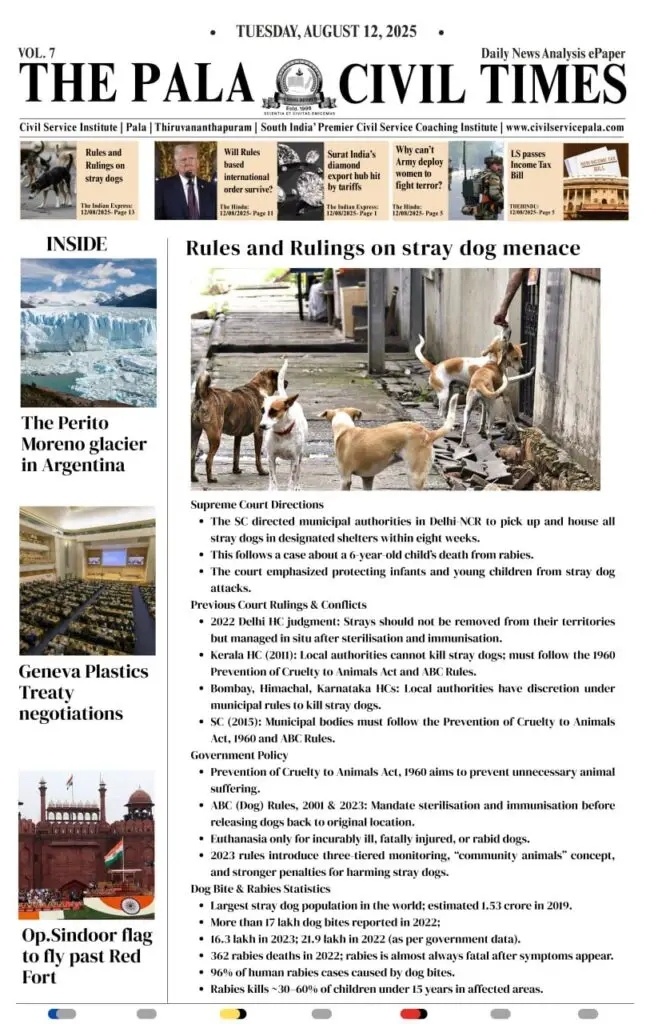
Daily News – 12-08-2025
Rules and Rulings on stray dog menace
Supreme Court Directions
- The SC directed municipal authorities in Delhi-NCR to pick up and house all stray dogs in designated shelters within eight weeks.
- This follows a case about a 6-year-old child’s death from rabies.
- The court emphasized protecting infants and young children from stray dog attacks.
Previous Court Rulings & Conflicts
- 2022 Delhi HC judgment: Strays should not be removed from their territories but managed in situ after sterilisation and immunisation.
- Kerala HC (2011): Local authorities cannot kill stray dogs; must follow the 1960 Prevention of Cruelty to Animals Act and ABC Rules.
- Bombay, Himachal, Karnataka HCs: Local authorities have discretion under municipal rules to kill stray dogs.
- SC (2015): Municipal bodies must follow the Prevention of Cruelty to Animals Act, 1960 and ABC Rules.
Government Policy
- Prevention of Cruelty to Animals Act, 1960 aims to prevent unnecessary animal suffering.
- ABC (Dog) Rules, 2001 & 2023: Mandate sterilisation and immunisation before releasing dogs back to original location.
- Euthanasia only for incurably ill, fatally injured, or rabid dogs.
- 2023 rules introduce three-tiered monitoring, “community animals” concept, and stronger penalties for harming stray dogs.
Dog Bite & Rabies Statistics
- Largest stray dog population in the world; estimated 1.53 crore in 2019.
- More than 17 lakh dog bites reported in 2022;
- 16.3 lakh in 2023; 21.9 lakh in 2022 (as per government data).
- 362 rabies deaths in 2022; rabies is almost always fatal after symptoms appear.
- 96% of human rabies cases caused by dog bites.
- Rabies kills ~30–60% of children under 15 years in affected areas.
Fresh tariff blow to diamond export hub Surat
- The U.S. has implemented a 26–27% tariff on Indian diamonds and jewellery exports—up from a previous 0% rate—raising costs by up to ₹2 lakh per carat for natural diamonds and ₹2,635 per carat for lab-grown variants.
- On top of that, a proposed 50% total tariff (combining existing and new levies) threatens to decimate competitiveness, with major disruptions expected for Surat’s economy.
- The Gem and Jewellery Export Promotion Council (GJEPC) warns of potential revenue halving and massive job losses if tariffs are fully enforced.
- Already, exports have declined sharply.A temporary 90-day pause on the tariff rollout gave the industry some breathing room, allowing about $1 billion worth of exports to clear before the hike took effect.
- However, the recent escalation has overridden that reprieve, creating fresh anxiety about upcoming orders—especially those from the JCK Las Vegas exhibition that were already in execution.
- Industry bodies are urging the government to step in with duty drawbacks, credit support, and regulatory relief. They stress the urgency, warning of redirection of trade to countries with lower tariffs like Vietnam, Thailand, and Turkey.
- there’s hope that emerging trade agreements—like the UK-India FTA—could offer new export opportunities for Surat by boosting access to European markets
IAF choppers with Operation Sindoor flag to fly past Red Fort on Independence Day
The Indian Air Force (IAF) will stage a special flypast over the Red Fort this Independence Day, with three helicopters flying in formation carrying the National Flag and “the Operation Sindoor flag”. As in previous years, the aircraft will shower petals over the public. The Ministry of Defence has made Operation Sindoor the central theme of this year’s Independence Day invitations. Security agencies have deployed enhanced aerial surveillance around the Red Fort.
An eye on CO2 from space could soon shut: why this matters?
Background
- The Trump administration has reportedly asked NASA to prepare to shut down two major satellites—OCO-2 and OCO-3—which monitor atmospheric CO₂ and crop health.
- NASA stated the missions are “beyond their prime mission” and are being terminated to align with budget priorities.
About the Orbiting Carbon Observatories (OCOs)
- Special Earth-remote sensing satellites designed to measure atmospheric CO₂ and identify its sources and sinks.
- OCO-2: Launched in 2014 after the failure of the original OCO (2009). Measures CO₂, tracks crops, and observes plant photosynthesis.
- OCO-3: Installed on the International Space Station in 2019 to expand time-of-day coverage and enhance CO₂ observation.
Importance of OCO Missions
- Revolutionized understanding of how quickly CO₂ accumulates in the atmosphere.
- Discovered that boreal forests in the northern hemisphere are significant carbon sinks, not just tropical rainforests.
- Data aids policymakers in emission reduction efforts and climate change strategies.
- Helps monitor crop health, drought conditions, and create detailed maps of plant growth.
Economic & Scientific Value
- Cost to design, build, and launch OCO-2 and OCO-3: ~$750 million.
- Annual maintenance cost: ~$15 million—a small fraction of initial investment.
- Data used by NASA, USDA, and private companies for agriculture and environmental monitoring.
- Scientists argue shutting them down would waste an invaluable source of data.
Next Step
- Congress may still vote to preserve funding for the satellites before the fiscal year ends on September 30.
Lok Sabha passes Income Tax Bill; officials’ powers broadened
Bill Passed: Lok Sabha passed the revised Income Tax Bill, 2025 to simplify, rationalise, and shorten the Income Tax Act, 1961.
- Word Reduction: New bill has 2.59 lakh words vs. 5.12 lakh words in the old Act.
- Chapter & Section Reduction: Chapters reduced from 47 to 23, sections from 819 to 536.
- Tables: Increased from 6 to 18; formulas from 6 to 16. Expanded Powers:
- Tax officials can forcibly break into personal emails and social media accounts during search operations.
- Can demand access to electronic data, books, documents, and override computer access codes.
- These powers extend to seizing WhatsApp messages and other electronic material. Concerns Raised:
- Congress MP Amar Singh warned of wide-ranging privacy risks and misuse potential.
- Urged for reduced powers and stronger privacy protections, citing Supreme Court’s Puttaswamy privacy case.
Bills Passed Without Debate:
- Income Tax (No. 2) Bill, 2025
- Taxation Laws (Amendment) Bill
- Sports Bill Passed: Lok Sabha also passed the National Anti-Doping Amendment Bill, 2025.
Protest by Opposition:
- Opposition MPs marched to the Election Commission HQ to protest electoral roll changes.
- They returned to Parliament but continued protests in the Well of the House.
Government’s Stance:
- Union Ministers, including Kiren Rijiju, assured that other important pending Bills will be taken up soon.
- Emphasis on accountability, transparency, and fairness in sports governance, especially with Olympics approaching.
Why can’t Army deploy women to fight terror, asks SC
- The SC questioned why the Army cannot deploy women officers to counter terrorism and insurgency, especially when other services like the Air Force have done so.
- The query arose during a hearing on a policy restricting women candidates from certain Army appointments (e.g., Judge Advocate General branch).
- Justices Dipankar Datta and Manmohan, noted that half the population’s talent should not be held back due to gender.
- The Bench said a policy bifurcating candidates on the basis of gender and re serving more posts for men did not meet the standards of law.
- Suggested common merit lists for Army positions, including both men and women.
- Dismissed Army’s argument that women officers are not deployed for counter- insurgency or counter-terrorism because they are “not expected to discharge the role of combatants.”
- Army claims women are mostly posted in legal or administrative roles and not in combat due to policy.
- The court said it further violated the right of women to be treated as equals in all aspects of their employment in the Army.
- The Air Force has continually opened new combat roles for women as fighter pilots and helicopter pilots.
Court cited examples of women officers already serving in high-risk zones:
- Captain Ojaswita Shree of the elite Parachute Air Defence Unit
- Major Dwipannita Kalita of highly specialised airborne medical unit of the Army
- Flight Lieutenant Shivangi Singh (pilot of Rafale jet) of the Air Force
- Other women who have operated in frontline roles in Air Force and Navy
Next Steps
- SC directed the government to file a common merit list for Judge Advocate General branch candidates (men & women).
- Indicated that policy should reflect equal opportunity in all aspects of military employment, including combat and counter-terrorism duties.
Rift between two blocs continues in Geneva Plastics Treaty negotiations
Background
- Since 2022, the UN Environment Programme has been working on a legally binding treaty to address plastic pollution on land and in oceans.
- Negotiations are led by the Intergovernmental Negotiating Committee (INC) on Plastic Pollution.
The Two Blocs
- High Ambition Coalition (HAC)
- Includes: Norway, Rwanda, European Union members.
- Pushes for cuts in plastic production to control pollution.
- Like Minded Countries (LMC)
- Includes: Iran, Saudi Arabia, Kuwait, Bahrain, China, Cuba.
- Opposes production cuts; favours waste management as the main solution.
- Mostly petrochemical states with strong economic stakes in plastic production.
Key Disagreements
- HAC view: Plastic pollution can’t be controlled without reducing production of plastics and its components.
- LMC view: Cutting production would disrupt trade and harm economies; better to focus on waste management.
- India supports LMC, citing concerns over trade disruptions and economic impact.
Industry Position
- All India Plastic Manufacturers Association opposes caps on production, warning it could harm industries and growth.
- Urges focus on improving waste management and behaviour change.
Economic & Trade Context
- Asia now dominates global trade in primary plastic polymers; analysis shows significant production shift from Europe to South and Southeast Asia.
- U.S.: Largest exporter of primary plastic polymers but not supporting production cuts; claims they would hurt “strong” economies.
- Africa & South America: Low production volumes, minimal impact from cuts.
Why a famously stable glacier in Argentina is now under threat?
- Perito Moreno Glacier in Argentina is known for its long-term stability, unlike many other glaciers worldwide.
- Located in Los Glaciares National Park, a UNESCO World Heritage site.
- The glacier is a major tourist attraction, with a large ice mass extending nearly 20 miles.
Recent Changes
- Since 2019, the glacier has been thinning at an accelerated rate, according to new research published on August 7 in Earth & Environment.
- Scientists warn that if thinning continues, it could lead to irreversible, large-scale retreat.
Scientific Findings
- Researchers used radar imaging from helicopters to measure the glacier’s thickness and bedrock structure.
- Found that the bedrock ridge supporting the glacier penetrates deeply into the ice at the glacier’s front.
- If ice around the ridge becomes thin enough, the ridge could detach, leading to faster retreat and higher vulnerability to melting or breaking apart.
Causes
- Acceleration in thinning likely linked to climate change impacts on snow and meltwater cycles.
- The glacier, though fed by large snowfields and high-altitude ice, is now experiencing unusual melt rates.
Expert Insights
- Glaciers sometimes recover with increased snowfall, but this one may not without significant climate intervention.
- Ongoing melt could destabilize one of the world’s most iconic and previously resilient glaciers.
Explained:Will the rules-based international order survive the Trump presidency?
Background
- The rules-based international order was created by the U.S. after World War II to ensure political stability, economic advancement, and prevent another global conflict.
- Known as Pax Americana, it relied on U.S. leadership, liberal economic policies, and multilateral institutions like the UN, IMF, and WTO.
- It aimed to maintain an open global market, rebuild war-torn regions, and support emerging economies.
Current Challenge
- Under U.S. President Donald Trump, the order faces political and economic confrontations.
- The question is not whether it will survive, but how much damage it might endure due to Washington’s coercive policies.
- Trump’s approach has been marked by economic nationalism, skepticism of alliances, and willingness to disrupt established norms.
Impact of Pax Americana
- Historically, the U.S. promoted open markets but also used its dominance to secure economic advantages.
- Post-WWII, U.S. actions included pressuring Japan to open its market and nurturing Asian economies while keeping strategic control.
- The system provided benefits but also reinforced U.S. power and influence over Asia, Europe, and developing nations.
Extent of U.S. Power
- The U.S.-led order is not purely liberal—it often imposes authoritarian political prescriptions and economic controls on other nations.
- While the U.S. claims to champion liberty and open trade, it also maintains strategic dominance and limits autonomy of Asian nations.
- Trump’s policies, such as backing authoritarian leaders and pressuring allies, have tested the system’s resilience.
Possible Future
- The old rules-based order may weaken or fall apart, replaced by bilateral deals and power- based arrangements.
- Growing U.S. unilateralism, selective sanctions, and retreat from global cooperation could create instability.
- There is a risk of economic fragmentation, reduced multilateral cooperation, and new power blocs emerging.
Overall Outlook
- The system may still persist in some form but will be reshaped by shifting power balances, reduced U.S. leadership, and the rise of other nations’ influence.
- A potential new order could emerge—less cooperative, more fragmented, and morecompetitive.
Prelims Corner:
Consider the following statements about the British in India.
1. East India Company opened their first company at Surat.
2. East India Company was exclusively funded by the government.
Which of the above statement is/are incorrect?
a) 1 only
b) 2 only
c) Both 1 and 2
d) Neither 1 nor 2
The English Association or Company to trade with the East was formed in 1599 CE under the auspices of a group of merchants known as “The merchant Adventurers”. The British East India Company was a joint stock owned company founded in 1600.
Consider the following statements about the various layers of earth.
1. The continental crust is denser than the oceanic crust.
2. The upper portion of core is the major source for magma.
Which of the above statement is/are correct?
a) 1 only
b) 2 only
c) Both 1 and 2
d) Neither 1 nor 2
Continental crust is broadly granitic in composition and, with a density of about 2.7 grams per cubic cm, is somewhat lighter than oceanic crust, which is basaltic (i.e., richer in iron and magnesium than granite) in composition and has a density of about 2.9 to 3 grams per cubic cm. Magma is primarily a very hot liquid, which is called a ‘melt. ‘ It is formed from the melting of rocks in the earth’s lithosphere, which is the outermost shell of the earth made of the earth’s crust and upper part of the mantle, and the asthenosphere, which is the layer below the lithosphere.
Arrange the following hills in North South direction
1. Jawady hills
2. Shevroy Hills
3. Palkonda range
4. Nallamala Hills
a) 3421
b) 4321
c) 3412
d) 4312
Nallamala hills – Palkonda range – Jawadi hills – Shevroy hills. All these are important hills in the Eastern Ghats.