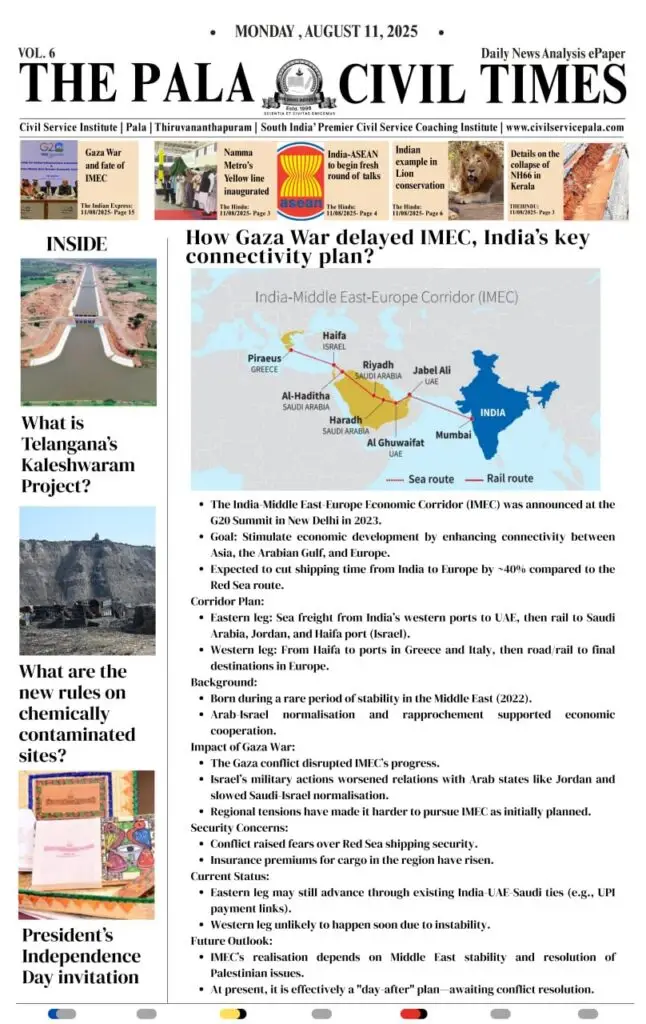
Daily News – 11-08-2025
How Gaza War delayed IMEC, India’s key connectivity plan?
- The India-Middle East-Europe Economic Corridor (IMEC) was announced at the G20 Summit in New Delhi in 2023.
- Goal: Stimulate economic development by enhancing connectivity between Asia, the Arabian Gulf, and Europe.
- Expected to cut shipping time from India to Europe by ~40% compared to the Red Sea route.
Corridor Plan:
- Eastern leg: Sea freight from India’s western ports to UAE, then rail to Saudi Arabia, Jordan, and Haifa port (Israel).
- Western leg: From Haifa to ports in Greece and Italy, then road/rail to final destinations in Europe.
Background:
- Born during a rare period of stability in the Middle East (2022).
- Arab-Israel normalisation and rapprochement supported economic cooperation.
Impact of Gaza War:
- The Gaza conflict disrupted IMEC’s progress.
- Israel’s military actions worsened relations with Arab states like Jordan and slowed Saudi-Israel normalisation.
- Regional tensions have made it harder to pursue IMEC as initially planned.
Security Concerns:
- Conflict raised fears over Red Sea shipping security.
- Insurance premiums for cargo in the region have risen.
Current Status:
- Eastern leg may still advance through existing India-UAE-Saudi ties (e.g., UPI payment links).
- Western leg unlikely to happen soon due to instability.
Future Outlook:
- IMEC’s realisation depends on Middle East stability and resolution of Palestinian issues.
- At present, it is effectively a “day-after” plan—awaiting conflict resolution.
Probe report by expert panel flags vulnerable segments, design oversight on NH 66 in Kerala
Investigation Findings Include :
- Expert panel found several slopes and reinforced earth (RE) walls on National Highway 66 (NH 66) in Kerala vulnerable to landslips and cave-ins.
- Report submitted to the National Highway Authority of India (NHAI) flagged vulnerable segments
Key Deficiencies:
- Absence or insufficient spacing of weep holes for drainage in the Chengala–Neeleswaram corridor.
- Vulnerability and alignment with high-risk geotechnical conditions require priority intervention.
- In Neeleswaram–Taliparamba corridor slope failure warranted urgent repair.
- Issues like peeling or delamination of shotcrete, destabilised slope facings, and progressive slope failure noted in Taliparamba–Muzhappilangad corridor
- Restricted water movement between chainage posed serious stability risks.
- Embankment collapsed due to soft, highly compressible fluvial subsoil unable to bear loads.
- Site treated as paddy field without considering its fluvial origin—a major oversight.
- Recommended viaduct or bridge design with deep piling instead.
Bengaluru Metro’s new line to carry 2.5 lakh people daily
Bengaluru’s long wait for the Yellow Line of Namma Metro finally ended on Sunday, as Prime Minister Narendra Modi inaugurated the 19.15-km corridor linking R.V. Road to Bommasandra. With this, the metro network in the city went up to 96 km. Bengaluru Metro is currently the second- largest metro network in the country after the Delhi Metro, which covers 353.3 km. The Yellow Line, a key metro link connecting the city’s IT hub in Electronics City is expected to significantly ease traffic congestion. The Yellow Line is expected to carry over 2.5 lakh passengers daily.
What are the new rules on chemically contaminated sites?
New Rules:
- Environment Ministry notified Environment Protection (Management of Contaminated Sites) Rules, 2025 under the Environment Protection Act.
- Provides a legal structure for identifying, assessing, and remediating chemically contaminated sites.
Definition of Contaminated Sites:
- Places where hazardous/other wastes were dumped historically, causing contamination of soil, groundwater, or surface water, posing environmental risks.
- Examples: landfills, dumps, waste storage/treatment sites, spill-sites, chemical waste handling/storage sites.
Current Situation:
- 103 such sites identified across India; only 7 have seen actual remediation.
- Some sites developed before hazardous waste management regulations existed.
- Polluters often shut down operations or lack capacity to pay for remediation.
Procedures Under the Rules:
- District administration to prepare half-yearly reports on suspected contaminated sites.
- State board or a ‘reference organisation’ (experts) to conduct preliminary assessment within 90 days.
- If hazardous chemical levels exceed safe limits:
- Site locations publicised and restricted.
- Remediation plan prepared.
- Polluters pay for clean-up; otherwise, Centre/State covers cost.
- Criminal liability possible under Bharatiya Nyaya Sanhita (2023) if contamination causes loss of life/damage.
Exemptions:
- Radioactive waste, mining pollution, oil pollution of the sea, and solid waste from dump sites — covered by separate laws.
Limitations:
- No fixed timeline for remediation once a site is identified, only that it must be restored to safe levels.
Message from Eastern states at President’s Independence Day Invitation
From Bihar
- Sikki Grass Box
- Made from sikki grass, a lesser-known traditional craft from Bihar.
- Golden-hued grass is used to weave boxes and utility items.
- Represents the rural craftsmanship of the region.
- Madhubani Art Tag & Painting
- Hand-painted Madhubani tag attached to the cloth bag holding the gift kit.
- Madhubani paintings are known for intricate patterns, bright natural colors, and mythological/nature-based themes.
- Tikuli Art (in the paintings)
- 800-year-old style from Patna.
- Traditionally made on hardboard with enamel-like finish, depicting folk motifs and mythological scenes.
From West Bengal
- Pattachitra Painting
- Style practiced by the Patua community of Midnapore.
- Painted scrolls depicting stories, folk tales, and religious themes.
From Odisha
- Talapatra Chitra
- Art on palm leaf scrolls.
- Intricately etched or painted with mythological and cultural themes.
From Jharkhand
- Paitkar Painting
- Old tribal scroll tradition from Amadubi village.
- Known for narrative storytelling through sequential panels.
- Bamboo Frame
- Crafted by tribal artisans from Jharkhand using bamboo weaving.
- The frame houses the Madhubani paintings in the invite kit.
Indian, ASEAN officials to begin fresh round of talks to review trade agreement today
- India and ASEAN (Association of South East Asian Nations) officials will meet in New Delhi from August 11 to 14 to review the ASEAN-India Trade in Goods Agreement (AITIGA).
- The review follows a 2009 agreement that India claims gives ASEAN countries easier access to Indian markets.
Context & Concerns:
- Commerce Minister Piyush Goyal earlier called the 2009 deal “silly” for disadvantaging India.
- Concerns exist over Chinese goods entering the Indian market via ASEAN countries.
- ASEAN nations: Brunei, Cambodia, Indonesia, Laos, Malaysia, Myanmar, Philippines, Singapore, Thailand, and Vietnam.
U.S. Tariffs Impact:
- On August 7, the U.S. imposed 25% tariffs on Indian goods, adding urgency to strengthen other trade ties.
- India is also negotiating trade deals with the EU, Australia, and New Zealand.
Trade Deficit:
- Trade balance with ASEAN is increasingly unfavourable for India.
- 2017–18: Exports $34.2B, imports $47.1B → deficit $12.9B
- 2024–25: Exports $39B (1.7% annual growth), imports $84.2B (7.5% annual growth) →deficit $45.2B
Review Goals:
- India seeks fairer terms to reduce the trade deficit and address market access issues.
- Both sides hope for progress despite no breakthrough in past year’s talks.
- ASEAN is also leading the Regional Comprehensive Economic Partnership (RCEP), a 15- nation free trade agreement, which India did not join.
MCQ of the Day:
Mahanavami dibba or Dassarah Dibba is a famous monument protected by the Government of India. Where is it located?
- Waranagal (Kakatiya dynasty)
- Mysore ( Wodayar dynasty)
- Hampi ( Vijayanagara)
- Hyderabad (Qutub Shahi dynasty)
Check answer on Civil Service Chronicle page
India has set an example in lion conservation: Minister
- Lion Population Growth: Asiatic lion population in Gujarat increased from 674 (five years ago) to 891 (2025 estimate).
- Minister’s Statement: Union Environment Minister Bhupender Yadav said the rise reflects India’s intimate relationship with nature and wildlife.
- Historical Growth: Population growth since 1889 shows India’s commitment to wildlife conservation.
- Establishment of the International Big Cat Alliance for conservation of seven big cat species.
Other Wildlife Conservation:
- India hosts 70% of global tiger population.
- Snow leopard conservation ongoing; population in India at 714.
- Successful African cheetah reintroduction.
- Projects include Project Lion, Project Tiger, Project Elephant, Project Dolphin, and Project Great Indian Bustard.
Community Role:
- Maldhari pastoralist community praised for coexistence with lions.
Global Cooperation:
- Modi called for collaboration in conserving big cats in 97 countries.
State Initiatives:
- Gujarat CM launched ₹189 crore eco-development projects, including a new safari park, interpretation centre, and artificial lake.
Asiatic Lion Facts:
- The Asiatic lion, also known as the Persian Lion or Indian Lion, belongs to the subspecies Panthera leo persica.
- Due to sustained conservation, the IUCN moved the Asiatic lion from “Endangered” (2008) to Vulnerable (2025) on its Red List.
- Asiatic Lions, once widespread from the Middle East to India, are now confined to Gujarat’s Gir Forest due to hunting, habitat loss, and poaching.
- Supreme Court orders to relocate lions to Madhya Pradesh remain unimplemented due to political and logistical challenges.
- CITES: Appendix I
- Wildlife Protection Act (India): Schedule I
Explained:What is Telangana’s Kaleshwaram project?
- Kaleshwaram Lift Irrigation Project (KLIP) is a multi-purpose irrigation project on the Godavari River in Kaleshwaram, Bhupalpally, Telangana.
- Described as the world’s largest multi-stage lift irrigation project.
- Intended to irrigate 16 lakh acres in 13 districts and supply water for drinking and industry.
- Built with a canal network over 1,800 km.
- Barrages built across Godavari at Ramadugu, Medigadda, Sundilla, and Annaram.
- Water stored at these barrages for drinking and irrigation needs.
Controversy:
- Location shifted from Tummidihatti to Medigadda despite water availability at Tummidihatti.
- Inquiry revealed decision taken without proper clearance from the State Cabinet.
- Allegations that barrages were built on permeable foundations, unable to withstand heavy water flow.
- Damage reported: Sundilla barrage piers sank; Annaram and Sundilla developed cracks
Judicial Inquiry:
- Judicial commission led by Justice Pinaki Chandra Ghose probed lapses; examined 110 witnesses.
- Report submitted on July 31; discussion planned in Telangana legislature.
- Inquiry was an election promise of the Congress party.
Political Responses:
- Congress government accused the previous BRS government of negligence and poor planning.
- BRS defended the project’s execution, citing approval from several statutory bodies.
Financial Scale:
- Project cost estimated at ₹1,000 crore for Tummidihatti and ₹11,000 crore for Medigadda.
- Further works are expected to cost thousands of crores more.
Explanation of the MCQ:
Dasara Dibba or the Mahanavami Dibba is a beautiful stone platform located within the Royal Enclosure of Hampi. It was built during the Vijayanagara period by King Krishnadevaraya to commemorate his victory over Udaygiri. It was here where the King of Vijayanagar used to celebrate the festival of Dasara (Dussehra). However, The Dasara Dibba is in a ruined state now with damaged carvings on the side of the platform.