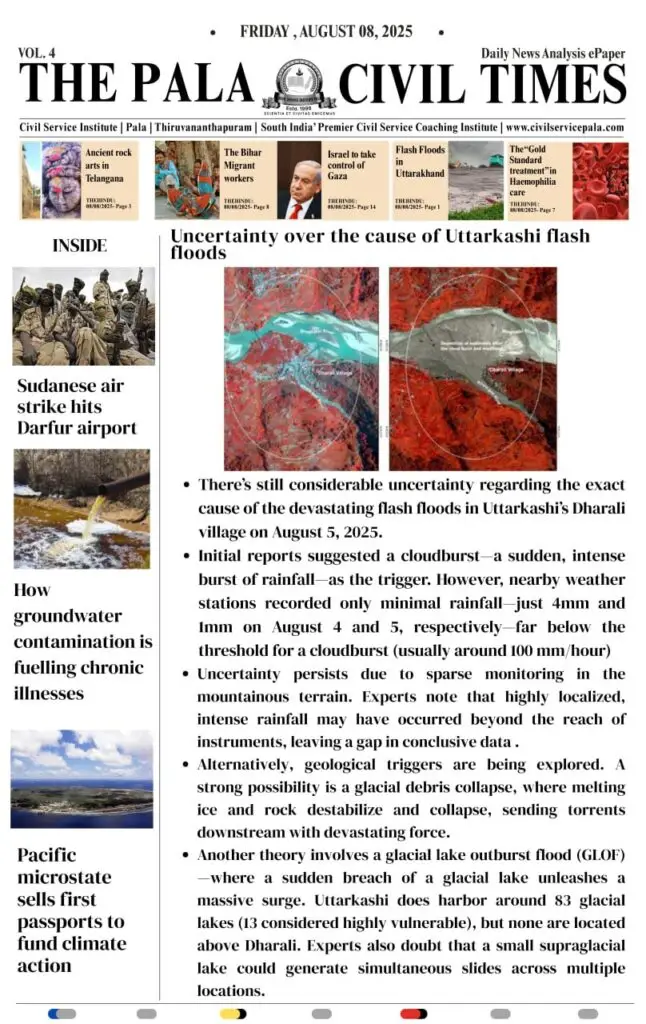
Daily News – 08-08-2025
Uncertainty over the cause of Uttarkashi flash floods
- There’s still considerable uncertainty regarding the exact cause of the devastating flash floods in Uttarkashi’s Dharali village on August 5, 2025.
- Initial reports suggested a cloudburst—a sudden, intense burst of rainfall—as the trigger. However, nearby weather stations recorded only minimal rainfall—just 4mm and 1mm on August 4 and 5, respectively—far below the threshold for a cloudburst (usually around 100 mm/hour)
- Uncertainty persists due to sparse monitoring in the mountainous terrain. Experts note that highly localized, intense rainfall may have occurred beyond the reach of instruments, leaving a gap in conclusive data .
- Alternatively, geological triggers are being explored. A strong possibility is a glacial debris collapse, where melting ice and rock destabilize and collapse, sending torrents downstream with devastating force.
- Another theory involves a glacial lake outburst flood (GLOF) where a sudden breach of a glacial lake unleashes a massive surge. Uttarkashi does harbor around 83 glacial lakes (13 considered highly vulnerable), but none are located above Dharali. Experts also doubt that a small supraglacial lake could generate simultaneous slides across multiple locations.
Uncovering ancient rock art and forgotten histories of Telangana villages
- Kotha Telangana Charithra Brundam (KTCB), meaning “New History Group of Telangana,” is a grassroots collective of around 125 members including farmers, professionals, students, and teachers.
- Members are passionate about unearthing remnants of Telangana’s past, often hidden in plain sight.
- Findings of the group include menhirs, stupas, rock art, terracotta pots, Neolithic beads, statues, prehistoric engravings, and buried structures.
- Many artefacts date back thousands of years, some as old as 10,000 years.
- Community Role: Local guides help in locating and protecting sites. Social media plays a key role in raising awareness and public engagement. Volunteers include non- historians like farmers who discovered significant heritage on their own land.
- Challenges: Threats include real estate development, vandalism, and neglect leading to “erasure” of history. Protecting sites requires community commitment to preserving heritage.
- Impact: Nearly 170 villages explored, resulting in 20 self-published books and numerous research papers. Monthly live YouTube sessions attract 30–90 participants. In-situ preservation is prioritised to keep artefacts in their original location.
- Vision: Telangana has about 5,000 villages, each with its own history. KTCB believes heritage preservation depends on local involvement to uncover and protect these histories.
MCQ of the Day: Which one of the following was a very important sea port in the Kakatiya Kingdom?
- Kakinada
- Motupalli
- Machilipatnam
- Nelluru Answer : b
In the 12th century, Motupalli was a major center of trade for horses, and it is said that the Kakatiya king Ganapati Deva imported Arabian horses through this port. It served as the primary port of the Kakatiya realm with Marco Polo referring to the Kakatiya state as the Kingdom of Motupalli.
Understanding prophylaxis: the ‘gold standard treatment’ in haemophilia care
Haemophilia Overview
- Inherited rare bleeding disorder where blood lacks clotting factor VIII.
- Leads to spontaneous internal bleeding, especially in joints and muscles, causing pain, swelling, and potential disability.
- Even minor injuries can cause prolonged bleeding
Situation in India
Expected cases: ~1.5 lakh; diagnosed: ~20,000.
Barriers: lack of awareness, limited diagnostic facilities, and economic constraints.
Without treatment, patients face chronic pain, disability, absenteeism, unemployment, and reduced productivity.
Prophylaxis as Gold Standard
- Preventive regular infusion of clotting factor to stop bleeding episodes before they occur.
- Started as a paediatric treatment in Sweden; now proven to prevent joint damage, maintain health, and improve life quality.
- Recommended over on-demand treatment (given only after a bleed starts).
Benefits of Prophylaxis
- Reduces joint bleeds, chronic pain, and long-term disability.
- Improves school/work attendance, independence, and physical activity.
- Long-term cost-effective by reducing complications and hospitalisations.
Implementation Challenges
- Requires regular intravenous or subcutaneous injections, which can be costly.
- Awareness and accessibility remain limited in India.
Global & Indian Outlook
- WHO and global experts recognise prophylaxis as the best practice in haemophilia care.
- India needs better screening, awareness drives, and affordable access to factor concentrates to improve patient outcomes.
The Bihar migrant worker, a Scylla-Charybdis moment
Context & Analogy:
- The article draws from Greek mythology’s Odyssey, comparing migrant labourers’ plight during the Special Intensive Revision (SIR) of electoral rolls to navigating between dangers (Scylla and Charybdis).
Meaning of ‘Ordinarily Resident’:
- As per Section 19 of the Representation of the People Act (1950), a person must be ordinarily resident in a constituency to be included in its electoral roll.
- Section 20 defines this, stating a person is not ordinarily resident merely because they own or rent a dwelling but don’t live there permanently.
- Temporary absences for work still count as ordinary residence, but prolonged absence without intent to return does not.
Current Issue:
- Many Bihar migrant labourers’ names are being deleted from electoral rolls as they are deemed ‘permanently shifted’.
- Migrants often keep ties with their home state but cannot prove residence during the SIR process.
- Disenfranchisement risk is high for those who cannot be physically present to register.
Supreme Court’s Position:
- Issues around disenfranchisement of migrant voters are complex and should consider social and political contexts, not just legal definitions.
Possible Solutions:
- Strict enforcement of statutory holidays on polling days.
- Special buses/trains to help migrants travel to vote.
- Multi-constituency Remote Electronic Voting Machine (RVM) to enable migrants to vote from their work location.
- Paid leave for voting.
Call for Inclusion:
- While including migrants in their original constituency is ideal, it should not be an excuse to avoid ensuring their actual participation.
- Parliament must address migrant voting rights with practical reforms to make elections more inclusive.
How groundwater contamination is fuelling chronic illnesses in India?
Groundwater Dependence in India
- Over 85% of rural drinking water and 60% of irrigation water in India comes from groundwater sources.
- Heavy reliance has made contamination a severe public health issue.
Contamination Types & Sources
- Common contaminants: fluoride, arsenic, nitrates, uranium, and heavy metals.
- Causes: excessive use of chemical fertilisers and pesticides, industrial discharge, and natural geological factors.
- Detected across states like Rajasthan, Punjab, Madhya Pradesh, Uttar Pradesh, Bihar, Haryana, Karnataka, and Tamil Nadu.
Health Impact
- Fluoride: causes dental and skeletal fluorosis, especially in Rajasthan, Andhra Pradesh, Telangana.
- Arsenic: linked to cancers, cardiovascular disease, skin lesions (notably in West Bengal, Assam, Bihar, Uttar Pradesh).
- Nitrates: cause methemoglobinemia (blue baby syndrome) and developmental issues in children.
- Uranium & heavy metals: linked to kidney diseases, bone damage, and neurological problems.
Alarming Data
- 2022 Annual Groundwater Quality Report:
- High nitrate levels exceeded safe limits in over 500 districts.
- Around 13% of rural children affected by fluorosis.
- Arsenic contamination above WHO limits found in 21 states.
- Central Pollution Control Board (CPCB) warns that contamination is rising.
Worsening Factors
- Over-extraction of groundwater leading to concentration of contaminants.
- Poor sewage and waste management, unregulated industrial effluents.
- Lack of coordinated national action.
Policy & Institutional Response Gaps
- Fragmentation between multiple agencies (CPCB, CGWB, state pollution boards) delays action.
- Need for a bold, coordinated, multi-dimensional strategy focusing on safe water access,
pollution prevention, and community awareness.
Recommendations
- Strengthen groundwater monitoring systems.
- Invest in water treatment infrastructure.
- Reduce chemical fertiliser dependency through sustainable agriculture.
- Implement stricter industrial discharge regulations.
Israel seeks to take control of Gaza, says Netanyahu
Israel intends to take full control of Gaza but does not want to keep or govern it, Prime Minister Benjamin Netanyahu said ahead of a security cabinet meeting. Opinion polls show that most Israelis want the war to end in a deal that would see the release of the remaining hostages. Israeli leaders have long insisted that Hamas be disarmed and have no future role in a demilitarised Gaza. The UN. has called reports about a possible expansion of Israel’s military operations in Gaza “deeply alarming” if true.
Fighting between the Sudanese Armed Forces (SAF) and the paramilitary Rapid Support Forces (RSF) has reignited widespread violence, including in Darfur, leading to accelerated humanitarian collapse.
Historical roots: The Darfur conflict began in 2003 when rebel groups (like SLA and JEM) rose against the Sudanese government, decrying unequal resource distribution. The government responded via the Janjaweed militia, leading to mass atrocities, displacement, and over 300,000 deaths.
Broader Implications include: Longstanding ecological degradation, Hunger & famine, Mass displacement, RSF and allied militias are accused of ethnic cleansing and genocide, Attacks on aid operations, Regional instability and Fragmented governance.
Darfur is once again engulfed in a complex conflict with roots in political marginalization, ethnic divisions, and environmental stress. With governance fractured and justice elusive, Darfur remains a flashpoint with global repercussions.
Case Study:
Pacific microstate Nauru has said it hopes to drum up more than $5 million in the “climate resilience citizenship” programme’s first year, which would equate to 66 “golden passports” sold at $105,000 each. Almost six months after the scheme opened in February, Nauru has so far approved six applications. Nauru believes the passports could eventually generate $43 million, which would account for al most 20% of projected government revenue. The Nauru passport provides visa-free entry in to more than 80 countries or territories. Nauru – A remote Pacific nation and the interest in joining the low-lying, largely barren island is increasing.