



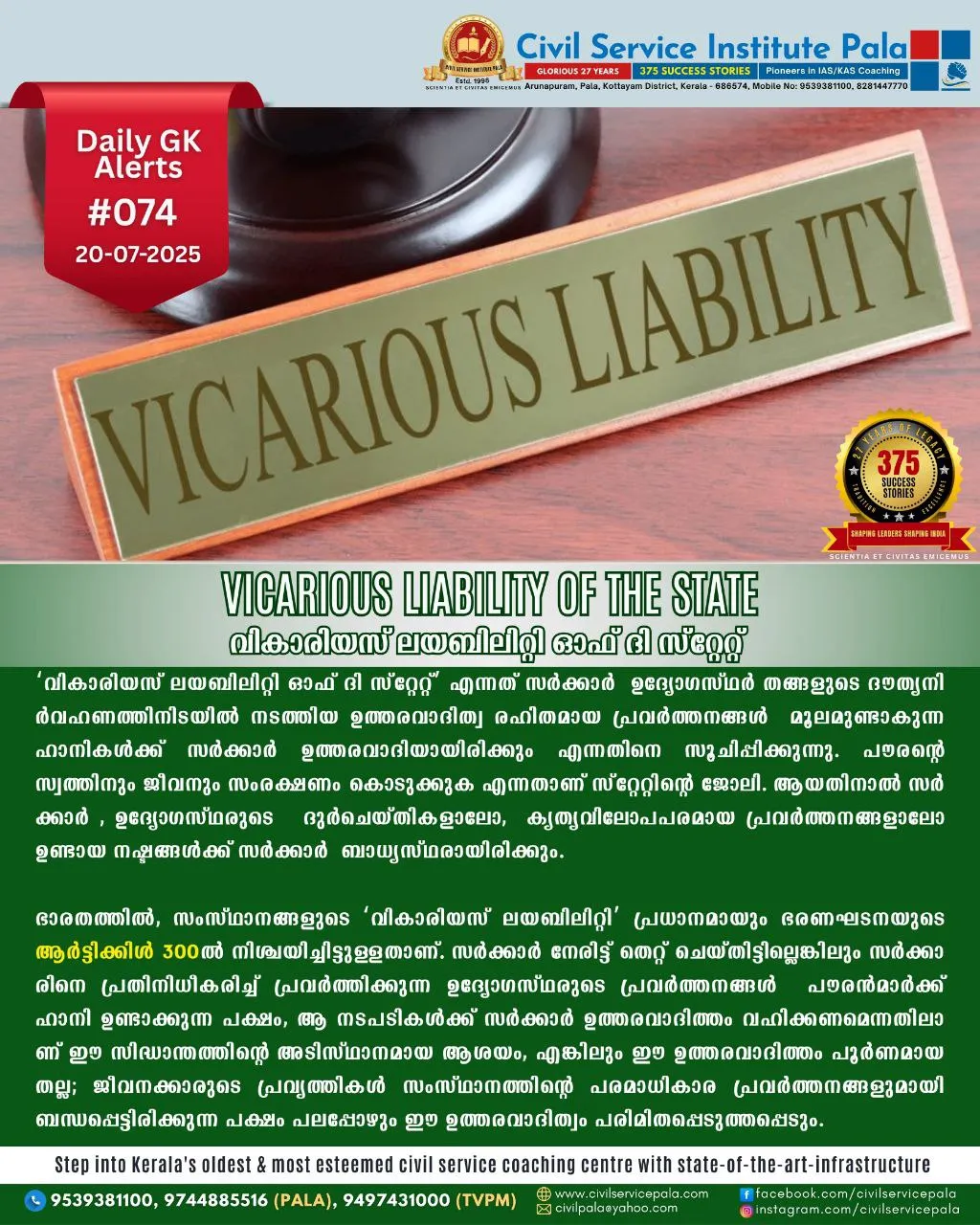
VICARIOUS LIABILITY OF THE STATE
VICARIOUS LIABILITY OF THE STATE AND ITS IMPORTANCE
The concept of vicarious liability of the State is a fundamental principle in administrative law that determines the extent to which the government can be held responsible for the wrongful acts (torts) committed by its employees. It defines state accountability in sovereign and non-sovereign functions, directly impacting citizens’ rights and remedies against state actions.
Historical Evolution
The doctrine of state liability in India evolved from colonial times to the present constitutional framework. Article 300 of the Indian Constitution acts as the cornerstone, enabling the Union and State Governments to sue and be sued like any ordinary person. This provision has its roots in the Government of India Acts of 1858, 1915, and 1935, connecting modern liability to the administrative structure established during the East India Company’s era.
Position in England
In England, under the common law doctrine of “King can do no wrong” (Res Non-Potest Peccare), the Crown was immune from civil and criminal liability for wrongful acts committed by its servants. This absolute immunity was modified through the Crown Proceedings Act, 1947, which made the state vicariously liable for torts committed by its employees in the course of employment.
Key Judicial Decisions in India
Peninsular and Oriental Steam Navigation Co. v. Secretary of State (1861): This landmark case distinguished between sovereign and non-sovereign functions. The government was held liable for negligence by its workmen engaged in non-sovereign functions, such as maintenance work.
Secretary of State v. Haribhanji (1882): Chief Justice Turner ruled that mere possession of sovereign powers by the East India Company did not grant it immunity, thus expanding the scope of state liability.
Kasturi Lal v. State of UP (1965): The Supreme Court reverted to the sovereign/non-sovereign distinction, holding the state not liable when a police officer misappropriated seized gold, as it occurred in the exercise of sovereign functions.
Classification of State Functions
Sovereign Functions: Activities essential to state sovereignty such as defence, maintenance of armed forces, national security, diplomacy, and policing. The state is generally immune from liability for acts done in these functions.
Non-Sovereign Functions: Commercial, welfare, and other activities like transportation, public facility maintenance, or industrial undertakings. The state is liable for wrongful acts committed by its employees in these domains.
Modern Constitutional Developments
The Indian judiciary has advanced state liability through constitutional remedies. In Rudul Sah v. State of Bihar (1983) and Nilabati Behra v. State of Orissa (1993), the Supreme Court awarded compensation for violations of fundamental rights, establishing that sovereign immunity does not bar constitutional remedies under Articles 32 and 226.
Importance of Vicarious Liability of the State
1. Ensures Accountability: It compels the state to maintain discipline, efficiency, and responsibility among its employees.
2. Protects Citizens’ Rights: Provides remedies for citizens against wrongful state actions, enhancing public trust.
3. Balances Immunity and Justice: While the doctrine protects essential sovereign functions, it also ensures that non-sovereign activities remain within the purview of legal accountability.
Conclusion
The doctrine of vicarious liability of the state has evolved from colonial immunity to a balanced system ensuring state accountability without undermining sovereign functions. Modern constitutional jurisprudence has strengthened citizen protection by establishing compensation as a remedy for rights violations, supplementing traditional tort remedies. However, there remains a pressing need for legislative clarity to align state liability with contemporary administrative practices and constitutional values.
