



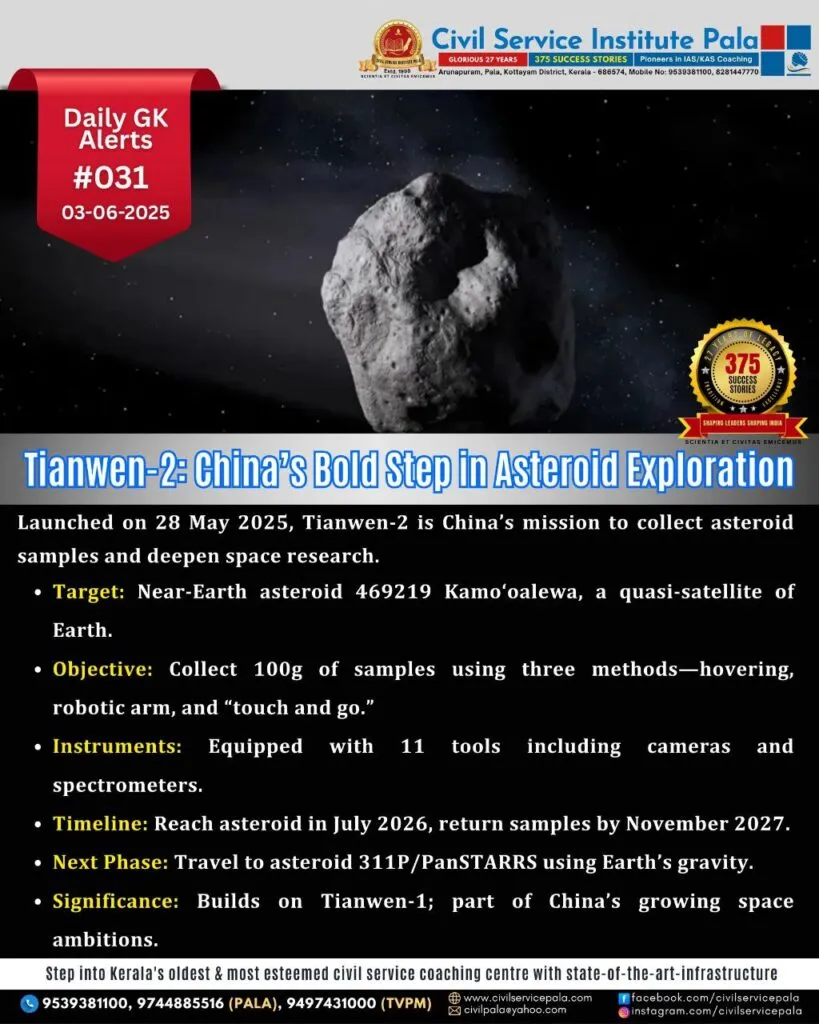
Tianwen-2: China’s Bold Step in Asteroid Exploration
Launched on 28 May 2025, Tianwen-2 marks China’s pioneering mission to explore and retrieve samples from a near-Earth asteroid. Targeting 469219 Kamoʻoalewa, a quasi-satellite orbiting Earth at distances of 15 to 39 million kilometres, this mission reflects China’s expanding footprint in deep space exploration.
Mission Goals and Instruments
Tianwen-2 aims to collect around 100 grams of material from the asteroid. Equipped with 11 advanced instruments, including cameras and spectrometers, the mission seeks to analyze the asteroid’s composition and gather clues about the early solar system.
Sample Collection Techniques
The mission incorporates three collection methods:
1. Hovering near the asteroid,
2. Using a robotic arm to gather samples,
3. A “touch and go” approach involving a brief landing and drilling operation.
Mission Timeline
The spacecraft is expected to reach Kamoʻoalewa in July 2026. After collecting samples, a return module will be launched back to Earth, with an estimated arrival in November 2027. This would make China the third nation**—after the US and Japan—to retrieve asteroid material.
Beyond Kamoʻoalewa
Following this mission, the spacecraft will continue to 311P/PanSTARRS, an active asteroid in the main belt, using Earth’s gravity to change trajectory. This extended mission adds depth to China’s 10-year space exploration roadmap.
Tianwen-2 builds on the success of Tianwen-1 and paves the way for Tianwen-3, aimed at Mars sample return. As China advances its capabilities through missions like Tianwen-2, its space programme moves closer to becoming a global leader in interplanetary exploration.
