



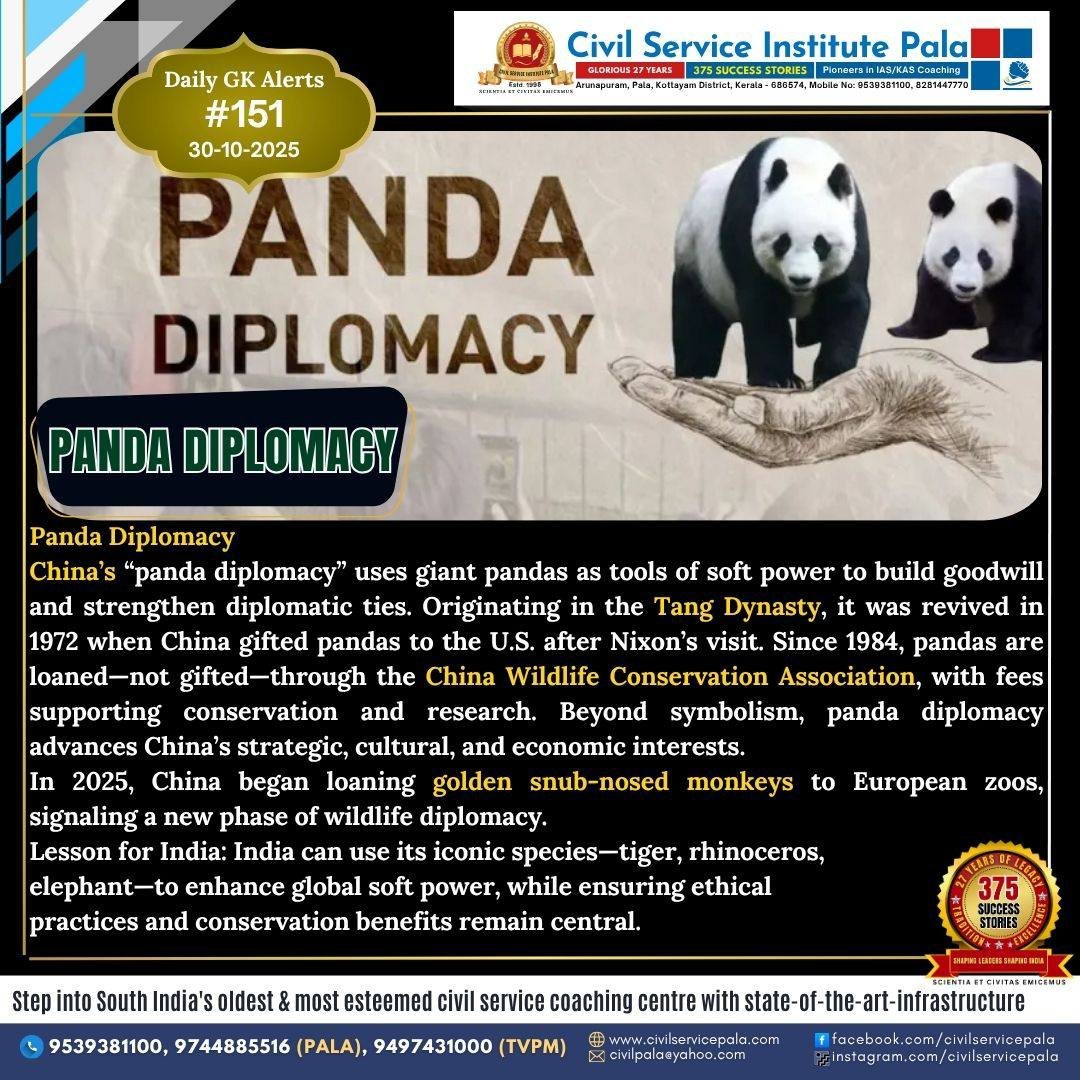
Panda Diplomacy
Meaning:
Panda diplomacy refers to the practice of China sending giant pandas to other countries as a symbol of goodwill, friendship, and diplomatic cooperation. It is a tool of soft power used by China to strengthen foreign relations and enhance its international image.
Historical Background
• Ancient roots: The tradition dates back to the Tang Dynasty (7th century) when Empress Wu Zetian sent pandas to Japan as gifts.
• Modern era: The concept became famous during the Cold War period. In 1972, following U.S. President Richard Nixon’s historic visit to China, the Chinese government gifted two pandas, Ling-Ling and Hsing-Hsing, to the Smithsonian National Zoo in Washington, D.C. This act symbolized the normalization of U.S.–China relations.
Contemporary Practice
• Since the 1980s, China no longer gives pandas as permanent gifts but loans them to foreign zoos through “panda lease agreements.”
• Typically, the host country pays an annual fee (around $1 million per pair), and any cubs born abroad remain the property of China.
• The program is managed by the China Wildlife Conservation Association, and the funds are said to support panda conservation efforts.
Diplomatic Significance
• Panda diplomacy is a form of soft power—it promotes cultural diplomacy, environmental cooperation, and positive public sentiment toward China.
• The presence of pandas often coincides with trade agreements, state visits, or improved bilateral relations.
• When diplomatic ties sour, China has sometimes requested the return of pandas, showing their symbolic importance in foreign policy.
Examples
• U.S.–China (1972): Pandas gifted after Nixon’s visit.
• France (2012): Loaned pandas after strong bilateral trade ties.
• Taiwan and Japan: Received pandas during phases of improving relations.
