



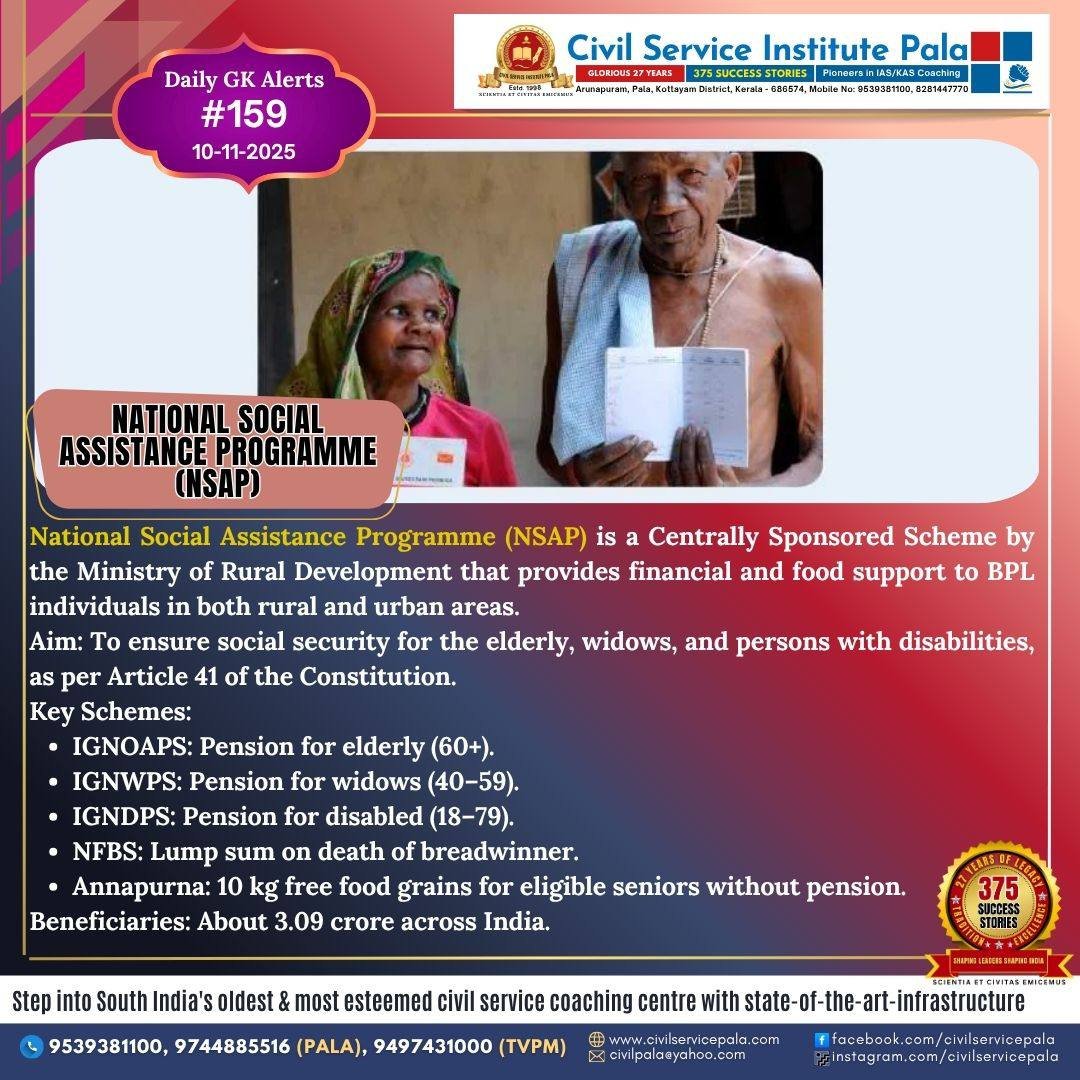
NSAP (National Social Assistance Programme)
NSAP stands for National Social Assistance Programme. NSAP was launched on 15th August, 1995.
It is implemented by the Ministry of Rural Development The National Social Assistance Programme (NSAP) represents a significant step towards the fulfillment of the Directive Principles in Article 41 and 42 of the Constitution recognizing the concurrent responsibility of the Central and the State Governments in the matter. In particular, Article 41 of the Constitution of India directs the State to provide public assistance to its citizens in case of unemployment, old age, sickness and disablement and in other cases of undeserved want within the limit of its economic capacity and development.
Objective of NSAP National Social Assistance Programme is a social security and welfare programme to provide support to aged persons, widows, disabled persons and bereaved families on death of primary bread winner, belonging to below poverty line households. Components of NSAP The NSAP at its inception in 1995 had three components namely National Old Age Pension Scheme (NOAPS, National Family Benefit Scheme (NFBS) and National Maternity Benefit Scheme (NMBS).
The National Maternity Benefit Scheme (NMBS) was subsequently transferred on 1st April, 2001 from the Ministry of Rural development to the Ministry of Health and Family Welfare. On 1st April, 2000 a new Scheme known as Annapurna Scheme was launched. This scheme aimed at providing food security to meet the requirement of those senior citizens who, though eligible, have remained uncovered under the NOAPS. In February 2009, two new Schemes known as Indira Gandhi National Widow Pension Scheme (IGNWPS) and Indira Gandhi National Disability Pension Scheme (IGNDPS) were introduced. Presently NSAP comprises of five schemes, namely – Indira Gandhi National Old Age Pension Scheme (IGNOAPS), Indira Gandhi National Widow Pension Scheme (IGNWPS), Indira Gandhi National Disability Pension Scheme (IGNDPS), National Family Benefit Scheme NFBS) and Annapurna.
