



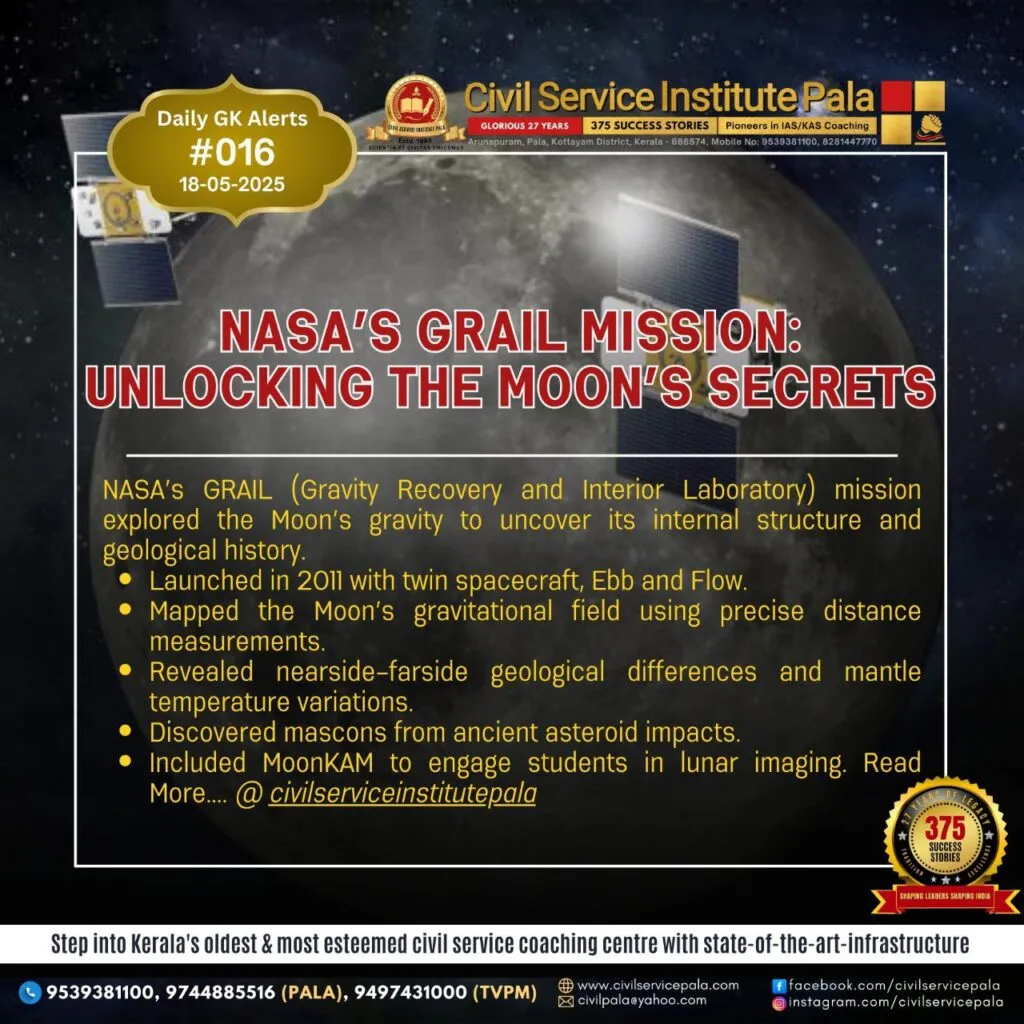
NASA’s GRAIL Mission: Unlocking the Moon’s Secrets
NASA’s Gravity Recovery and Interior Laboratory (GRAIL) mission has revolutionized our understanding of the Moon. Launched in 2011, it consisted of two spacecraft—Ebb and Flow—tasked with mapping the Moon’s gravitational field. Recent findings have highlighted stark differences between the Moon’s nearside and farside, offering new insights into its formation and internal structure.
Objectives and Methods
The GRAIL mission aimed to study the Moon’s gravity by measuring the distance between the twin spacecraft as they orbited the Moon. This method revealed variations in the gravitational pull, helping scientists explore the Moon’s hidden interior.
Key Discoveries
One major discovery is the geological contrast between the nearside and farside. The nearside, visible from Earth, contains smooth, dark plains called *mare*, formed by ancient volcanic activity. In contrast, the farside is rugged and mountainous. GRAIL also revealed that the nearside mantle is 100–200°C hotter due to the presence of radioactive elements like thorium and titanium.
Tidal Deformation and Mascons
The gravitational influence of Earth causes tidal deformation, affecting the Moon’s shape and volcanic history. GRAIL also discovered *mascons*—mass concentrations beneath the surface—believed to be remnants of asteroid impacts, offering clues to the Moon’s geological evolution.
Educational Legacy
GRAIL’s MoonKAM project engaged students in lunar exploration by allowing them to capture images, inspiring interest in space science.
NASA’s GRAIL mission has provided invaluable data on the Moon’s interior, geological differences, and history. Its findings not only deepen our understanding of the Moon but also pave the way for future lunar exploration and education.
