



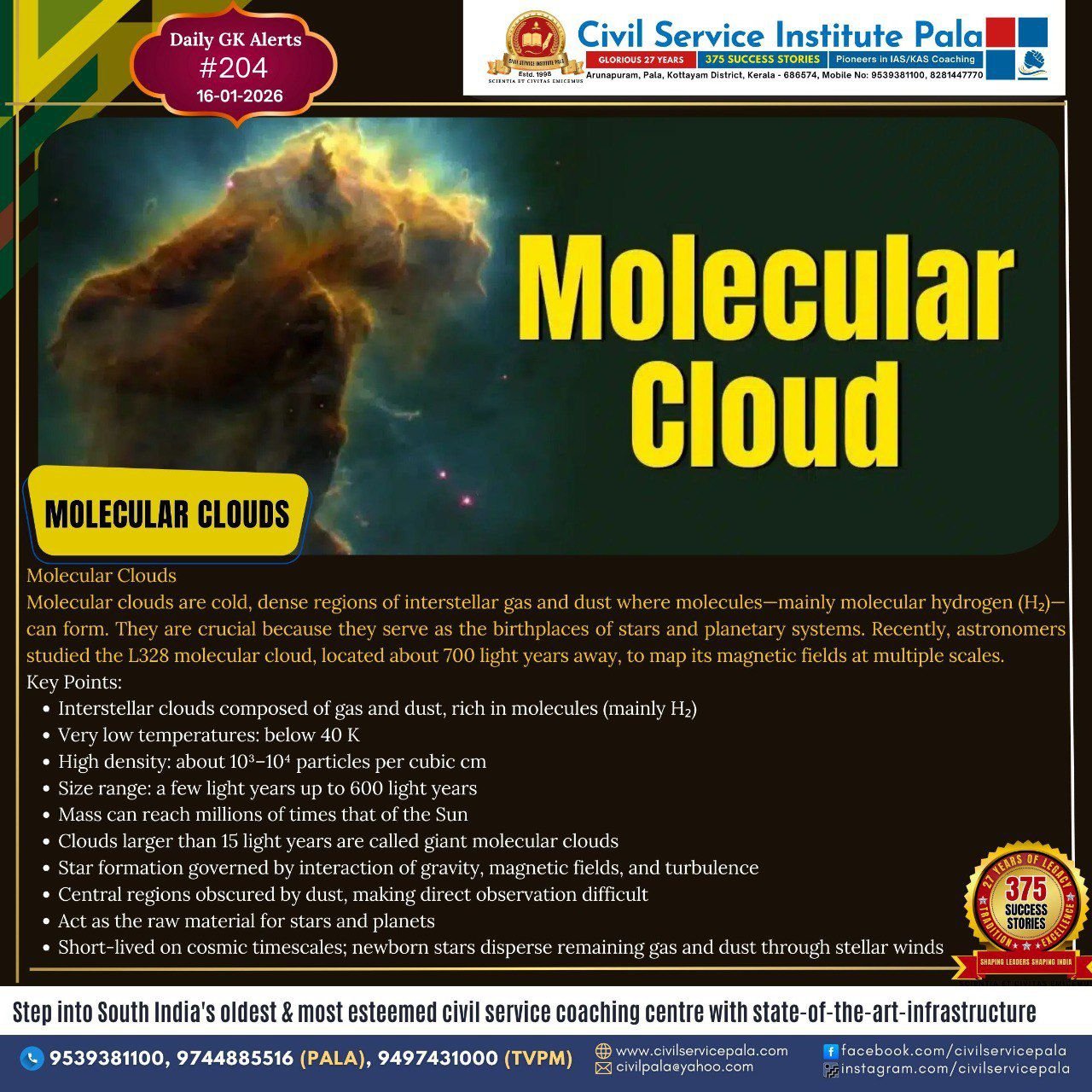
Molecular Clouds
Molecular clouds are cold, dense regions of interstellar gas and dust where molecules—mainly molecular hydrogen (H₂)—can form. They are crucial because they serve as the birthplaces of stars and planetary systems. Recently, astronomers studied the L328 molecular cloud, located about 700 light years away, to map its magnetic fields at multiple scales.
Key Points:
Interstellar clouds composed of gas and dust, rich in molecules (mainly H₂)
Very low temperatures: below 40 K
High density: about 10³–10⁴ particles per cubic cm
Size range: a few light years up to 600 light years
Mass can reach millions of times that of the Sun
Clouds larger than 15 light years are called giant molecular clouds
Star formation governed by interaction of gravity, magnetic fields, and turbulence
Central regions obscured by dust, making direct observation difficult
Act as the raw material for stars and planets
Short-lived on cosmic timescales; newborn stars disperse remaining gas and dust through stellar winds
