



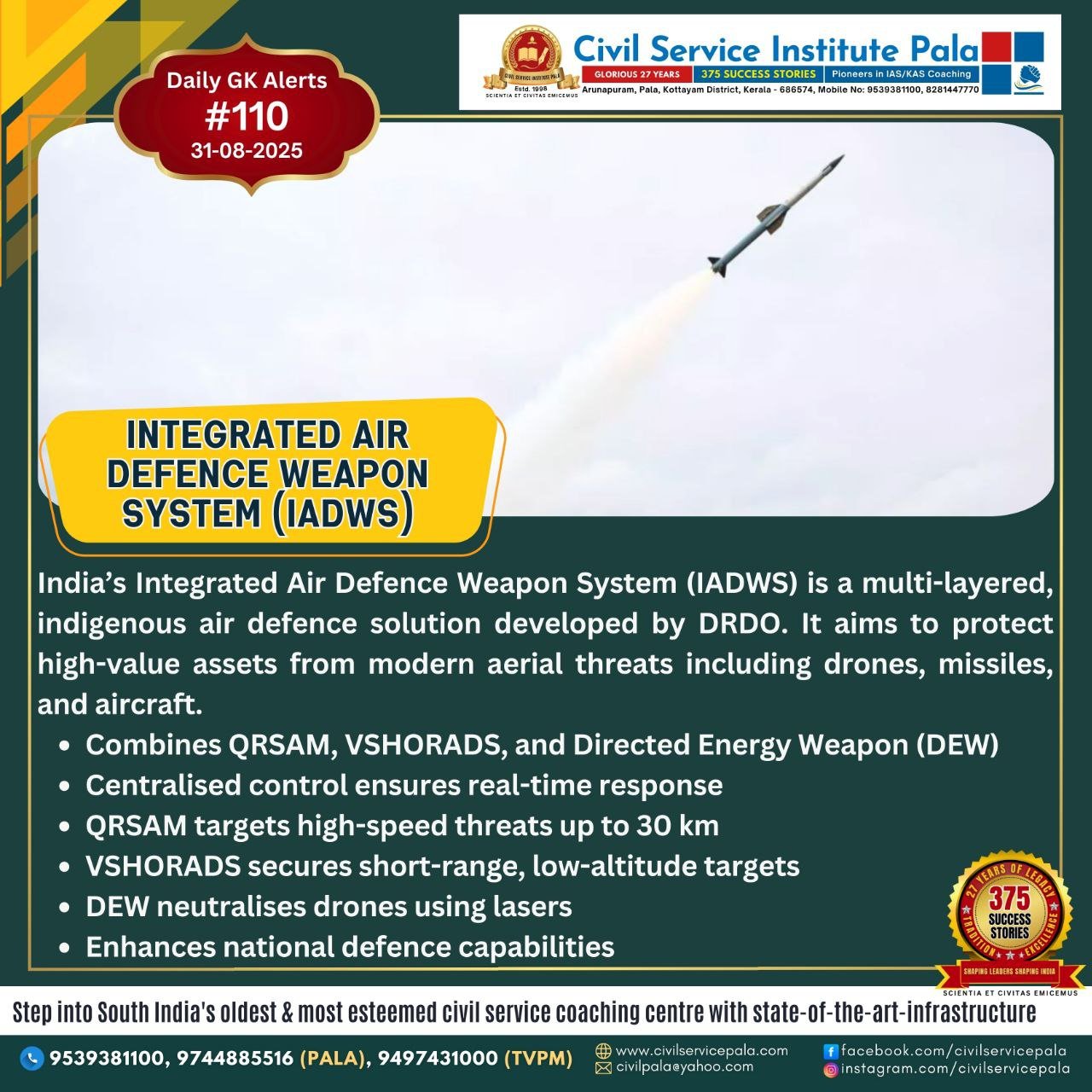
Integrated Air Defence Weapon System (IADWS): India’s Next-Gen Air Shield
India has successfully tested its Indigenous Integrated Air Defence Weapon System (IADWS), a multi-layered, network-centric defence shield developed by DRDO under Project Sudarshan Chakra. The test, conducted off Odisha’s coast, marks a major milestone in strengthening India's air defence capabilities.
What is IADWS?
IADWS is a layered air defence system combining three key components: * QRSAM (Quick Reaction Surface-to-Air Missile): Engages high-speed aerial targets like jets and cruise missiles at a range of 25–30 km. * VSHORADS (Very Short Range Air Defence System): A shoulder-fired infrared missile effective against low-flying drones and helicopters within 6 km. * DEW (Directed Energy Weapon): A high-power laser that neutralises drones and loitering munitions at close range, offering unlimited firing with minimal cost.
How It Works
At the core lies the Centralised Command and Control Centre (C2C2), which integrates radar and optical sensors to create a real-time air picture. Based on parameters like speed, altitude, and trajectory, C2C2 assigns the right weapon to intercept each threat. The three-tiered system ensures rapid response and simultaneous targeting of multiple threats.
Strategic Importance
The IADWS protects high-value assets such as airbases, radar sites, command centres, and critical infrastructure. It is mobile, indigenous, and capable of handling both conventional and asymmetric threats—including swarming drones.
IADWS represents a major leap in India’s air defence capabilities. With its multi-layered protection and real-time coordination, it ensures robust defence against evolving aerial threats.
