



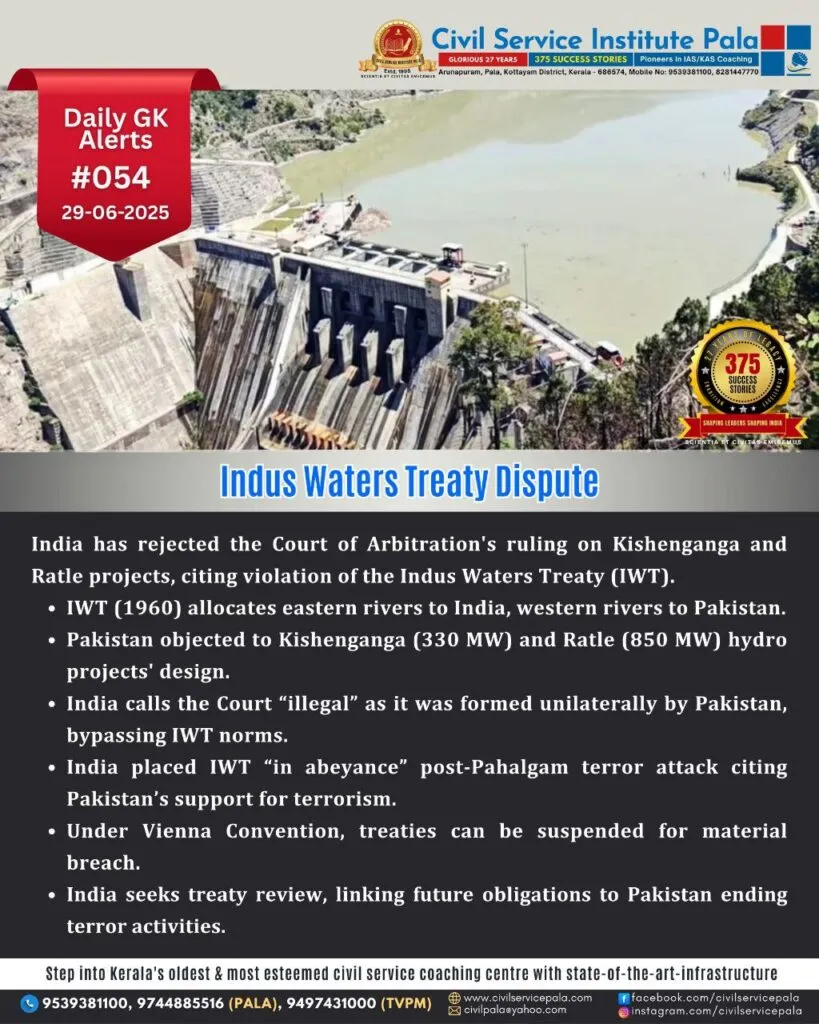
Indus Waters Treaty Dispute
Indus Waters Treaty Dispute: India Rejects Court of Arbitration Award
Background of Indus Waters Treaty (IWT)
Signed in 1960 between India and Pakistan after nine years of negotiations, the Indus Waters Treaty (IWT) allocates waters of eastern rivers (Sutlej, Beas, Ravi) to India and western rivers (Indus, Jhelum, Chenab) to Pakistan, with provisions for hydroelectric projects under specific conditions.
Recent Court of Arbitration Ruling
Recently, a Court of Arbitration issued a “supplemental award” questioning the design and functioning of India’s Kishenganga (330 MW) and Ratle (850 MW) hydroelectric projects in Jammu and Kashmir. Pakistan objects to their design, claiming violations of IWT clauses on spillway structure and pondage.
India’s Stand on the Court’s Legality
India has categorically rejected the Court’s ruling, calling it “illegal” and in “brazen violation” of the Treaty. The Ministry of External Affairs stated that the Court was formed unilaterally at Pakistan’s request, bypassing IWT norms requiring bilateral agreement for such an arbitration mechanism. India argues the so-called Court has “no existence in law” and that any award by it is “void”.
Treaty Suspension by India
Following the April 2025 Pahalgam terrorist attack linked to Pakistan-based groups, India placed IWT “in abeyance” under its sovereign rights. It asserts that treaties can be suspended under the Vienna Convention in case of material breach, citing Pakistan’s continued support for cross-border terrorism.
Strategic and Diplomatic Implications
India warns that unless Pakistan eradicates all terror infrastructure and activities, the Treaty will remain suspended. India has also initiated review and modification notices to Pakistan, indicating its intent to renegotiate the treaty framework in the future.
The Indus Waters Treaty, a symbol of rare India-Pakistan cooperation, faces unprecedented strain due to terrorism-related diplomatic breakdowns. India’s rejection of the arbitration award underscores its assertion of sovereignty, linking future water-sharing commitments directly to Pakistan’s anti-terrorism accountability.
