



India’s S-400 Missile Defence System: The Sudarshan Chakra of Modern Warfare
India’s national security architecture has seen significant advancements in recent years, with an emphasis on building robust and multi-layered defence systems. One of the most powerful additions to India’s military arsenal is the S-400 Triumf missile defence system, an advanced surface-to-air missile (SAM) system acquired from Russia. Nicknamed the “Sudarshan Chakra” by the Indian military, the S-400 represents a formidable shield against aerial threats, drawing symbolic inspiration from the mythological weapon of Lord Vishnu that annihilates evil with precision and power. With its cutting-edge technology and long-range strike capabilities, the S-400 system strengthens India’s integrated air defence network and acts as a strategic deterrent in the region.
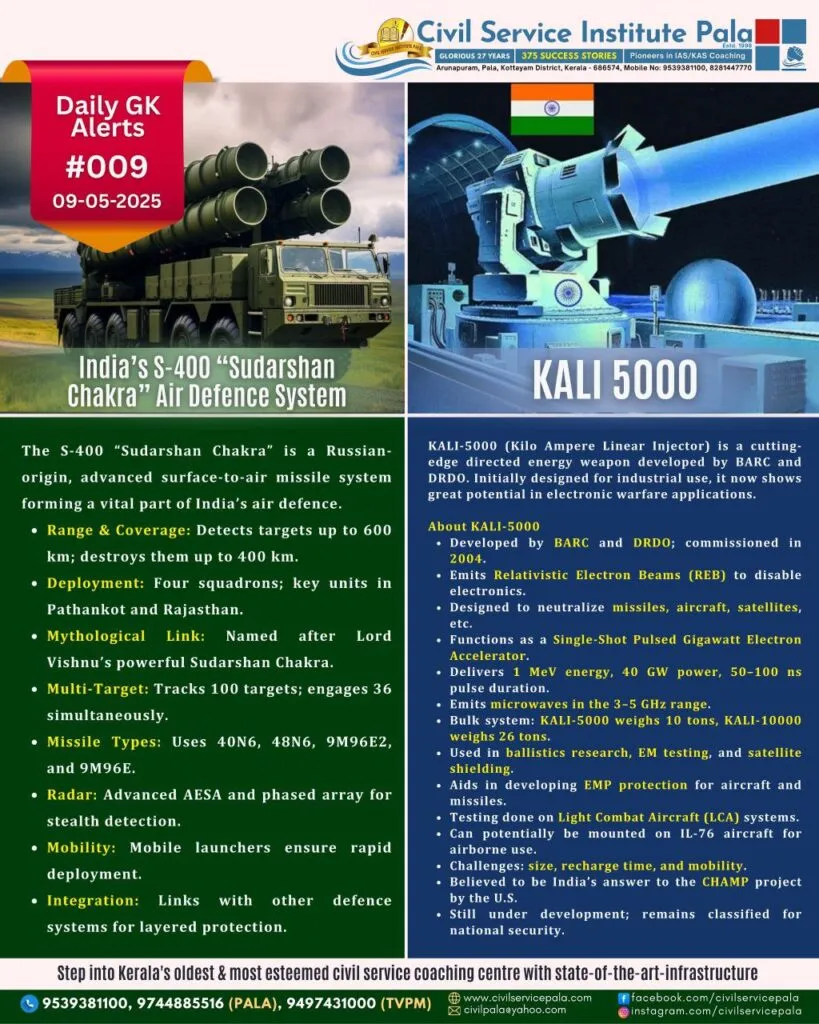
The S-400 system stands out as one of the most sophisticated air defence systems in the world. It can detect aerial targets from a distance of up to 600 kilometres and destroy them at ranges of up to 400 kilometres and altitudes reaching 30 kilometres. This wide coverage ensures the protection of critical infrastructure and airspace from multiple threats including enemy aircraft, drones, cruise missiles, and even ballistic missiles.
India currently possesses four squadrons of the S-400 Sudarshan Chakra. These squadrons are strategically deployed, with one located in Pathankot to safeguard the sensitive borders of Jammu and Kashmir and Punjab, and another positioned to protect vital regions in Rajasthan and Gujarat. Such deployment ensures the rapid neutralization of threats arising from India’s western borders.
One of the key strengths of the S-400 lies in its multi-target tracking and engagement capability. It can track up to 100 aerial targets simultaneously and engage 36 of them at once, allowing a swift and overwhelming response to multiple intrusions. The system is equipped with four different types of missiles—40N6 (400 km), 48N6 (250 km), 9M96E2 (120 km), and 9M96E (40 km)—providing layered and flexible defence against a spectrum of threats.
Another notable feature is its advanced radar technology. The S-400 employs a combination of phased array and Active Electronically Scanned Array (AESA) radars, capable of detecting stealth aircraft and low-flying targets even under heavy electronic countermeasure conditions. Its mobility adds to its strength; being mounted on mobile platforms, the system can be rapidly deployed or relocated, offering both offensive and defensive tactical advantages.
The induction of the S-400 missile system, aptly dubbed “Sudarshan Chakra,” marks a transformative leap in India’s air defence capabilities. Much like the mythological weapon it is named after, the S-400 stands as a symbol of speed, precision, and formidable power. It not only acts as a shield protecting India’s skies but also sends a strong message of deterrence to potential adversaries. As India continues to modernize its military infrastructure, the S-400 plays a crucial role in ensuring strategic dominance and operational preparedness in a complex security environment.
KALI-5000: India’s Secret Electromagnetic Warfare Weapon
India’s defense capabilities have steadily evolved with advances in technology and innovation. Among the most mysterious and potentially groundbreaking developments is the KALI-5000, a high-powered electromagnetic weapon still under development. KALI, which stands for Kilo Ampere Linear Injector, is a linear electron accelerator initially designed for industrial applications. However, its immense potential for defense was soon realized, and since then, the project has progressed under the joint efforts of DRDO (Defence Research and Development Organisation) and BARC (Bhabha Atomic Research Centre).
Development and Design
The origins of the KALI project trace back to 1985 when Dr. R. Chidambaram, then Director of BARC, envisioned an electron accelerator. Officially launched in 1989, the project aimed to produce high-energy electron pulses lasting around 100 nanoseconds at 1 MeV (Mega Electron Volt). The KALI series evolved through various stages—KALI 80, 200, 1000, 5000, and 10000—each version significantly more powerful than the last. KALI-5000, commissioned in 2004, is capable of generating electron beams with 40 GW of power, a pulse duration of 50–100 nanoseconds, and 40kA current.
The technology uses water-filled capacitors to store energy, which is released in a single powerful burst. The system emits high-power microwaves in the 3–5 GHz range and can produce relativistic electron beams (REB) that could disable any object with electronic circuitry—like missiles, aircraft, and satellites. However, its operational limitations include bulkiness, heavy power demands, and slow recharge times, which currently restrict it to single-use functionality.
Applications and Strategic Importance
Although still not fully weaponized, KALI-5000 has been used for critical defense-related testing. The DRDO has utilized it for evaluating the vulnerability of systems such as the Light Combat Aircraft (LCA) and in developing protective electrostatic shields to guard against microwave and electromagnetic pulse (EMP) attacks. The flash X-rays generated by KALI are employed in ultrahigh-speed photography for ballistics research at DBRL (Defence Ballistics Research Laboratory) in Chandigarh.
In future, KALI holds promise as an anti-satellite or missile defense weapon, potentially mounted on airborne platforms like IL-76 aircraft. The system could serve as a strategic counter to threats posed by nations like China and Pakistan. There have even been unverified reports linking KALI to the 2012 Siachen glacier avalanche, suggesting its capability to influence geophysical environments using focused energy.
KALI-5000 represents a significant leap in India’s indigenous high-energy defense technologies. While still under development, the potential applications of this electron accelerator in warfare are vast—from disabling enemy electronics to protecting national assets against EMP attacks. As efforts continue to miniaturize the system and improve its efficiency, KALI could emerge as a cornerstone of India’s futuristic defense strategy. Its existence underscores India’s commitment to staying ahead in the increasingly high-tech realm of modern warfare, even if much about the system remains classified for national security reasons.
