



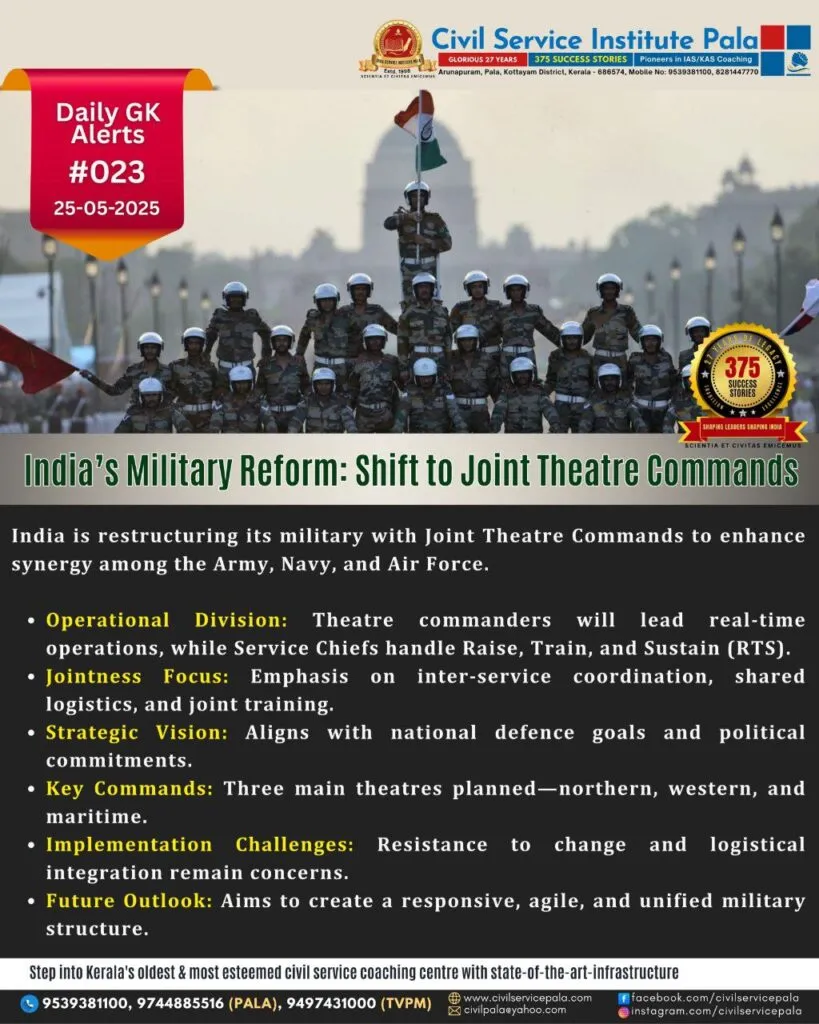
India’s Military Reform: Shift to Joint Theatre Commands
India is undertaking a significant military reform by introducing Joint Theatre Commands to enhance operational synergy among the Army, Navy, and Air Force. Spearheaded by Chief of Defence Staff General Anil Chauhan, this transformation aims to modernise defence capabilities and streamline decision-making.
Structure and Responsibilities
Under the new framework, theatre commanders will handle operational execution, including real-time deployments and strategic operations. On the other hand, the Service Chiefs will be responsible for the ‘Raise, Train, and Sustain’ (RTS) functions, focusing on preparing and maintaining combat-ready forces. This clear separation ensures operational efficiency and focused resource management.
The Need for Jointness
A core element of this transformation is jointness**—encouraging close coordination among the three services. This involves conducting joint training exercises, sharing logistics, and establishing integrated communication systems. Such collaboration is expected to result in faster and more effective responses to security threats.
Challenges in Implementation
Transitioning to joint theatre commands comes with challenges. Traditional resistance to change and logistical issues in integrating existing systems may slow progress. Therefore, continuous communication and capacity-building among personnel are essential for successful implementation.
Strategic and Political Relevance
The reform also aligns with the political vision outlined in the ruling party’s manifesto. The plan includes establishing **three main theatre commands for land and maritime operations. Appointing senior four-star officers reflects the high priority placed on this initiative.
The introduction of Joint Theatre Commands marks a historic step in India’s military evolution. It is expected to foster a culture of integration, improve operational capabilities, and create a more agile and responsive defence force for the challenges of the 21st century.
