



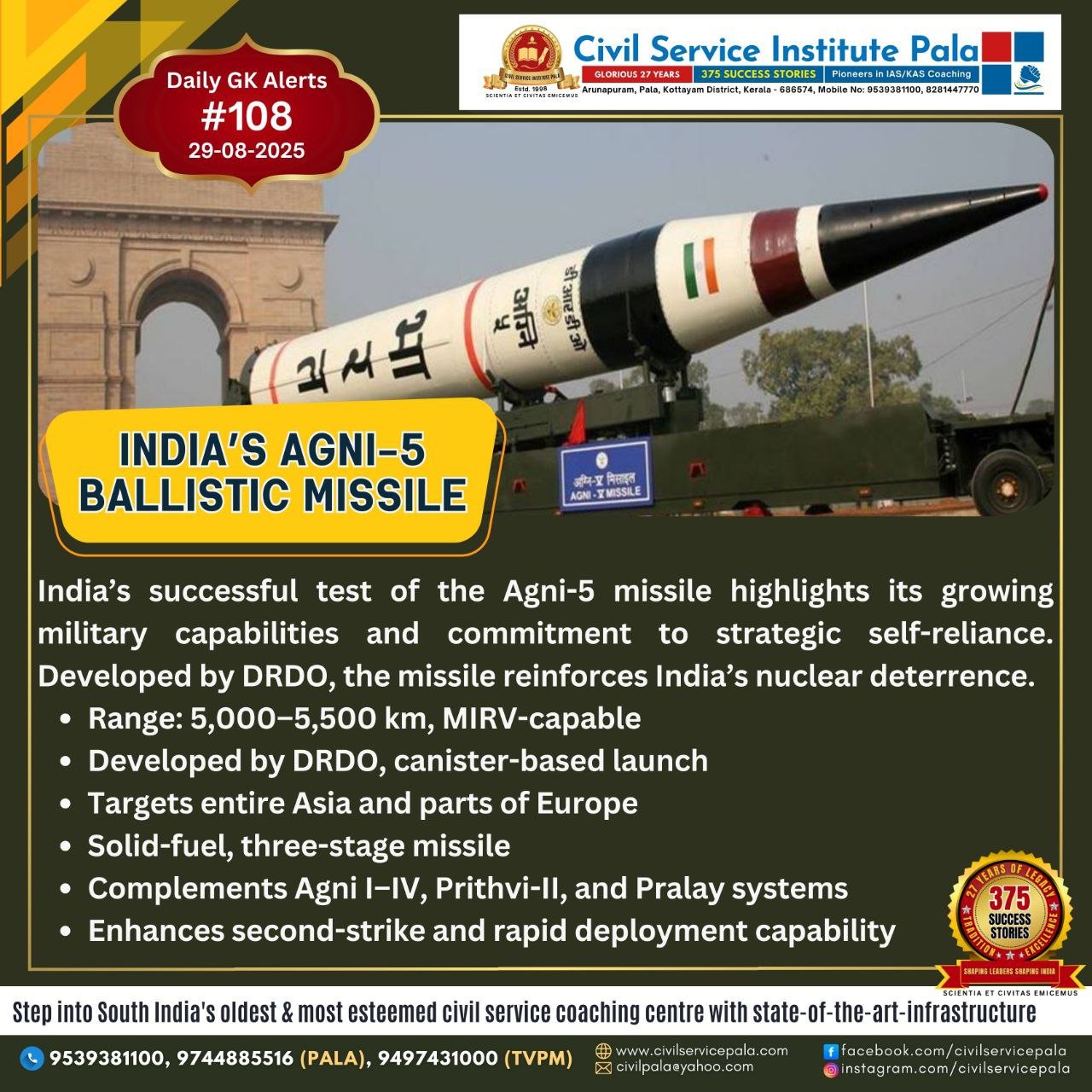
India’s Agni-5 Ballistic Missile: Strengthening Strategic Deterrence
India successfully test-fired the Agni-5 intermediate-range ballistic missile (IRBM) from the Integrated Test Range in Chandipur, Odisha, under the Strategic Forces Command. This test reinforces India’s strategic deterrence and technological prowess in missile development.
Agni-5: Key Features
Agni-5 is India’s most advanced surface-to-surface nuclear-capable missile, developed by the Defence Research and Development Organisation (DRDO). Though officially categorized as an IRBM, its range and capabilities place it within intercontinental ballistic missile (ICBM) classification.
* Range: 5,000–5,500 km, with potential upgrades to 7,500 km
* Payload: Up to 1.5 tonnes, including MIRV (Multiple Independently Targetable Re-entry Vehicles)
* Launch: Canisterised system allowing quick, mobile deployment
* Technology: Three-stage, solid-fuel propulsion, ring laser gyros, micro inertial navigation systems, and composite materials for strength and lightness
Strategic Significance
Agni-5 can cover entire Asia, including northern China, and parts of Europe and Africa. This enhances India’s second-strike capability and solidifies its nuclear deterrence posture. The successful test, following regional tensions, signals India’s military readiness and technological maturity. Prime Minister Modi also praised DRDO for their achievement.
Agni Missile Series
India's Agni missile family ranges from short-range (Agni-I, \~700–900 km) to long-range (Agni-IV, \~3,500–4,000 km), all developed indigenously. Agni-5 stands as the most capable variant, following successful deployment of Agni-1 to Agni-4 and complementary systems like Prithvi-II and Pralay missiles.
Conclusion
The Agni-5 test not only strengthens India's strategic defence but also reaffirms its growing self-reliance in advanced military technology. With ongoing upgrades like MIRV and extended range, India is poised to play a leading role in regional stability and global security frameworks.
