



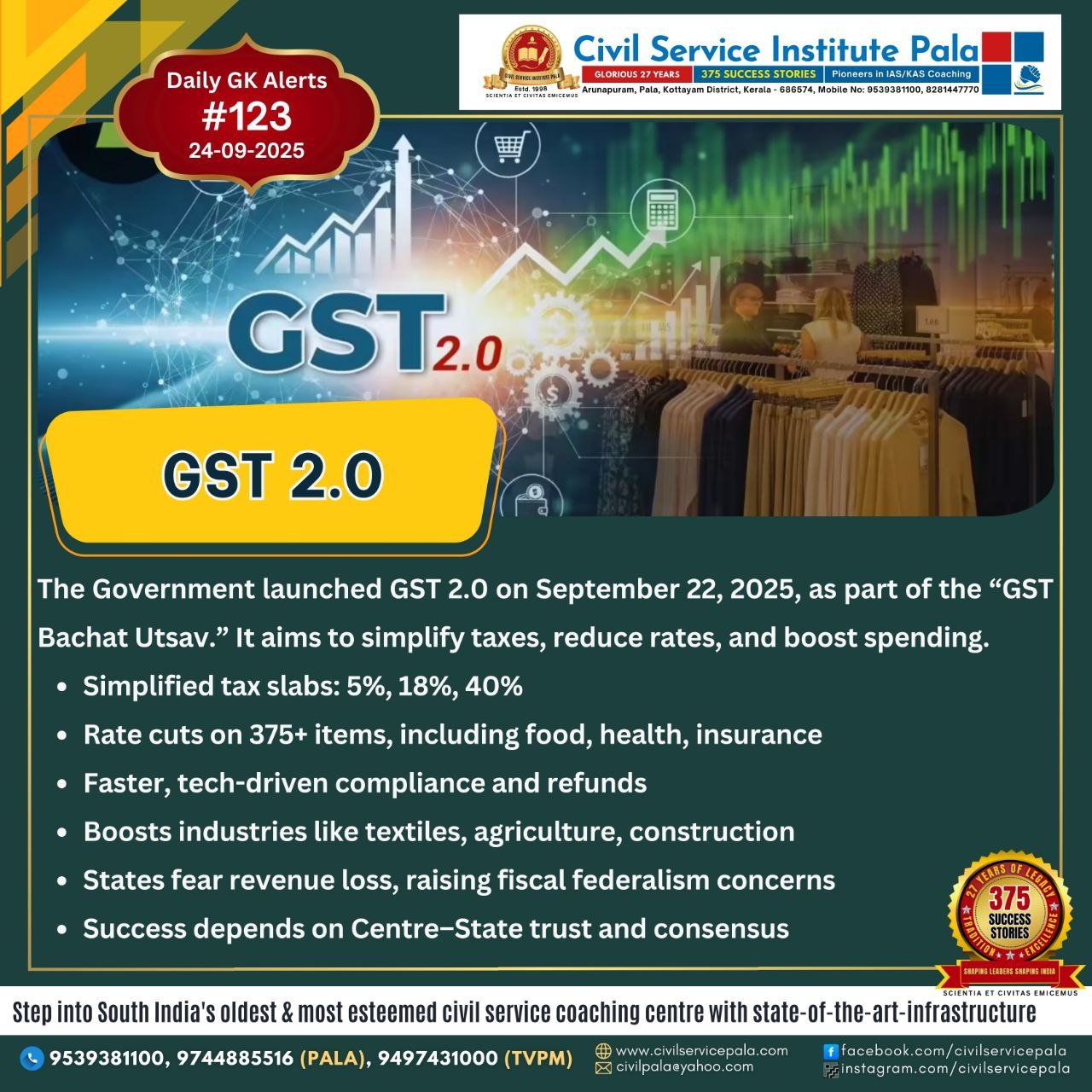
GST 2.0 – Reform and Federal Challenges
The Government of India launched GST 2.0 on September 22, 2025, calling it the *“GST Bachat Utsav.”* It is a major tax reform under the Goods and Services Tax (GST) regime first introduced in 2017. The reform aims to simplify taxes, reduce rates, and boost consumption, but it has also raised debates on fiscal federalism.
Key Features of GST 2.0
GST 2.0 rationalises tax slabs into a simpler structure: 5% (merit goods), 18% (standard goods), and 40% (demerit goods). Over 375 items saw rate cuts, including food, medical devices, agricultural machinery, life and health insurance, and beauty services. Precious metals and diamonds received special lower rates. Compliance has been simplified through tech-driven registration, pre-filled returns, and faster refunds. By leaving more money in the hands of people, the government hopes to encourage spending and investment, especially in industries like textiles, agriculture, and construction.
Federal Concerns
While GST 2.0 benefits consumers, states fear revenue losses. GST has already reduced state autonomy in taxation, with decisions largely shaped by the GST Council where the Centre has significant voting power. Opposition-ruled states argue that without adequate safeguards, slab rationalisation could harm their finances. Some have demanded compensation, while the Union government insists that rising consumption will cover revenue shortfalls. This debate reflects the larger issue of fiscal federalism—balancing Centre’s reforms with states’ financial independence.
Conclusion
GST 2.0 is an important step towards a simpler and consumer-friendly tax system. However, for its success, the Union and states must work with trust and consensus. Ensuring fair revenue sharing and protecting states’ fiscal space is essential for strengthening cooperative federalism in India.
