



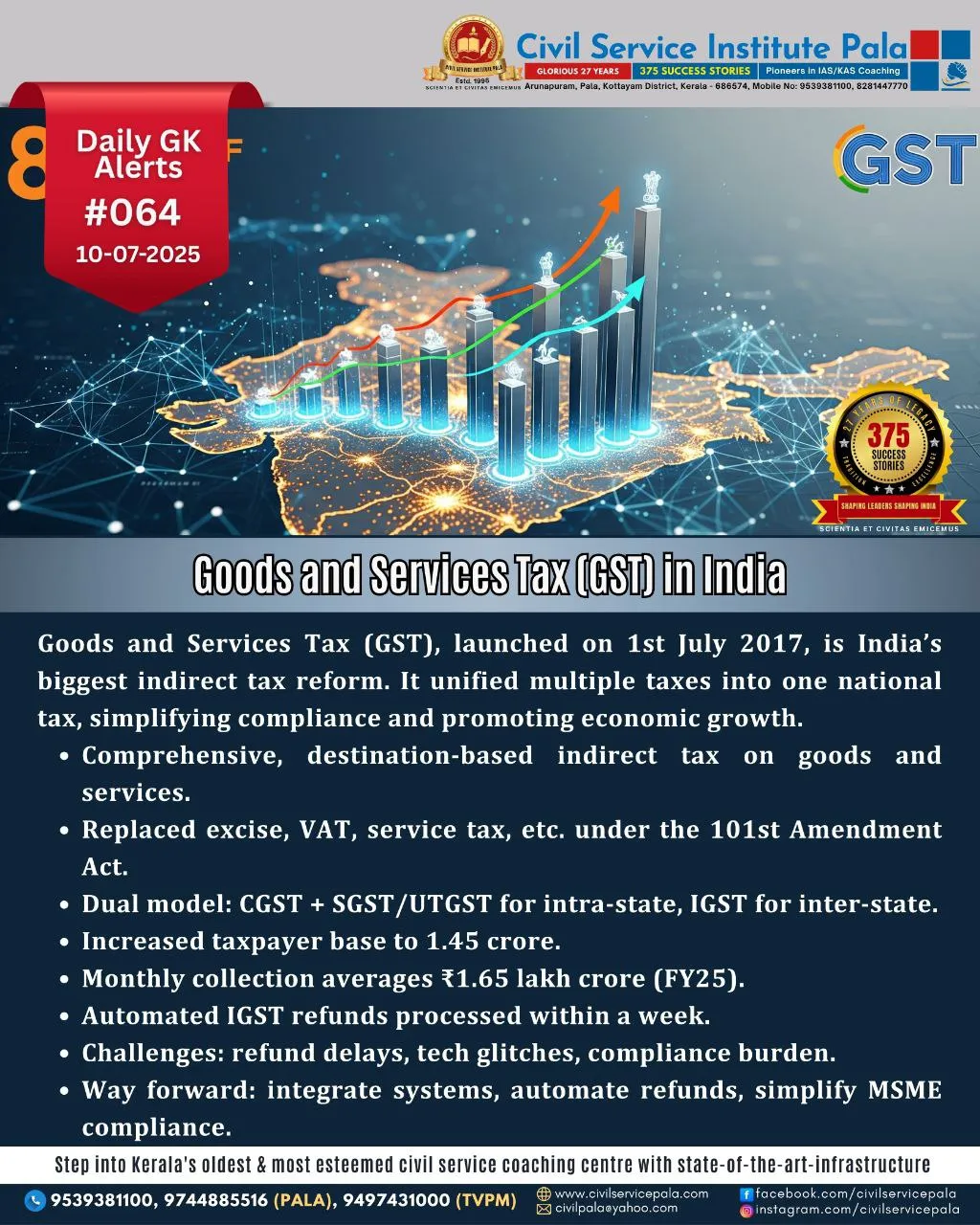
Goods and Services Tax (GST) in India
Goods and Services Tax (GST) in India
Goods and Services Tax (GST) is one of the biggest tax reforms in India, introduced to simplify the complex indirect tax system. It replaced multiple central and state taxes, creating a single unified tax regime across the country.
What is GST?
GST is a comprehensive, multi-stage, destination-based indirect tax levied on goods and services consumed within India. It follows the Value Added Tax (VAT) principle, where tax is charged at every stage of production but the final burden falls on the consumer. GST aims to create ‘One Nation, One Tax, One Market’, ensuring seamless credit and reducing tax on tax (cascading effect).
Evolution and Launch
* The idea of GST was suggested by the Kelkar Task Force in 2003.
* Proposed in Budget 2006-07, introduced through the Constitution (101st Amendment) Act, 2016.
* Finally launched on 1st July 2017.
*Constitutional Framework*
*The 101st Amendment Act introduced:*
* Article 246A: Both Centre and States can make GST laws.
* Article 269A: Centre collects IGST on inter-state trade and shares with states.
* Article 279A: Provides for GST Council to decide tax rates and rules.
GST Structure
India follows a Dual GST Model:
* CGST: Collected by the Centre on intra-state supply.
* SGST/UTGST: Collected by States/UTs on intra-state supply.
* IGST: Collected by Centre on inter-state supply and imports.
Key Features
* Technology-driven using GSTN portal.
* Input Tax Credit (ITC) available to reduce tax burden.
* Zero-rated exports to promote foreign trade.
* Multiple slabs for goods and services.
* E-way bills for goods movement above ₹50,000 in value.
Achievements in 8 Years
* Taxpayer base expanded to 1.45 crore.
* Monthly collections averaged ₹1.65 lakh crore in FY25, with a record ₹2.10 lakh crore in April 2025.
* Automated IGST refunds processed within a week, totalling ₹1.18 lakh crore in FY25.
* Reduced logistics cost, improved Ease of Doing Business, and created a common national market.
Challenges
* Refund delays under GST officers, unlike fast IGST refunds.
* Technical glitches affecting small businesses.
* Compliance burden due to frequent changes and portal issues.
* Limited fiscal autonomy for states, raising concerns.
* Inverted duty structure leads to refund accumulation and blocked working capital.
Way Forward
1. Integrate GST and Customs systems for faster refunds.
2. Extend automation to all refund processes.
3. Simplify returns for MSMEs with single-page formats.
4. Strengthen appellate tribunals for faster dispute resolution.
5. Implement GST 2.0 to expand tax base (including fuel/alcohol) and simplify rates.
In eight years, GST has transformed India’s indirect tax system by simplifying taxes, reducing cascading, and creating a unified market. However, issues like refund delays, compliance burden, and tech glitches need urgent reforms. A stable, transparent, and taxpayer-friendly GST will boost economic growth, improve competitiveness, and strengthen India’s tax governance in the coming years.
