



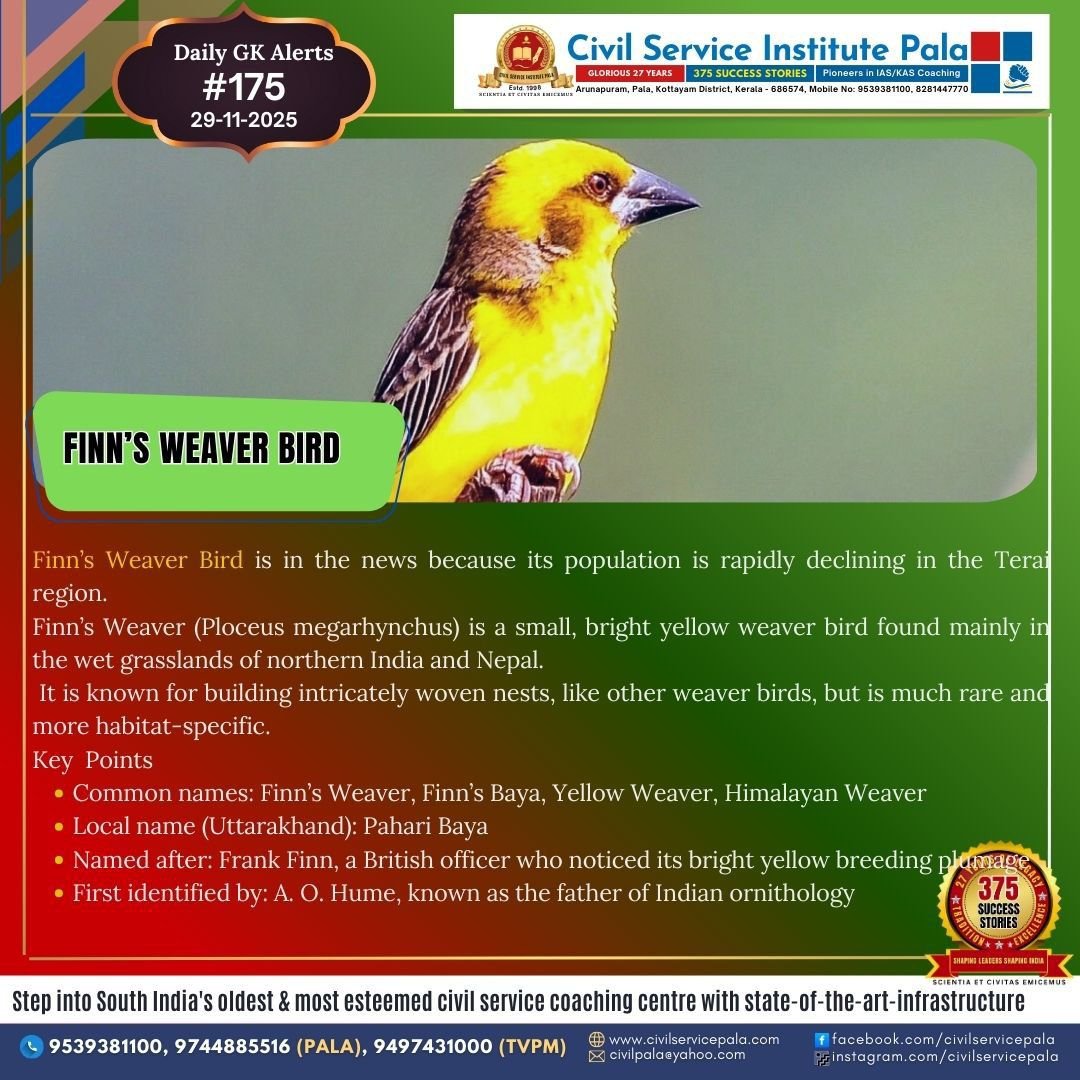
Finn’s Weaver (Finn’s Baya)
Why in news?
Finn’s Weaver, a rare weaver bird species of the Indian subcontinent, is in the news because its population is rapidly declining in the Terai region, especially in Uttarakhand and Uttar Pradesh.
What is Finn’s Weaver?
Finn’s Weaver (Ploceus megarhynchus) is a small, bright yellow weaver bird found mainly in the wet grasslands of northern India and Nepal.
It is known for building intricately woven nests, like other weaver birds, but is much rare and more habitat-specific.
Key Identity Points
Common names: Finn’s Weaver, Finn’s Baya, Yellow Weaver, Himalayan Weaver
Local name (Uttarakhand): Pahari Baya
Named after: Frank Finn, a British officer who noticed its bright yellow breeding plumage
First identified by: A. O. Hume, known as the father of Indian ornithology
Where is it found?
Finn’s Weaver lives mainly in the Ganges and Brahmaputra river valleys, especially in the Terai grasslands of:
Northern India
Southern Nepal
Typical Habitat
Areas near dams, reservoirs, marshy soil and tall grasses
Grasslands with abundant water and nesting vegetation
Diet
Mainly granivorous – eats seeds
Also insectivorous during the breeding season to feed chicks
Conservation Status
IUCN Red List: Endangered
Wildlife Protection Act, 1972: Schedule IV
This means the bird faces a very high risk of extinction in the wild.
Why is it declining? (Threats)
Expansion of agriculture into grasslands
Grass cutting during nesting season
Construction and infrastructure development
Water management changes (reservoirs, dams)
Floods destroying nests
Predation by crows
Low breeding success
