



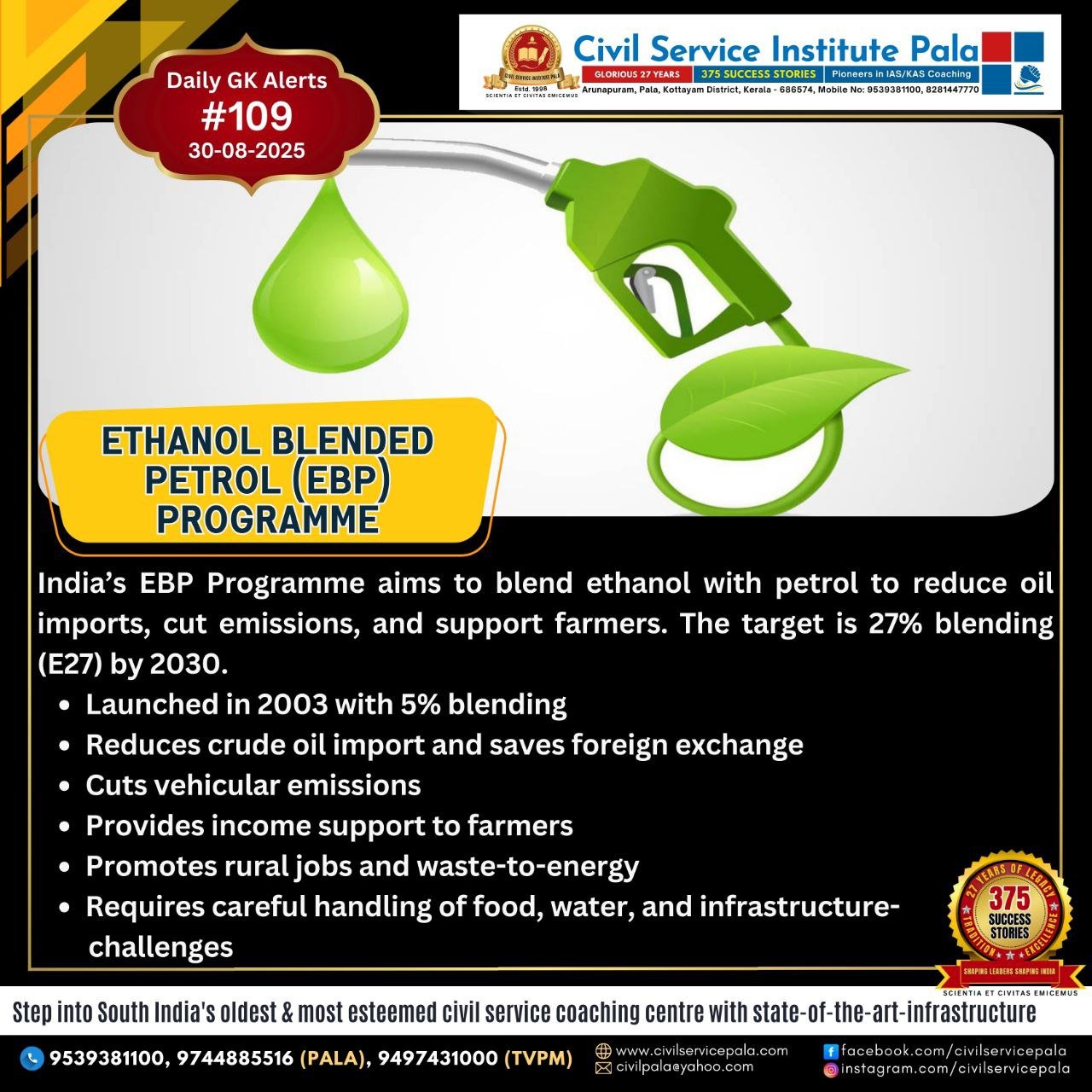
Ethanol Blended Petrol (EBP) Programme: A Step Towards Energy Security and Sustainability
India’s Ethanol Blended Petrol (EBP) programme is a major government initiative aimed at reducing the country’s dependence on imported crude oil while promoting cleaner fuels and supporting farmers. Recently, the government has set an ambitious target of achieving 27% ethanol blending in petrol (E27) by 2030, building on the programme’s earlier success.
What is the EBP Programme?
The Ethanol Blended Petrol (EBP) programme was launched in 2003 with the goal of blending 5% ethanol with petrol. Ethanol is an alcohol made mainly from sugarcane, maize, and surplus food grains. Blending ethanol with petrol helps create a cleaner-burning, renewable fuel. Over the years, India has steadily increased its blending targets. The country achieved 10% blending (E10) in 2022 and aims to reach 20% (E20) by 2025—five years ahead of schedule.
Key Objectives of the Programme
The main goals of the EBP programme are: * Reduce dependence on imported crude oil. * Save foreign exchange reserves. * Lower vehicle emissions to fight air pollution and climate change. * Provide farmers with steady markets for their crops, improving rural incomes. * Promote second-generation ethanol made from agricultural waste to reduce stubble burning.
Major Benefits of Ethanol Blending
1. Energy Security
India imports about 88% of its crude oil. Ethanol blending helps reduce this dependence by replacing part of the petrol with domestically produced ethanol. According to government estimates, the E20 programme alone could save up to ₹30,000 crore per year in foreign exchange and replace around six million tonnes of crude oil.
2. Environmental Gains
Ethanol is a cleaner fuel than petrol. It helps reduce emissions like carbon monoxide and hydrocarbons, which are harmful to health and the environment. Ethanol use supports India’s Net Zero emissions target by 2070 and contributes to the National Green Mobility Strategy.
3. Support for Farmers
Farmers benefit from a stable market for crops like sugarcane and maize. In the last decade, over ₹1.2 lakh crore has been transferred to farmers through ethanol procurement. This helps reduce price fluctuations and increases income stability in rural areas.
4. Rural Development and Job Creation
The ethanol industry, including distilleries and supply chains, promotes rural industrial development and creates employment opportunities. It also reduces migration from villages to cities by offering local jobs.
5. Circular Economy and Waste Management
Second-generation ethanol from crop residues, supported by the PM-JI-VAN Yojana, turns agricultural waste into energy. This not only adds value but also helps in reducing air pollution from stubble burning in northern India.
Conclusion
The Ethanol Blended Petrol (EBP) programme is a bold step towards a cleaner, more self-reliant India. It offers multiple benefits—reducing oil imports, supporting farmers, improving air quality, and creating jobs. However, to fully realise its potential, challenges like food security, water use, vehicle compatibility, and infrastructure must be carefully managed. With a balanced and inclusive approach, India can ensure that its ethanol journey becomes a model of sustainable innovation rather than a tale of missed opportunities.
