



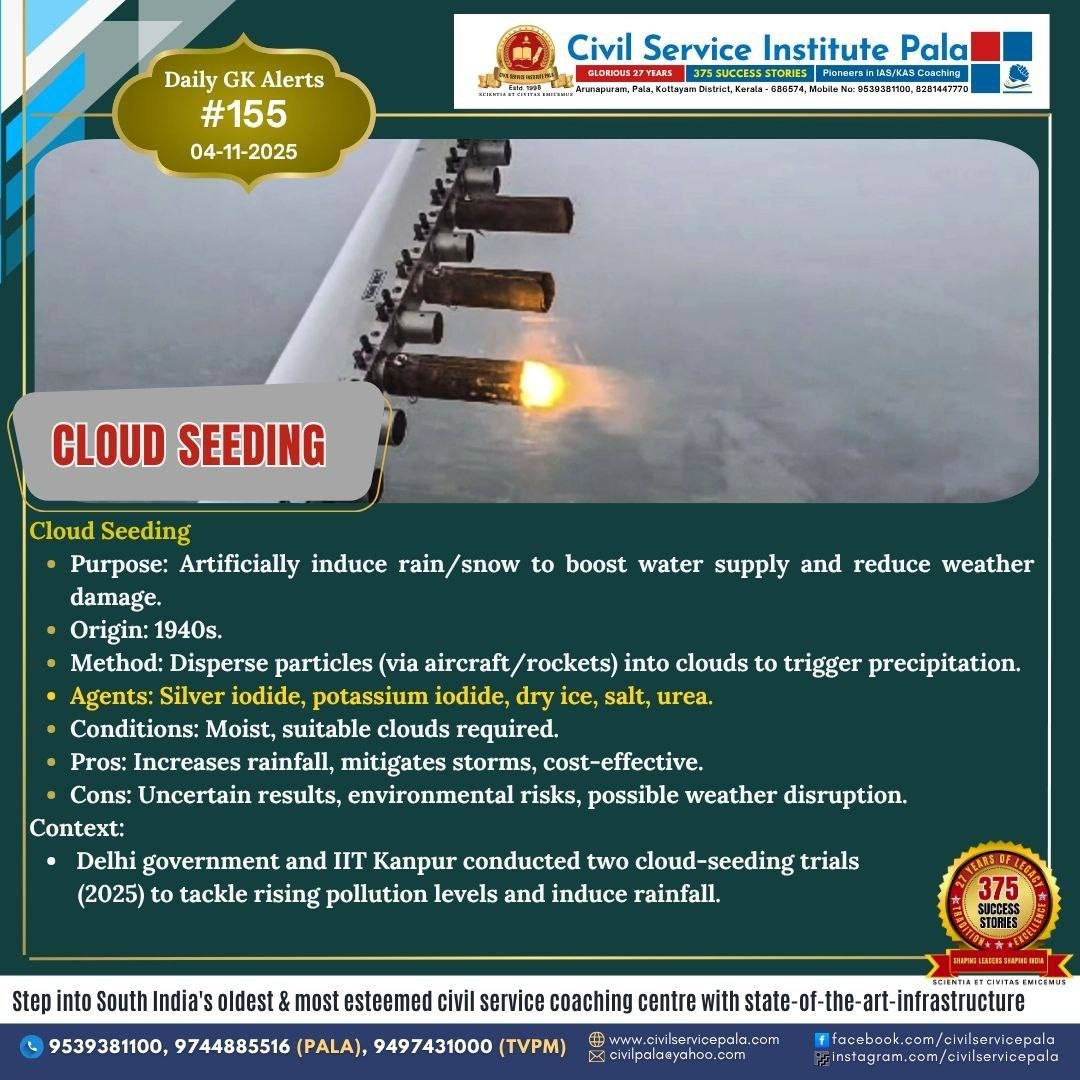
Cloud Seeding
Cloud seeding is a weather modification technique aimed at inducing or enhancing precipitation (rain or snow) by dispersing specific substances into clouds that act as condensation or ice nuclei.
Chemicals Used • Silver Iodide (AgI) • Sodium Chloride (NaCl) • Potassium Iodide (KI) • Dry Ice (Solid CO₂)
Methods
1. Static Seeding: Introduces particles to help cloud droplets form and grow.
2. Dynamic Seeding: Aims to strengthen cloud updrafts to increase moisture.
3. Hygroscopic Seeding: Uses salts to encourage formation of larger droplets that fall as rain.
Purposes / Applications
• Increase rainfall in drought-prone areas.
• Fog dispersal (especially at airports).
• Hail suppression.
• Enhance snowfall in cold regions.
• Reduce air pollution by washing out particulates.
Limitations
• Works only if clouds already contain moisture.
• Results uncertain and hard to quantify.
• High operational costs.
• Environmental concerns (Silver Iodide residues).
Cloud Seeding in India
• Conducted in Maharashtra, Karnataka, Tamil Nadu, Andhra Pradesh, Himachal Pradesh.
• Implemented by Indian Institute of Tropical Meteorology (IITM), Pune and ISRO.
• Projects: Varshadhara (Karnataka), Project Meghdoot (Maharashtra).
