



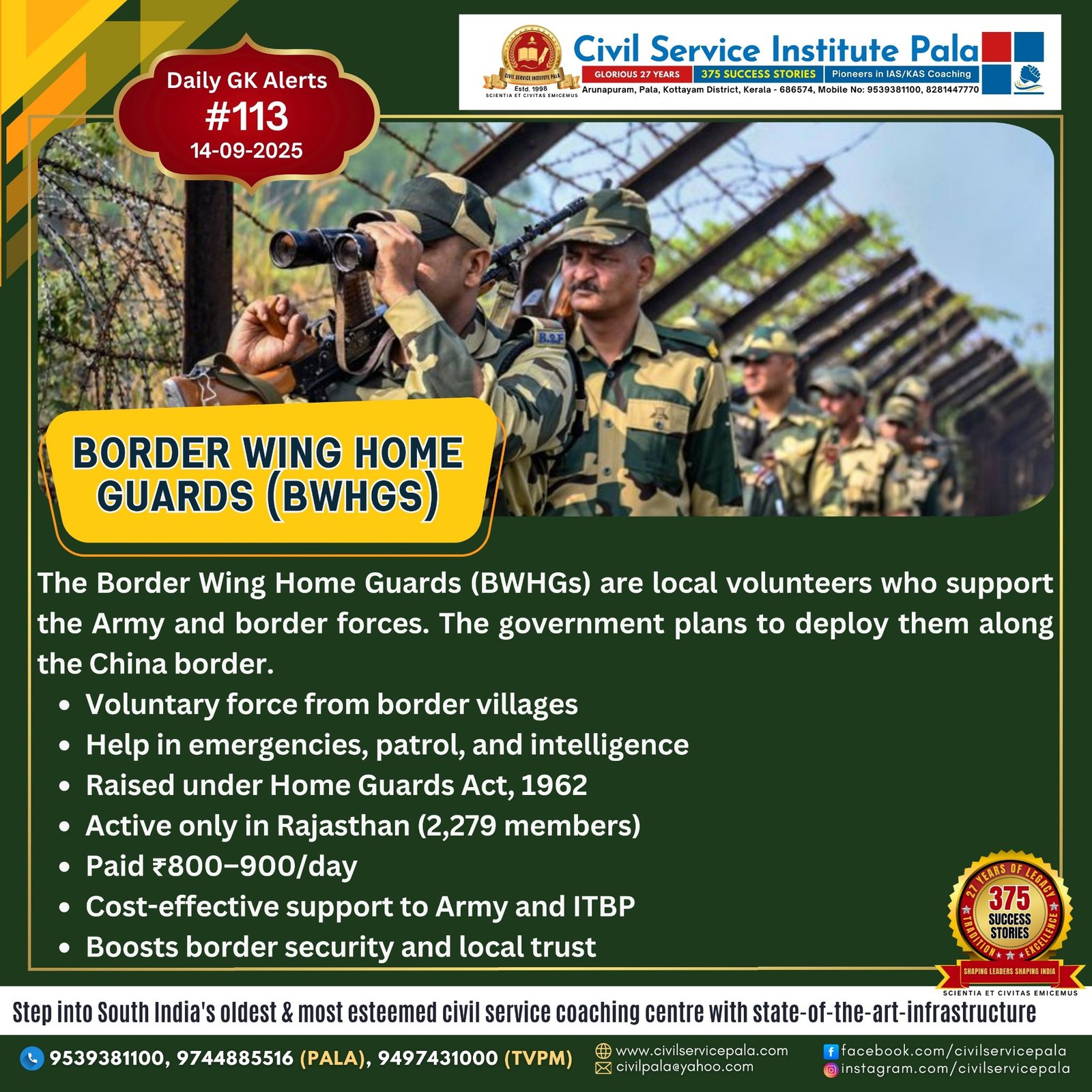
Border Wing Home Guards (BWHGs)
Introduction
The Ministry of Home Affairs (MHA) is planning to deploy Border Wing Home Guards (BWHGs) along the India-China border. These guards are already active along the India–Pakistan border and have shown great utility in supporting regular forces.
What are BWHGs?
BWHGs are a *voluntary auxiliary force* made up of local civilians living near border areas. They support the Indian Army and border forces during emergencies, conflicts, and intelligence operations. They are raised under the Home Guards Act, 1962, and fall under the MHA, in coordination with state governments.
Current Status
Seven states are authorised to raise BWHGs — Meghalaya, Tripura, Assam, West Bengal, Punjab, Rajasthan, and Gujarat. However, currently, only Rajasthan has an active BWHG unit with 2,279 members. These guards played a key role in Operation Sindoor, especially in gathering and relaying intelligence.
Key Features
* Voluntary enlistment for 3–4 years * Daily pay of ₹800–900 (equal to constable salary) * 25% of training cost paid by the Central Government * Cost-effective and requires minimal infrastructure
Significance
The BWHGs act as a force multiplier, improving coordination between security forces and local communities. Their local knowledge makes them valuable in intelligence gathering and maintaining law and order in remote border areas.
Conclusion
Given the rising tensions along the LAC with China, expanding BWHGs is a smart and practical move. It strengthens India’s border presence, promotes local involvement in national security, and enhances the effectiveness of regular forces like the ITBP and the Army.
