



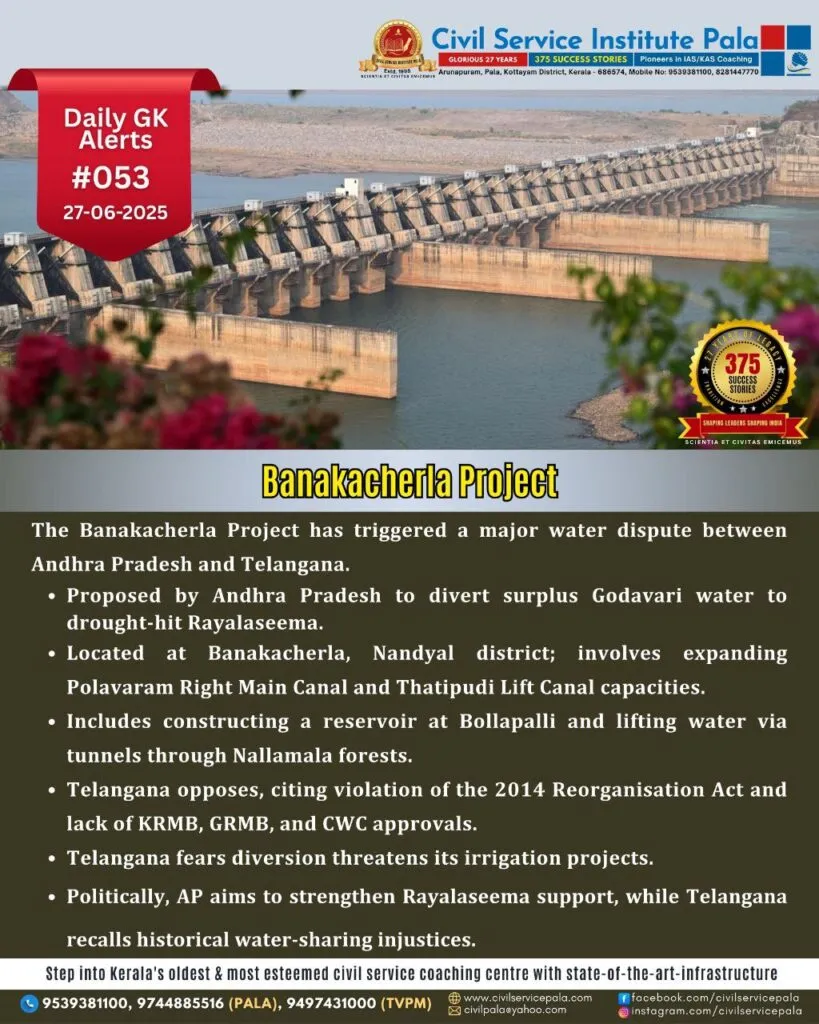
Banakacherla Project
Banakacherla Project: An Emerging Inter-State Water Conflict
The Banakacherla Reservoir Project, proposed by the Andhra Pradesh government, has sparked a renewed water dispute with Telangana, highlighting long-standing regional tensions over water rights.
Project Overview
Located in Banakacherla, Nandyal district, Andhra Pradesh, the project seeks to divert surplus Godavari River water to alleviate drought conditions in Rayalaseema. It involves expanding the Polavaram Right Main Canal’s capacity from 17,500 to 38,000 cusecs and the Thatipudi Lift Canal from 1,400 to 10,000 cusecs. A reservoir at Bollapalli in Guntur will lift water through five major lift stations, transporting it via tunnels through the Nallamala forests to Banakacherla. The plan integrates Godavari, Krishna, and Penna river systems to ensure water availability for the drought-prone region.
Telangana’s Concerns
Telangana strongly opposes the project, arguing it violates the Andhra Pradesh Reorganisation Act, 2014, which mandates prior approvals for inter-basin projects. The state claims the project lacks clearance from the Krishna River Management Board, Godavari River Management Board, and the Central Water Commission. Additionally, Telangana fears that diverting Godavari waters could threaten its existing irrigation schemes and water security, as the extent of surplus water remains unclarified by the Godavari Water Disputes Tribunal.
Political Context
The project holds significant political importance. Andhra Pradesh Chief Minister N Chandrababu Naidu promotes it to consolidate support in Rayalaseema, while Telangana views it as another injustice reminiscent of historical water-sharing grievances since its formation in 2014.
Conclusion
The Banakacherla Project exemplifies the enduring complexities of river water disputes in India, underlining the need for transparent inter-state agreements to balance regional development with equitable water sharing.
