



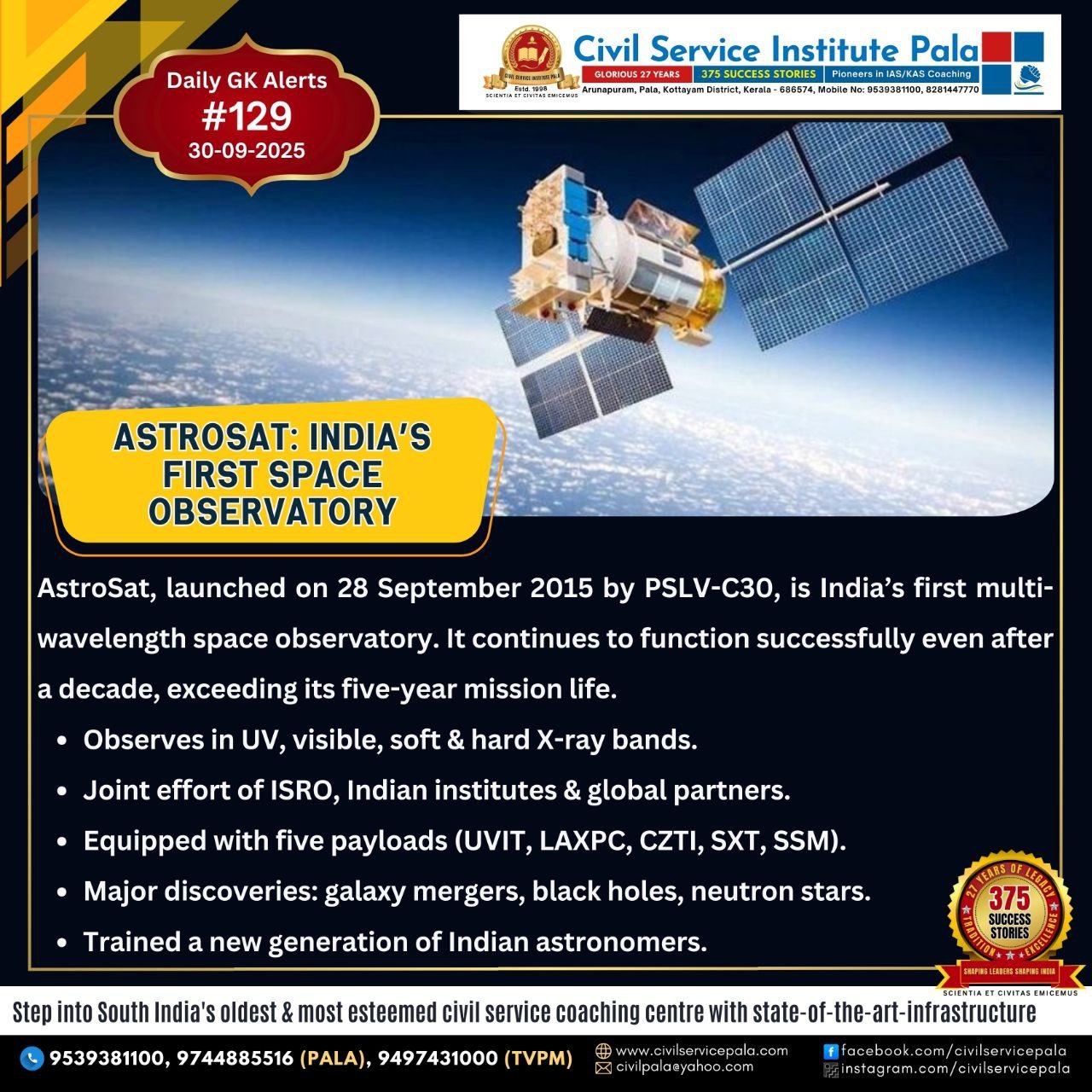
AstroSat – India’s First Space Observatory
AstroSat, India’s first dedicated space-based astronomy observatory, marks a milestone in the nation’s scientific journey. Launched on 28 September 2015 aboard PSLV-C30 from Sriharikota, it continues to deliver valuable data even after a decade, despite its original five-year mission life.
What is AstroSat?
AstroSat is a multi-wavelength observatory, designed to observe the universe in ultraviolet (UV), visible, soft X-ray, and hard X-ray bands simultaneously. This unique capability allows comprehensive study of celestial objects and phenomena, positioning India among nations with advanced space astronomy programs.
Collaborative Effort
The mission was developed by ISRO in collaboration with premier Indian institutes such as the Inter-University Centre for Astronomy and Astrophysics (IUCAA), TIFR, Indian Institute of Astrophysics, and Raman Research Institute, along with partners from Canada and the UK.
Scientific Payloads
AstroSat carries five advanced instruments: * UVIT (Ultraviolet Imaging Telescope) * LAXPC (Large Area X-ray Proportional Counter) * CZTI (Cadmium–Zinc–Telluride Imager) * SXT (Soft X-ray Telescope) * SSM (Scanning Sky Monitor) These payloads enable simultaneous multi-band observations, a rare capability globally.
Major Discoveries
Over ten years, AstroSat has contributed significantly to astronomy: * Detected far-UV photons from galaxies 9 billion light years away. * Discovered fast-spinning black holes and studied X-ray binaries. * Provided insights into galaxy mergers, the Butterfly Nebula, and neutron stars. * Solved puzzles about stellar brightness variations.
Significance
AstroSat not only advanced global astronomy but also nurtured a new generation of Indian researchers, with over half of its users being students and young scientists.
Conclusion
AstroSat exemplifies India’s growing strength in space science. By enabling world-class research and discoveries, it has reduced dependence on foreign observatories and inspired future missions, reinforcing India’s place in the global scientific community.
