



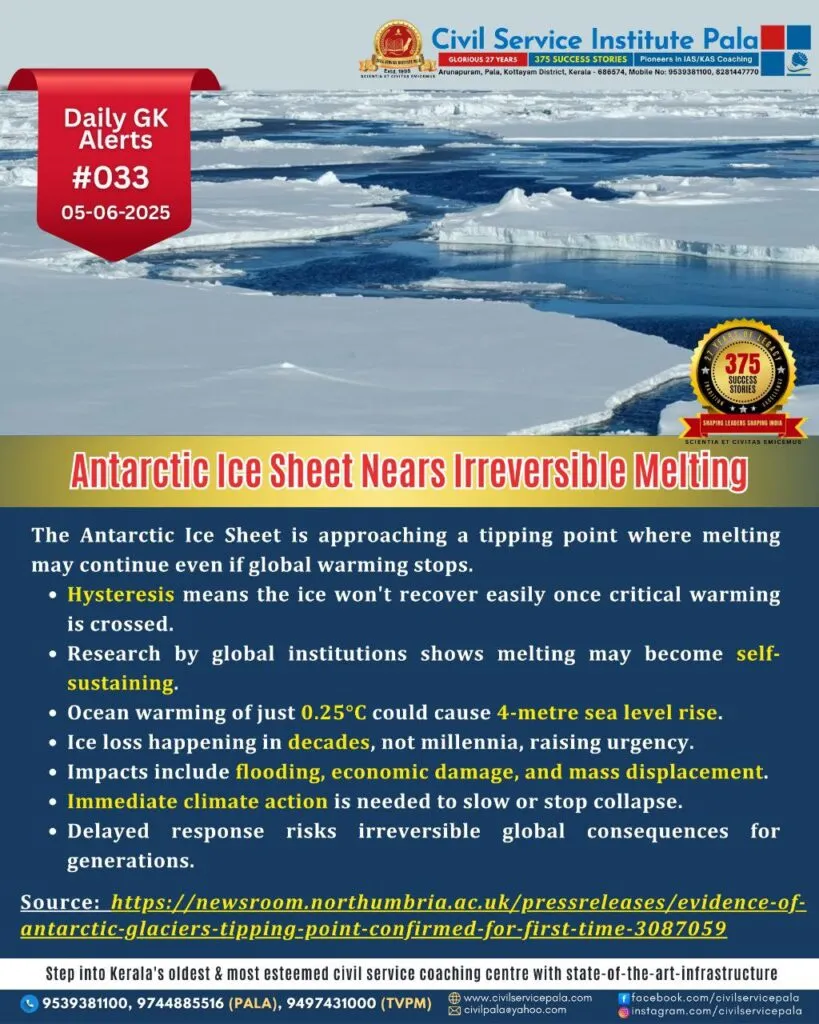
Antarctic Ice Sheet Nears Tipping Point: A Climate Alarm
The Antarctic Ice Sheet, a vast frozen expanse holding most of the Earth’s freshwater, is nearing a critical tipping point. Recent research shows that even if global warming is curbed, the ice sheet might continue melting—a process known as hysteresis. This discovery is deeply concerning, as it signals irreversible damage to one of the world’s most important climate stabilizers.
Understanding Hysteresis in Ice Sheet Dynamics
Hysteresis is a phenomenon where a system, after undergoing a change, does not return to its original state even when the initial conditions are restored. Applied to the Antarctic Ice Sheet, this means that once a critical temperature threshold is breached, the melting becomes self-sustaining, regardless of future global cooling. This irreversible melting pattern could severely accelerate sea-level rise, with long-lasting global impacts.
Research and Modeling
The warning comes from collaborative studies by NORCE Research, Northumbria University, and Potsdam University. To examine long-term ice sheet behavior, researchers used advanced computer simulations. These models tracked the ice sheet’s responses across 800,000 years of glacial and interglacial periods, giving scientists a deeper understanding of how it could react to today’s warming trends. The findings point to a possible future where, despite halting emissions, the ice continues to disappear due to past climate damage.
Role of Ocean Warming
While atmospheric warming is a key driver, ocean temperatures are equally critical in determining the ice sheet’s fate. The study reveals that even a 0.25°C increase in ocean temperatures could lead to a sea-level rise of up to four metres. This seemingly small change has enormous consequences, threatening to inundate coastal cities and displace millions of people. Oceanic heat penetrates beneath the floating ice shelves, weakening them from below and accelerating the disintegration of the ice sheet.
Speed and Uncertainty of Change
One of the most alarming aspects is the pace of current ice loss. Historically, ice sheets took thousands of years to respond to climate shifts. Today, however, researchers have observed significant changes within just 40 years, suggesting a rapid acceleration. This short timeframe makes it difficult to predict future behavior with certainty, but all signs point to an urgent need for preventive action.
Global Consequences of Melting
If the Antarctic Ice Sheet continues to melt, the global consequences will be severe. Coastal flooding could damage infrastructure, disrupt ecosystems, and displace entire populations. The economic fallout would stretch across industries, nations, and generations. Vulnerable countries and island nations will be hit the hardest, heightening global inequality and humanitarian crises.
Mitigation and Urgent Climate Action
Despite the grim outlook, hope remains. Researchers emphasize that immediate mitigation strategies—especially reducing greenhouse gas emissions—can help prevent or at least slow down the collapse. Political will, technological innovation, and public awareness must come together to act swiftly. The longer we delay, the more difficult and expensive it will be to protect both nature and human society.
The Antarctic Ice Sheet is sending a clear warning. The science shows we are dangerously close to a tipping point beyond which recovery may take thousands of years. Understanding hysteresis and oceanic impacts helps shape smarter climate policies. We must act now—aggressively and globally—to ensure that this icy giant does not melt away, taking with it the safety and security of our coastal future.
