



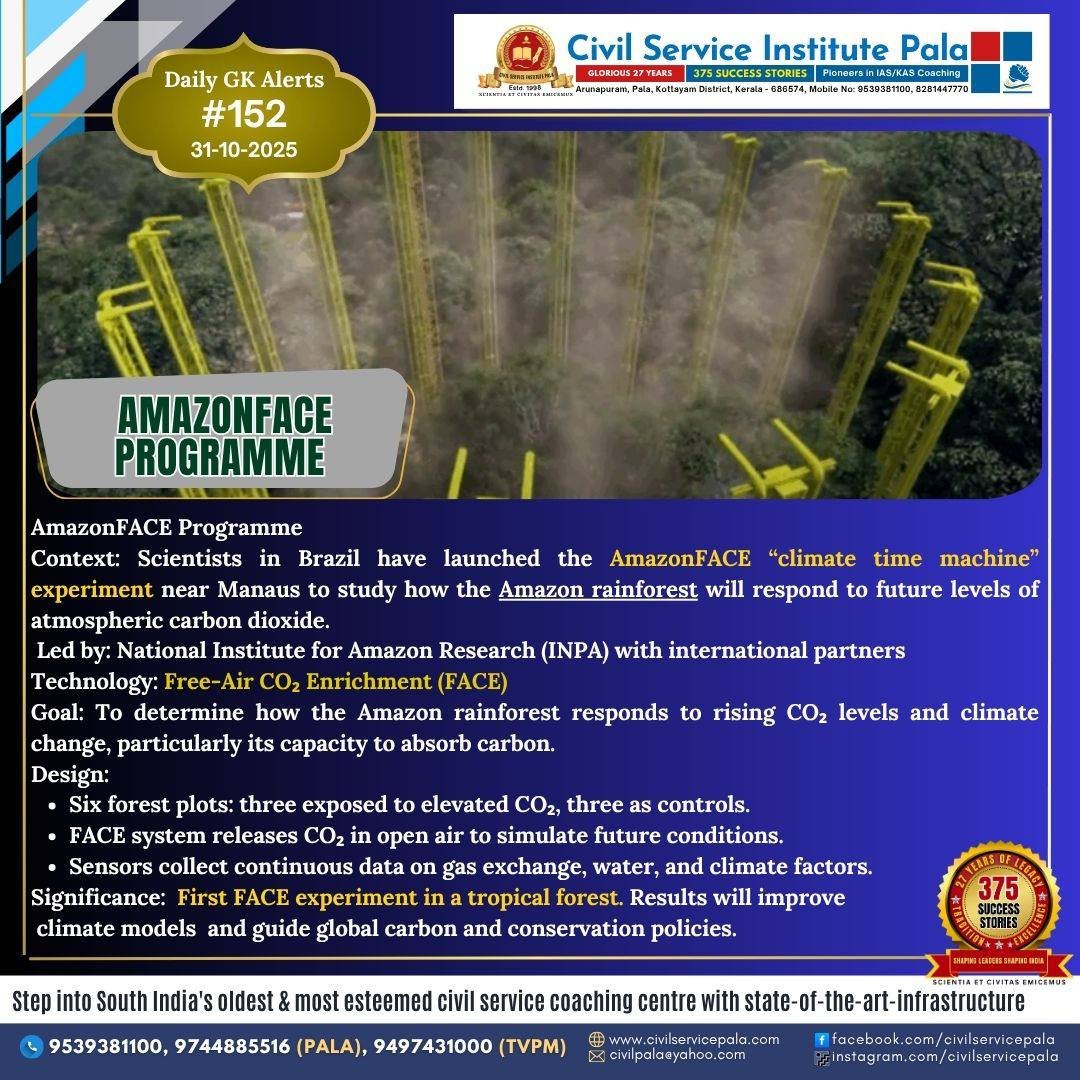
AmazonFACE Program
AmazonFACE – Amazon Free-Air CO₂ Enrichment Project
Implementing Agencies
• Lead: National Institute for Amazonian Research (INPA), Brazil
• Partners: UK Met Office, International Institute for Applied Systems Analysis (IIASA, Austria), and other global universities.
• Funded by: Brazil’s Ministry of Science, Technology and Innovation (MCTI) with international collaboration.
Location
• Conducted near Manaus, in the central Amazon rainforest, Brazil. Objective • To study the impact of rising atmospheric CO₂ levels on:
• Forest productivity and tree growth
• Carbon storage and nutrient cycles
• Water balance and ecosystem resilience
• The overall ability of the Amazon to act as a carbon sink Method
• Uses Free-Air CO₂ Enrichment (FACE) technology.
• Large open-air plots of forest are surrounded by towers that release additional CO₂, simulating future atmospheric conditions.
• Control plots (normal CO₂) are compared with treatment plots (elevated CO₂).
• Long-term monitoring of tree growth, soil, water, and biodiversity responses is carried out.
Significance
1. The Amazon rainforest plays a crucial role in absorbing global CO₂ emissions.
2. Climate change, droughts, and deforestation may reduce this ability, turning the forest into a carbon source.
3. AmazonFACE helps predict how the forest ecosystem will respond to future CO₂ levels and climate stress.
4. Findings will refine global climate models and aid in policy decisions related to forest conservation and carbon management.
5. It represents a major example of international scientific cooperation in climate research.
Key Concerns
• The Amazon’s capacity to absorb extra CO₂ may be limited by nutrient shortages, especially phosphorus.
• Even with higher CO₂, rising temperatures and frequent droughts may offset any potential gains in plant growth.
• Long-term data will determine whether the Amazon can continue functioning as a carbon sink or risks reaching a tipping point. Current Status
• Pilot phase completed; full-scale phase running (2025–2030).
• Expected to provide the first long-term, real-world data on tropical forest response to elevated CO₂
