



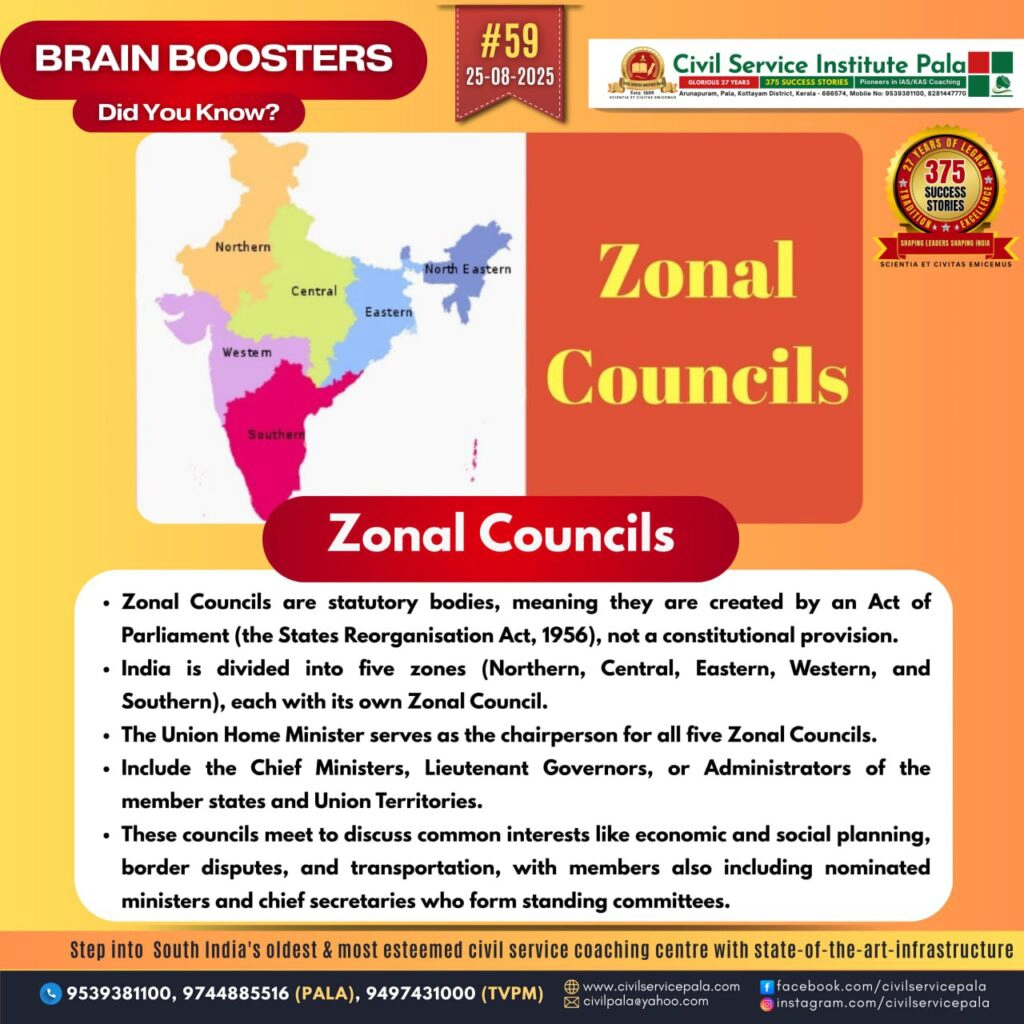
Zonal Councils
Zonal Councils are advisory bodies in India created to promote interstate cooperation and coordination. They were set up under the States Reorganisation Act, 1956 to strengthen the fabric of cooperative federalism.
Number & Composition
- There are five Zonal Councils, each covering a group of states and Union Territories:
- Northern Zonal Council – Haryana, Himachal Pradesh, Jammu & Kashmir, Punjab, Rajasthan, NCT of Delhi, Chandigarh, Ladakh
- Central Zonal Council – Chhattisgarh, Madhya Pradesh, Uttar Pradesh, Uttarakhand
- Eastern Zonal Council – Bihar, Jharkhand, Odisha, West Bengal
- Western Zonal Council – Goa, Gujarat, Maharashtra, Dadra & Nagar Haveli and Daman & Diu
- Southern Zonal Council – Andhra Pradesh, Karnataka, Kerala, Tamil Nadu, Telangana, Puducherry
- Apart from these, there is also a North-Eastern Council (NEC) created separately in 1971, which is not one of the original five but works in a similar way for the northeastern states.
Composition
- Chairperson – Union Home Minister
- Vice-Chairman – Chief Minister of the host state (rotational basis)
- Members – Chief Ministers & Governors of states in the zone, and two Union Ministers nominated by the Centre
- Advisory Members – Senior officers from the central and state governments
Functions of Zonal Councils
- Promote economic and social planning between states.
- Resolve inter-state disputes (like water sharing, transport, boundary issues).
- Discuss matters of common interest:
- Economic & social planning
- Border disputes
- Inter-state transport
- Linguistic minorities
- Security cooperation
- Foster regional cooperation and reduce friction between Centre and States.
Significance
- Strengthens Centre-State relations.
- Encourages cooperative federalism.
- Acts as a discussion platform for resolving contentious issues.
Helps in balanced regional development by sharing best practices.
Source:https://www.pib.gov.in/PressReleasePage.aspx?PRID=2139316
