



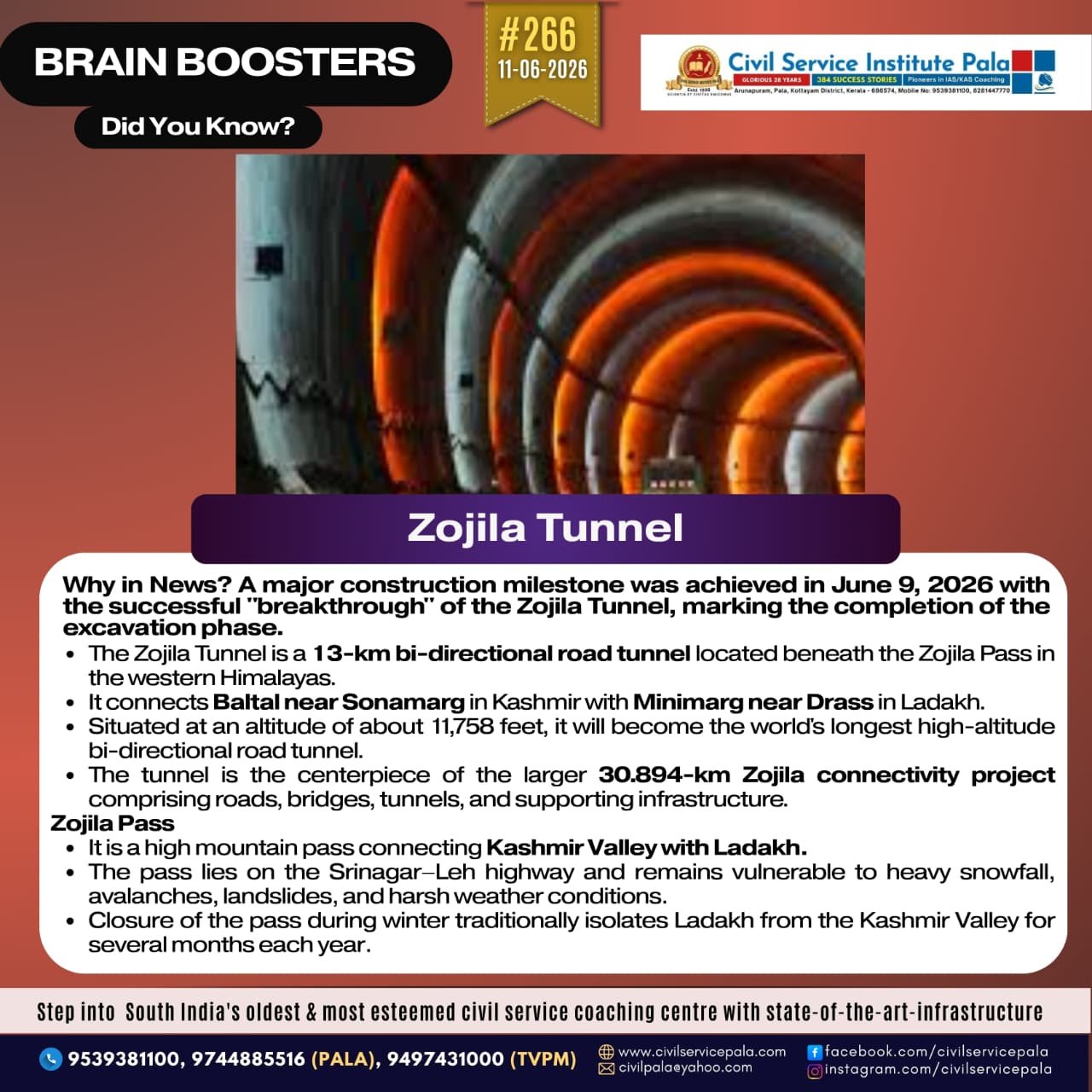
Zojila Tunnel Project
Zojila Tunnel Project
Why in News?
A major construction milestone was achieved in June 2026 with the successful "breakthrough" of the Zojila Tunnel, marking the completion of the excavation phase.
The project is a critical strategic and infrastructure initiative aimed at providing all-weather connectivity between Kashmir and Ladakh.
What is the Zojila Tunnel?
The Zojila Tunnel is a 13-km bi-directional road tunnel located beneath the Zojila Pass in the western Himalayas.
It connects Baltal near Sonamarg in Kashmir with Minimarg near Drass in Ladakh.
Situated at an altitude of about 11,758 feet, it will become the world's longest high-altitude bi-directional road tunnel.
The tunnel is the centerpiece of the larger 30.894-km Zojila connectivity project comprising roads, bridges, tunnels, and supporting infrastructure.
Zojila Pass
Zojila Pass is a high mountain pass in the Himalayas connecting Kashmir Valley with Ladakh.
The pass lies on the Srinagar–Leh highway and remains vulnerable to heavy snowfall, avalanches, landslides, and harsh weather conditions.
Closure of the pass during winter traditionally isolates Ladakh from the Kashmir Valley for several months each year.
Key Features of the Project
The tunnel will bypass the hazardous Zojila Pass and ensure year-round road connectivity.
It will reduce the travel distance between Sonamarg and Drass by about 27 km.
It is expected to cut travel time by more than two hours.
The project also includes smaller tunnels, bridges, ventilation shafts, snow galleries, and emergency infrastructure.
Construction Technology: NATM
New Austrian Tunnelling Method (NATM)
The tunnel is being constructed using the New Austrian Tunnelling Method (NATM).
NATM is particularly suitable for fragile and geologically unstable mountain terrains.
The method relies on sequential excavation and immediate ground support measures.
Continuous geological monitoring allows engineers to adapt construction techniques according to changing rock conditions.
NATM is widely used in Himalayan tunnelling projects because of its flexibility and safety.
Strategic Importance
Defence Significance
The tunnel will provide uninterrupted connectivity to Ladakh throughout the year.
It will improve military logistics in sensitive border regions adjoining China and Pakistan.
The project will facilitate faster movement of troops, equipment, fuel, and essential supplies.
It will reduce dependence on costly and weather-sensitive air transport.
Improved mobility will strengthen India's operational preparedness along both the Line of Actual Control (LAC) and the Line of Control (LoC).
National Security Perspective
The importance of secure land connectivity became evident during the 1999 Kargil conflict when strategic road links came under enemy observation and fire.
The tunnel is expected to provide safer and more reliable access in times of emergency and conflict.
Socio-Economic Significance
The project will ensure all-weather access for residents of Ladakh.
It will enhance tourism, trade, healthcare access, and economic integration of remote Himalayan regions.
Better connectivity is expected to reduce transportation costs and improve supply chains.
Year-round connectivity can accelerate regional development and reduce isolation of border communities.
